






Agreeing upon language use in the workplace

For whom? The language-use agreement process is suitable for teams that use several languages or that consist of members with different language skills or linguistic backgrounds. The process can be facilitated by a supervisor, HR representative, or external facilitator.
Why? Clear agreements on language use promote the smooth flow of work and reduce tensions in the workplace. Linguistic practices can also support the development of employees’ language skills.
What? The process involves mapping employees’ needs and wishes related to the use of different languages in the workplace. This provides the basis for testing new practices and agreeing on the team’s linguistic principles. This page provides instructions and material for the process.
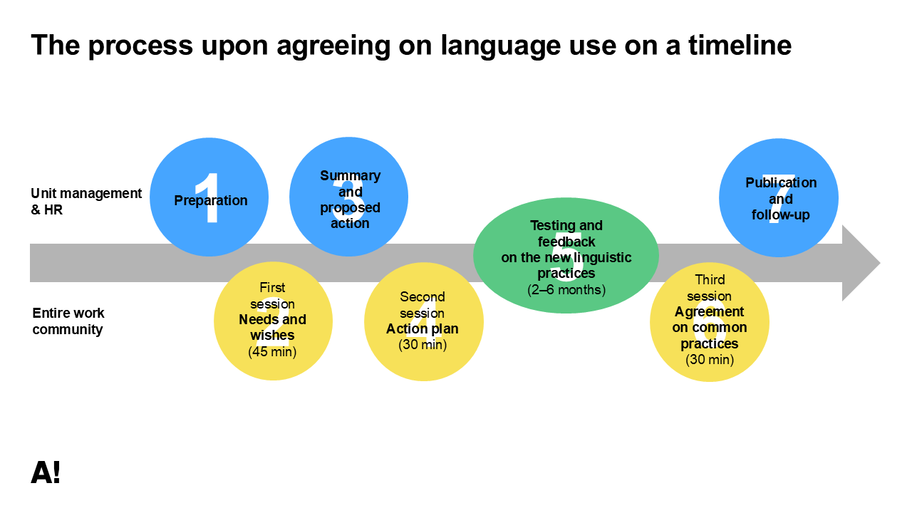
Model process for a multilingual workplace
Aalto University published its new general language guidelines in 2024. The guidelines encourage the development of inclusive multilingual practices and communication methods in the workplace. The goal of the language-use agreement process is to formulate general language practices that take into account employees’ needs and wishes. To ensure a successful end result, it is important to engage the entire work community in the process and reserve sufficient time for discussion and the planning and testing of action points.
This page provides guidelines for facilitating the process. The facilitator could be, for example, a supervisor, unit head, HR partner or any other person interested in the topic. Here, only one option is presented for performing the process: the unit can arrange one longer event or several shorter meetings every few months, and the different stages can be realised either face-to-face or remotely using platforms like Teams or Mentimeter.
The unit management, HR partner and facilitator engage in a preliminary discussion on the unit’s current situation, needs, and requirements for success. The facilitator prepares for the meeting by familiarising themselves beforehand with the staircase model for a multilingual workplace and presenting the model to others at the meeting. The unit management, HR partner, and facilitator discuss the unit’s present language practices: effective practices and development needs. The discussion is supported by the PowerPoint template below. The discussion forms the basis for deciding the kind of process the unit will follow.
Materal:
- Staircase model for a multilingual workplace on the Kielibuusti.fi website
- PowerPoint slides: Stage 1 PowerPoint presentation for the preliminary meeting (in English and Finnish). The PowerPoint presentation notes contain more detailed instructions for the facilitator
All staff members from the unit assemble to discuss their linguistic needs and wishes. The Language User Profiles developed in the Kielibuusti project are used as the basis for the discussion. The discussion results in concrete proposals for agreeing on language use in the unit.
Before the meeting:
- The languages used at the meeting are agreed upon. Staff members can be asked beforehand about their language preferences for the event using, for example, a Webropol survey. Below are some suggestions for the questions
- It is beneficial for staff members to familiarise themselves with Aalto’s General Language Guidelines and Language User Profiles before the meeting
- The facilitator prepares for the meeting by learning about the Language User Profiles
Workflow for the meeting:
- The facilitator presents the Language User Profiles with the help of the PowerPoint presentation below
- In small groups, staff members discuss any thoughts arising from the profiles and current linguistic practices in the workplace (10 min)
- Staff members discuss and post on the Mentimeter platform (or similar) concrete examples of what currently works well and what should be changed. This could concern both the use of various languages and support for language learning (15 min)
- Staff members decide on the next steps in the process
Materials:
- Language User Profiles on the Kielibuusti website
- PowerPoint slides: Stage 2 PowerPoint presentation for the first entire-work-community session (in English and Finnish). The PowerPoint presentation notes contain more detailed instructions for the facilitator
- File: Sample questions for the staff Webropol survey
- The facilitator prepares by familiarising themselves with the support resources offered by Aalto and the Kielibuusti.fi website (see the PowerPoint template) and presents them to others at the meeting
- The unit management, HR partner and facilitator go through the staff’s Mentimeter comments and summarise their needs and wishes
- The actions to be proposed to the staff are determined based on the discussion, the Mentimeter comments, and the support resources presented by the facilitator
Material:
- Kielibuusti’s resources for a multilingual workplace: kielibuusti.fi
- PowerPoint slides: Stage 4 PowerPoint template for the second entire-work-community session and the summary (English and Finnish)
Unit staff members assemble to discuss the actions they wish to test in the unit. The discussion is based on the action proposal from Stage 3, which, in turn, is based on the staff comments in Mentimeter and pre-existing support resources. The discussion results in an agreement on which actions should be tested.
Workflow for the event:
- Staff comments are summarised
- The facilitator presents the staircase model for a multilingual workplace.
- Staff members agree on which actions should be tested. They can vote on what they consider to be the most important actions
Material:
- Staircase model for a multilingual workplace on the Kielibuusti.fi website
- PowerPoint slides: Stage 4 PowerPoint template for the second entire-work-community session and the summary (English and Finnish). The PowerPoint presentation notes contain more detailed instructions for the facilitator. This PowerPoint presentation is prepared by the management, HR partner, and facilitator in Stage 3
The unit tests the new linguistic practices over a period of a few months. Feedback on the practices is collected either electronically or face-to-face with the help of the example questions below. The unit management, HR partner, and facilitator use the feedback to formulate a proposal for the unit’s final joint linguistic practices.
Material:
- Example questions for the feedback survey:
- What has worked well? What would you still like to change?
- Template: The Unit’s Linguistic Practices (in English and Finnish)
- Example: Linguistic Practices at the Department of Design (in English and Finnish)
- Example: Linguistic Practices at the Language Centre (in English, Finnish and Swedish)
The purpose of the third joint meeting is to agree on the linguistic practices to which the unit will continue to commit. The unit management, HR partner, and facilitator have formulated a draft version of those common linguistic practices based on earlier discussions and the practices tested in the unit. This document is sent to staff members beforehand. During the meeting, the document is discussed in small groups, and comments are collected using, for example, Presemo.
Workflow for the event:
- Summary of the feedback and discussion on the testing of new practices
- Presentation of the proposal for linguistic principles in the workplace, i.e. common linguistic practices
- Discussion of the proposal in small groups
- Joint decision on
- which principles to commit to
- which principles are written down
- when the matter will be next reviewed
Material:
- Ppt-pohja: Vaihe 6 Kalvopohjat kolmatta työyhteisötapaamista varten. Ppt-esityksen muistiinpanoissa on tarkemmat ohjeet fasilitoijalle.
- PowerPoint slides: Stage 6 PowerPoint presentation for the third entire-work-community session (English and Finnish). The PowerPoint presentation notes contain more detailed instructions for the facilitator
If necessary, changes are made to the unit’s final linguistic practices document based on the discussion at the joint meeting in Stage 6. The document is published through the unit’s internal communication channels, and it is updated, for example, once a year, during the team agreement process. Practices are fine-tuned and adapted to changes in the unit.