





Toolkits for Co-creation: Practical tools for collaborative development

How can development teams move from a challenge to a better-informed idea, and learn whether it works before investing too much in it? Aalto Design Factory’s free Toolkits for Co-creation offer a practical way to explore those questions, with ready-to-use activities for educators, students and professionals.
The toolkits cover key stages of collaborative development: gathering user insights, reframing challenges, generating ideas, planning experiments and testing concepts with users. Each includes guidance and materials to help teams run a session, whether they are working face-to-face or remotely. Users can follow a complete toolkit or select the activities that suit their project.
The first toolkits were developed in connection with Design Factory’s DesignBites research project, which explored ways to support co-creation and experimentation among food and beverage entrepreneurs. The materials drew on methods that Tua Björklund and Floris van der Marel had used in teaching and training and were initially designed so learners could apply them to their own projects.
“The toolkits build on the methods we use in our innovation courses at the Design Factory, making it easy for learners to apply what they've learned to their own projects – whether you are a student or professional,” says Tua Björklund, Design Factory Director and Associate Professor. “The toolkits have also become an easy way to share our ways of working with teachers at Aalto and beyond in a format that's easy to incorporate to different types of courses and assignments.”
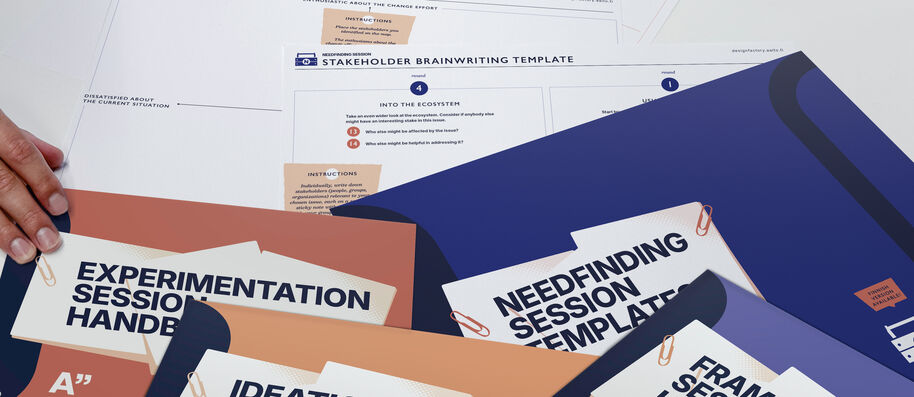
Five toolkits from forming understanding to tested Ideas
The Toolkits for Co-creation cover different stages of collaborative development, from understanding people’s needs to testing early ideas. Each can be used as a complete guided session or adapted to fit a course, project or team.
- Needfinding: Helps teams understand the needs and motivations of users and other stakeholders. The session guides participants in mapping stakeholders, deciding whose perspectives to explore, planning data collection and practicing interview questions.
- Framing: Helps teams clarify what it is trying to achieve, for whom and why. Through perspective-taking and insight mapping, participants explore different ways to define a challenge, develop “How Might We” questions and refine the questions they want to take forward.
- Ideation: Guides teams through a facilitated process for generating a broad range of ideas, not just the most obvious solutions. The methods help participants explore possibilities together and identify promising directions to develop further.
- Experting: Helps teams plan early experiments to learn what works, what does not and why. Participants shape an idea into something they can try out, consider what they need to learn and plan how to gather feedback before making larger commitments.
- User Testing in Practice: Provides step-by-step tools for planning, running and analysing user tests while ideas are still flexible. The toolkit also includes an industry case and optional fictional briefs, user profiles and role-play cards for simulated testing when real prototypes or users are unavailable.

Ready to run and adapt
Rather than offering a collection of exercises without a path between them, each toolkit is designed as a guided session.
“We designed the toolkits with methods that we tried and tested in Design Factory courses,” says Design Educator Floris van der Marel. “Each toolkit is a ready-to-run session where every method builds intuitively on the previous one. With a facilitator handbook, a cheat sheet, printable templates, and Miro whiteboards with built-in instructions, the sessions work well both face-to-face and remotely.”
The collection has also expanded beyond its original focus. The User Testing in Practice toolkit was developed as part of a collaboration with the Finnish–Turkish Knowledge Partnership (TFK), with the same aim of making teaching materials easy to share. It helps users plan, conduct and analyse tests early in the development process, when feedback can still inform changes. For teaching situations without a real prototype or test users, it also includes fictional briefs, user profiles and role-play cards for simulated sessions.
The toolkits’ visual design is part of making them usable. “The toolkits form a unified product series, so it was important that the visual solution would support the user experience, making the tools easy to approach and understand,” states Anna Kuukka, Design and Communication Coordinator, who led the graphic design.
Supporting shared understanding
The tools are intended not only to help teams complete workshop activities, but also to make their thinking visible to one another. Used collaboratively, they can give participants a shared structure for exploring a problem, developing ideas and communicating what they have learned.
“As an educator, I use these tools to provide a structured way to guide student thinking and sense-making. Especially when development is collaborative and multidisciplinary!” says Vikki Eriksson, University Lecturer at Design Factory. “The tools become boundary objects that deepen understanding within the team using them and enable communication of those ideas to other stakeholders.”
The open-access Toolkits for Co-creation are available through the Aalto Design Factory website
Read more news

EIT RawMaterials SIGN Expert Forums
SIGN Expert Forum is a great place to connect with top EU stakeholders from industry, policy, research, and academia.
Aalto WiT Programme and Fida International collaborate in Kenya to create accessible playgrounds for children with disabilities
The Inclusive Play project designs an accessible playground that is suitable also for children with disabilities. The project strives for a holistic experience of education, play and belonging.
Aalto University and partners launch MELANGE, a new EU project using design to transform colouration practices in the interior textile industry
The new Horizon Europe project MELANGE will transform colouration practices in the European interior textile industry by moving colour design from the end to the beginning of the manufacturing process.