






When atoms begin to dance – At Aalto University, metallurgy became choreography

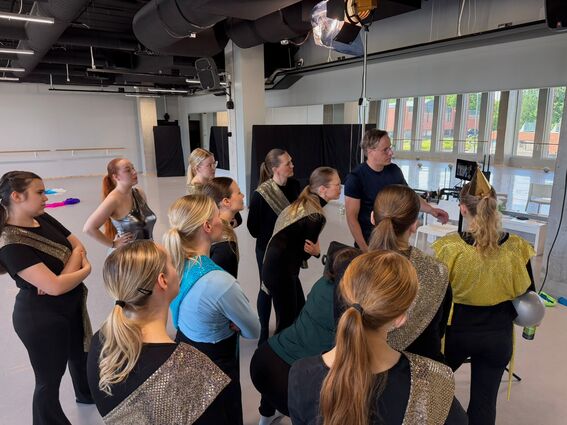
In early June, electrolysis reactions were rehearsed in a dance studio in Otaniemi. Participants in the first-ever Dance Metallurgy course embodied metallurgical phenomena whose understanding is essential to the green transition and metal recycling.
According to Mari Lundström, Professor of Hydrometallurgy, it is precisely the tangible nature of metallurgy that makes it a natural subject to express through dance. Copper is matter that moves and remains still, while giving and receiving electrons.
"Oxidation and reduction can sound difficult. But if you experience them physically yourself, they can become incredibly understandable and logical. In solutions, metal ions sort of swim around. That's familiar movement, and it's fantastic to be able to express it through dance," Lundström says.
Copper is one of the key enablers of the green transition. Electrifying society requires copper everywhere: in wind turbines, solar panels, batteries, electric vehicles and energy storage systems.
Organised by the School of Chemical Engineering, Dance Metallurgy was an intensive week-long course in which most of the time was spent in the dance studio. Alongside rehearsals, participants attended lectures and visited laboratories. The group consisted of 15 dance enthusiasts of different ages, with backgrounds ranging from hip hop and ballet to ballroom dancing.
Giving copper ions a face
Hydrometallurgy involves separating metals using water-based solutions. In Dance Metallurgy, the topic was transformed into a three-part dance performance under the guidance of dance teacher and choreographer Laura Poikolainen. The first two choreographies depicted the anodic and cathodic reactions of copper electrolysis, while the third illustrated a pulsed electrolysis method developed at Aalto that is particularly suited to processing recycling and multi-metal solutions.
Lundström, who practices ballet herself, also put on her training clothes and joined the participants on the dance floor. During rehearsals, she occasionally stopped the dancing to explain the phenomena behind the movements.
Each dancer had a role in the choreography. Chemical concepts became familiar as they were given movement and a face.
"I could say that this part relates to Iina, who represents nickel. Or that this part relates to Elina, who is lead."
Lundström was delighted by the participants' enthusiasm. Although most had no prior connection to metallurgy, learning through movement sparked curiosity and moments of insight. When the choreography addressed additives used in copper electrolysis, simply knowing that they were added to the process was not enough. The participants wanted to understand exactly how each additive helps create a smoother metal surface.
"While dancing atomic movement, they asked, 'But how exactly, Mari?' They genuinely wanted to know what the mechanism was. If I lectured about the same topics, perhaps a few people would ask. Here, the level of interest was enormous."


A field where you can truly make a difference
Behind Dance Metallurgy lies a practical goal as well: making the importance of metallurgy more visible. Lundström has been recognised for her pioneering work advancing the green transition, hydrometallurgy and metal recycling. Aalto is a world leader in hydrometallurgical expertise.
Metallurgy is one of the key fields enabling the green transition, and it needs new experts.
"The entire green transition is so metal-intensive that you can genuinely make a difference by working in this field. Metal refining is an important industry for Finland and a major employer."
Lundström hopes that dance can lower the threshold to fields that are often perceived as difficult or suited only to certain kinds of people. In the future, embodied learning can deepen understanding and offer an alternative route into metallurgy for young people, adult learners and career changers alike. In particular, she hopes that more young women will see engineering as an opportunity.
Radical creativity opens doors to new possibilities
According to Lundström, the common language of dance and metallurgy is creativity. Both research and art involve searching for something new, solving problems and embracing uncertainty. Dance Metallurgy embodies Aalto University's idea of radical creativity, where crossing the boundaries between science and art gives rise to new possibilities.
"When university culture supports bold ideas, they are not dismissed as play. Instead, they are seen as opportunities to reach something bigger and discover something truly meaningful."
Dance Metallurgy was the first experiment in teaching metallurgy through embodied learning, but Lundström hopes it will continue so that the potential of dance as a teaching method can be fully explored. The goal is to find ways in which movement can support learning even without previous dance experience.
"We already have a funding application under review to develop inclusive teaching methods through virtual learning and other pedagogical approaches. If we are able to launch the research project, we already have a clear plan for how this work could be developed further."
The first Dance Metallurgy course culminated in a public dance performance. The occasion also celebrated the publication of Aalto University Senior University Lecturer Jari Aromaa's new book, Electrolytic Production of Copper: Its Development and Significance for Technology (in Finnish).
Text: Marjukka Puolakka
Read more news

Making music with the Cosmos: sound art and radio astronomy improvising at the Metsähovi Radio Observatory
Want to know what the origins of a solar system sound like? Scientists joined forces with a sound artist to play with molecular gas thousands of light-years away
Professor Anton Zasedatelev awarded Väisälä grant to study how large particles behave near quantum limit
A better understanding of how macroscopic objects behave could unlock ultra-precise sensors or even help determine if gravity is quantum mechanical.
Aalto ARTS exhibiting AI-inspired designs at Dutch Design Week 2026
Aalto University’s School of Arts, Design and Architecture returns to Dutch Design Week with ‘art-ai-fact’, an exhibition featuring multiple AI-inspired designs.