






Collaborating to revolutionize critical care
A collaboration across Design Factory, HUS, Biodesign Finland, and Aalto students brings urine monitoring into the 21st century

When working at the frontier of space technology, student collaboration might not be the first thing that comes to mind. Yet for Isaware, a Finnish deep-tech company building instruments for space missions, collaborating with Aalto Design Factory’s Product Development Project (PdP) has proven to be an effective way to explore new ideas.
“We build instruments that go into deep space,” says CEO David Leal Martínez from Isaware. “But at the same time, we’re constantly looking for new ways to extract knowledge from complex data - and that’s where fresh perspectives really matter.”
A different kind of starting point
Closely connected to Finland’s research landscape, Isaware originates from a spin-off of the University of Helsinki’s Astronomy Laboratory with strong ties to major international space missions. The company started as a project-driven, research-based organization. Over time, Isaware has been evolving toward product and service development, combining sensor technology with AI and machine learning. This shift created the perfect moment to engage with PdP.
“We had a real-world challenge from a potential client — and no bandwidth to explore it properly. So we thought ‘why not give it to a PdP team and see what happens?’” explains David, an ADF alumni himself.
Freedom to explore, responsibility to deliver
The challenge given to the PdP team focused on environmental monitoring — specifically, detecting and understanding the impact of illegal mining activities in South America. Starting from satellite data, the team was encouraged to define their own direction: “We showed them many doors, but they chose the right ones,” David states.
For the students, this balance between guidance and independence was key: “The industry sponsor came to us with a very broad scope and allowed us to take the project in any direction that we wanted,” says the student team’s project manager, mechanical engineering student Mircea Geler. “We were always the ones setting the direction — and I think that’s what allowed us to bring it to this level.”
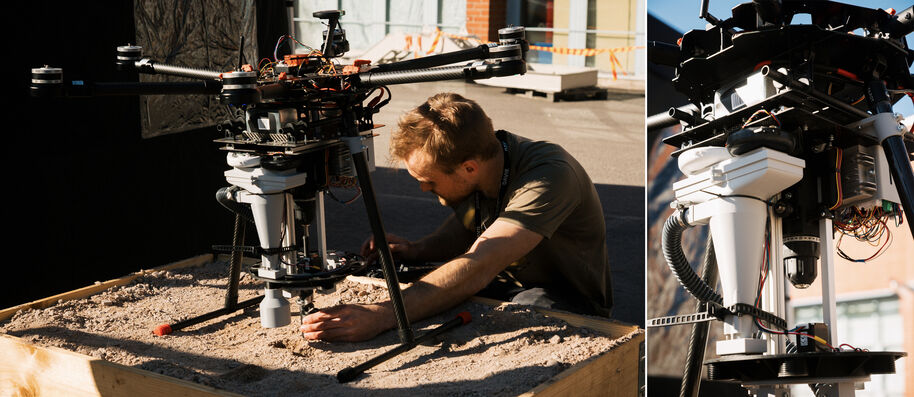
This approach led the team to develop a solution combining satellite data, AI models, and a drone-based system to gather “ground truth” measurements. “I would have done it differently myself,” David admits. “But I’m very happy I didn’t stop them — because they proved it works. And now they’ve even filed a patent!”
The power of multidisciplinary thinking
For Isaware, one of the most valuable aspects of PdP was the team’s ability to step outside established ways of thinking: “In our company, we have highly experienced people who know what works,” David explains. “But it’s not always easy to zoom out and try something completely new.”
That’s where PdP’s multidisciplinary structure makes a difference. “I was interested in people who are not biased by what we already know,” he says. “People who bring in the newest ideas and mix things in unexpected ways.”
For the students, working across disciplines was equally transformative: “I wanted to see how design can actually work in a real problem alongside different fields,” says Laura Rodríguez, a visual communication design student. “This project showed how everything connects in practice.”
The diversity of the team also strengthened the project’s societal relevance. For some, the challenge was deeply personal.
“The illegal mines causing negative environmental impact is a big problem in my homeland Colombia. Knowing that this project can actually help people by prioritizing actions and helping to reduce environmental damage — it’s amazing!” says electronic engineering student Maria Alejandra Perafán. “We hope that people living near these rivers will no longer have to worry about water safety,” the team shares.
From ideas to real-world impact
The collaboration resulted in a functional prototype combining hardware, data models, and a user interface. For Isaware, the value goes far beyond the technical outcome: “We now have something we can use to leverage further funding, and that’s critical for a small company like us,” David says.
With limited resources, PdP offered a way to explore ideas that would otherwise remain out of reach. “We simply don’t have the resources to prototype everything ourselves,” he explains. “Having a team fully dedicated to a challenge — it’s definitely worth it!”
At the same time, the students experienced what it means to build solutions for real users and real contexts. “PdP took me through the whole process, from scratch to a solution that somebody can actually use,” says computer science student Adamay Bhardwaj. “It’s not just about a pipeline of building a product, it’s about building something meaningful.”
Mircea emphasizes the user perspective in the learning process: “In order to create a successful project, the key difference is that you're taking key information from customers, not just designing what you think they need. I think the firsthand experience gained during PdP will be incredibly useful in my future career, especially if I'm going for leader positions.”

A key role in the innovation ecosystem
From David’s perspective, PdP plays an important role in the broader innovation ecosystem by bringing together diverse expertise and encouraging collaboration across boundaries.
“At the beginning, the students didn’t know each other, and their disciplines were quite separate,” he recalls. “But by the end, they were working as a unified team and learning to trust each other’s expertise.” This kind of collaboration mirrors real-world innovation environments, where complex challenges require multiple perspectives. “You don’t get ten experts doing the same thing,” David says. “You get variety and that’s a huge advantage.”
Students also highlighted how working with an industry partner bridges the gap between academia and practice. “In university, you work with the resources available to you,” Mircea explains. “But through the sponsor, we got access to tools and knowledge that are actually used in industry today.”
Advice for future partners
If asked to define PdP in one sentence, David keeps it simple: “Here, they get things done.”
For companies considering PdP collaboration, David emphasizes openness, trust, and the courage to let go: “The more transparent you are, and the more time you invest, the more you get back,” he says. At the same time, he cautions against over-managing the process: “Don’t micromanage. Show them the doors, but let them choose their path.”
From the student perspective, this trust was exactly what enabled success. “That freedom allowed us to explore even unrealistic idea — and then turn them into something real,” Laura reflects.

A collaboration across Design Factory, HUS, Biodesign Finland, and Aalto students brings urine monitoring into the 21st century

Vaisala collaborates with the Product Development Project course to gain new perspectives, low risk experiments, concrete tools, and future talent.

Tervetuloa oppimaan tuotekehityksestä poikkitieteellisesti ja käytännönläheisesti!


