






From deep space to dental care: Product Development Project creates value across industries

For 30 years, Aalto Design Factory’s Product Development Project (PdP) has brought students from business, design and technology together to solve real-world industry challenges. Its multidisciplinary format gives organizations a structured way to explore new ideas, develop prototypes and connect with emerging talent.
The 2025–2026 projects spanned fields from environmental monitoring, drone defense and circular construction to medical technology, dental ergonomics, geological analysis, building maintenance, smart devices and seaweed-based biomaterials. For sponsors, PdP offers more than a final prototype: it creates space for experimentation, fresh perspectives and cross-disciplinary problem-solving beyond the scope of conventional in-house R&D.
With another batch of projects starting now in September, we took stock of sponsor perspectives of the benefits of collaborating with Aalto through the course.
Exploring what internal R&D cannot
For many organizations, PdP provides a dedicated team and a defined timeframe for investigating ideas that are promising but not yet ready for conventional product development. For example, Miikka Tamminen, the Vice President of Research and Development of Sako (one of PdP’s recurring partners) notes that for them, PdP complements rather than duplicates in-house R&D by creating space for more experimental, research-driven work.
“We’ve been involved since around 2012, and every year we’ve received truly great results,” Tamminen says. He describes the PdP format as an efficient way to access expertise within a tightly defined period. “The cost-benefit ratio in PdP projects is very high,” he says. “We get a lot of expertise, a tightly defined timeframe, and within that, a surprisingly large number of insights and findings.”
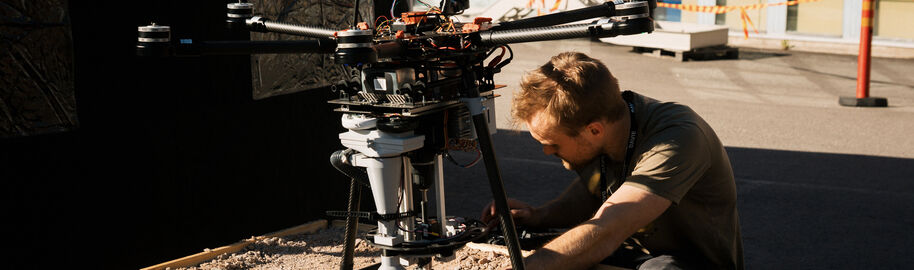
The value of this exploratory model was also evident for Isaware, a Finnish deep-tech company developing instruments for space missions. Isaware presented the student team with a broad challenge and allowed it to define its own direction. The result was a functional prototype combining satellite data, AI models, a drone-based system and a user interface to mitigate illegal mining. The project has also led to a patent application.
For a small company, the opportunity to investigate a substantial challenge without committing extensive internal resources can be significant. “We simply don’t have the resources to prototype everything ourselves,” David Leal Matinez, the CEO of Isaware says. “Having a team fully dedicated to a challenge—it’s definitely worth it!”
A safe space for experimentation
Another benefit highlighted in the collaboration is the experimentation. For example, Vaisala has returned to the course multiple times because the collaboration offers a practical way to test ideas, conduct technology scouting and explore future product opportunities. Product and Package Design Specialist Noe Anttonen describes the course as “a safe setting to play in”.
In PdP26, the company’s “No More Connectors” brief focused on a specific and timely development challenge. The team worked on technology scouting and market mapping that Vaisala’s own R&D organization would otherwise have needed to undertake internally.
“It was a timely and suitable topic that you can really deep-dive into in the PdP format,” recalls Product Manager Nevon Mansour says. “It’s practical and not too broad, and when the result comes, it’s easy for us to continue developing it further. It’s something that could become a product one day, not just another project.”
The collaboration has influenced how Vaisala works. After participating in a Design Factory product development sprint, the company incorporated the PD6 six-hour sprint into its own toolbox. The experience has also sharpened how Vaisala frames challenges for external teams. “We realized how important it is that the scope and brief are concrete enough,” Anttonen says. “The more focused it is, the easier it is to grab onto.”

Fresh perspectives across industries
A central feature of PdP is the combination of different disciplines, nationalities and areas of expertise. For sponsors, this diversity can disrupt familiar patterns of thinking and reveal opportunities that are difficult to see from within an organization.
PrinSys Project Specialist Muhammad Tanweer, a PdP student alumnus, describes the multidisciplinary team as one of the course’s greatest strengths.
“Students come from all disciplines and different cultures, even different levels of education,” he says. “They think about the same problem differently, and then they come up with a solution,” Tanweer says. “That fresh mind thinking is something you really miss inside a company.”
PrinSys challenged the team to develop a smarter way to detect and respond to leaks in buildings. The team created a communication device intended to reduce sensor-network installation costs, as well as an application connected to a secure cloud platform.
Saab, which has sponsored PdP repeatedly, also values the outside perspective. Its challenge involved a semi-mobile launching concept for decentralized drone defense, designed to place interceptors closer to critical targets and reduce response time.
“What makes PdP interesting is that students are given a lot of freedom to think independently and develop their own solutions,” says Innovation & Collaboration Coordinator Juha Vuorenalho.
Innovation under a clear deadline
PdP is open-ended in its outcome, but not in its timeframe. Teams work within a defined academic year, creating a rhythm that encourages experimentation while maintaining momentum. For another recurring sponsor, Torggler, a construction-materials company, this time-boxed structure has been a key strength in collaboration. The most recent student team explored circular materials, investigating how waste could be transformed into valuable ingredients for concrete and adhesives.
“What’s nice about PdP is that it’s really time constrained. You know how long it’s going to take, even if you don’t know exactly what you’re going to get,” says Torggler co-owner Felix Johannes.
The same balance between freedom and structure was important for HUS Helsinki University Hospital and Biodesign Finland. Their joint challenge addressed the manual measurement and recording of urine output in intensive care units and operating rooms.
The team worked towards an automated, affordable and hospital-system-integrated solution that could save nurses’ time, improve data accuracy and support faster clinical decision-making.
“Nothing restricts the brainstorming,” says Susan Laine, an EHR Nurse at HUS. “We start from the premise that everything is possible. When you work with a large company, they immediately set frames: ‘This is realistic, that’s not.’ Here, we simply started to solve the practical problem.”
Salla Keränen, Development Manager at HUS, says that the students’ lack of pre-existing assumptions about medical-device development enabled them to approach the challenge with unusual agility: “They started from, ‘What’s the best solution?’ That let us move much more agilely and get to a functional solution faster.”

Building relationships and future talent
For several sponsors, recruitment and relationship-building are an important part of the PdP experience. The course allows companies to observe how potential future colleagues approach ambiguity, collaborate across disciplines and turn an unfamiliar challenge into a working solution. Many sponsors end up hiring students to summer jobs and thesis positions – finding new talent from the course.
For Finndent CTO Johan Haltia, himself a PdP student alumnus and now a sponsor alumnus as well, the course provides a realistic experience of product development—one that includes uncertainty, setbacks and communication challenges.
“Here, you learn what real product development projects are like,” he says. “They are not always success stories. There are challenges, mistakes, communication breaks down, and sometimes personalities don’t work together as expected.”
The course has also led to research collaboration and joint initiatives, both with Aalto as well as across sponsor organizations.
Considering joining PdP as a partner?
Read more news

An interest in global supply chains took our alum Maija Lehner abroad
Maija Lehner first completed a bachelor’s degree in Business Technology at Aalto University School of Business, then a double degree in the CEMS Global Management and Strategy master’s programmes.
A joint Anniversary Class Reunion was piloted at Aalto University School of Business
The classes who started their studies at the School of Business 30, 20 and 10 years ago gathered in a festive atmosphere at the old School of Business building in Töölö.
Unite! Seed Fund 2026 – Aalto involved in eight projects
From the 2026 Seed Fund call, 22 proposals were selected for funding. Aalto is involved in eight of these projects and coordinates one.