






Experience Isn't the Finish Line: Payam Salarvand on Learning to Build Better

Many people see entrepreneurship as something you learn by doing. While experience is one of the best teachers, it often comes at the cost of trial and error. The Founder Minor offers another path: combining practical experience with proven frameworks, founder insights, and a community of people who challenge the way you think.
Payam Salarvand, an entrepreneur, management consultant, and Aalto University alumnus with nearly two decades of experience in business development, strategy, and operations, joined the Founder Minor not because he was starting from scratch, but because he wanted to test his own assumptions, sharpen his thinking, and continue learning.
We spoke with Payam about why experienced founders should never stop learning, what surprised him most about the Founder Minor, and why he believes the people you meet can be just as valuable as the courses themselves.
Can you tell us a little about yourself, your professional background, and what motivated you to pursue the Founder Minor?
So, a bit about me. I’ve got close to two decades of professional experience behind me, wearing a lot of different hats along the way: founder, consultant, operations manager, business developer, strategist, marketing specialist, and plenty in between. I’m someone who genuinely loves the craft of building and running a business — devising the strategy, then actually executing it. My satisfaction comes from operating a business rather than falling in love with a single idea or getting fixated on one particular industry, product or service. My real passion has always been self-development and growth around a dedicated team, all pointed at that next milestone and beyond. So the thing is, I didn’t pursue the Founder Minor because I felt I was missing the basics — I did it because I was curious enough to examine my own experience carefully and question what I might have overlooked across my entrepreneurial journey. I went in curious, and I came out sharper.
Having already worked closely with entrepreneurs and growing businesses, what were you hoping to gain from the Founder Minor that you couldn’t learn on the job?
During my entrepreneurial journey, we had to learn a lot of things the hard way — through trial and error, with experience as the teacher. Effective, sure, but costly. So when I enrolled in the Founder Minor, what I actually wanted was to see how closely my hands-on experience as a founder lined up with the course content, and to get to know like-minded people who shared that entrepreneurial mindset, especially people from backgrounds different to mine, and to get to know them closely. So basically, on-the-job experience had taught me plenty about running a business, but it couldn’t put me in a room full of driven people from completely different walks of life. On top of that, I wanted a bit of academic flair to complement my experiential expertise. Lastly, the business environment keeps moving, so part of it was simply upskilling and staying relevant to the times.

Payam SalarvandEven if you consider yourself experienced, don't assume you've got nothing to learn.
Looking back, what has been the biggest shift in how you think about entrepreneurship since starting the Founder Minor?
Well, honestly, it wasn’t so much a shift as a realization. So the thing is, I’ve never really been the founder who leans entirely on either the plan or the gut. For me it was always the combination of the two. Even early on, I planned with structure across sales, marketing, operations, product development, team management and stakeholder considerations, but I always paired that with the readiness to pivot the moment reality stopped cooperating.
And that’s something people tend to underestimate: businesses are unpredictable by nature, so leaning too heavily on a rigid plan is honestly a recipe for disaster. You have to be able to react when plans fall flat, because they will. What the Founder Minor did was confirm exactly that: the founders and companies who scale well aren’t the ones with the most detailed plan or the sharpest instinct, they’re the ones who can hold structure and improvisation at the same time and shift the balance as the situation demands. Seeing that laid out through real frameworks and case studies validated the way I’d already been operating and gave me a cleaner way to be intentional about it. So basically, the biggest takeaway wasn’t structure over instinct or the other way round — it’s that the real ultimate weapon is being able to wield both, and knowing when to lean on which.
Was there a course, discussion, project, or interaction that challenged your existing assumptions or gave you a new perspective?
So the thing is, I originally assumed entrepreneurship was reserved for certain personality types — that if you didn’t hold a specific set of traits, you could more or less forget about being a founder. I also assumed a business background was essential. When I took Maija Renko’s “Founder Insights” course, that assumption got shot down pretty quickly. It was a very grounded course, digging into the stories and life lessons of some of the most successful founders behind companies like Anthropic, Airbnb, DoorDash and Wolt, just to name a few.
What struck me was how much their advice aligned and stayed globally applicable, even though they came from wildly different backgrounds, which basically proved anyone can be a founder if the passion is there. That was reinforced by the sheer diversity of people around me: different ethnicities, ages, personalities and interests, from arts, design, technology, engineering and law, alongside the usual business crowd. In fact, where I’d assumed the most likely entrepreneurs would come out of business school, my view flipped completely: it’s often the people outside of business school who are the most inclined to take the entrepreneurial path.
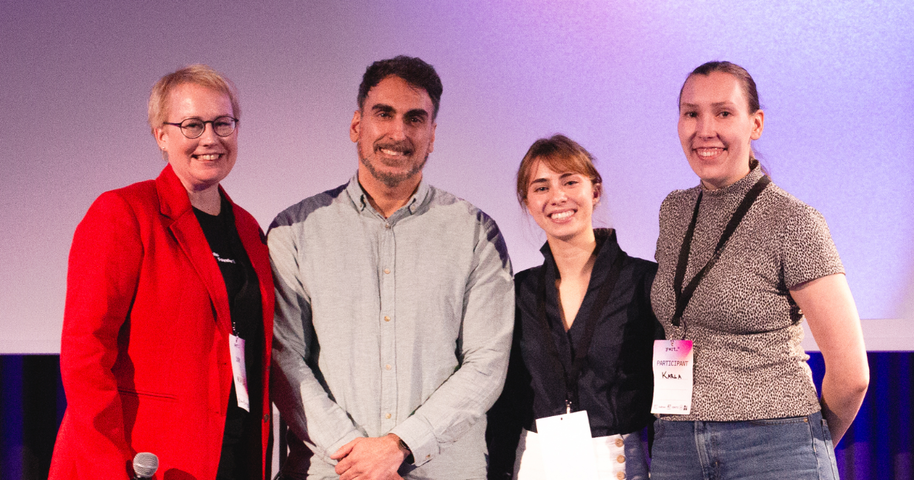
How has learning alongside students from different backgrounds influenced your experience in the Founder Minor?
Well, I’d say it was both exhilarating and eye-opening. Having studied in business school myself, I’d experienced the oversaturation of near-identical mindsets, so the diverse group in the Founder Minor was refreshing, and I really appreciated the perspectives coming from other disciplines. Those were the people who addressed the blind spots someone from a business background simply couldn’t see, and their contribution to widening my perspective was priceless.
One course that stands out was Antti Lähtevänoja’s “Go to Market for Founders”. That’s where the introduction for aspiring entrepreneurs was at its most effective, thanks to a practical, no-BS approach backed by the teacher’s own experience as a founder. It gave us the perfect environment to simulate a startup venture with a heterogeneous team: getting to know each member personally, planning under time pressure, brainstorming, disagreements, a bit of bantering… you name it. As a founder, I can tell you those are all part of the dawn of any new venture. So while I already knew the value of a diverse team going in, the Founder Minor is a convincing testament to it in practice, especially for anyone who still has doubts.
Looking back on your experience, what would you tell someone who’s considering the Founder Minor?
Put your assumptions about entrepreneurship aside and enroll with an open mind. The courses are down to earth, practical, informative and most importantly, some of them let you taste the entrepreneurial experience hands on, rather than just reading about it. I’d rank these among the best courses I’ve taken in Aalto University. The Founder Minor is basically the shortcut I wish I’d had all those years ago as a founder: it’ll equip any new aspiring entrepreneur with the tools to sidestep the usual mistakes and skip a lot of the slow, expensive trial-and-error learning. If I’m being honest, the absolute highlight will be the people.
The relationships you build and the networking with like-minded, driven individuals are immense. You might genuinely end up starting a venture with someone you met in the classroom. The teachers are empathetic and genuinely invested in your learning, so you never feel like you’re navigating it alone. And even if you already consider yourself experienced, don’t assume you’ve got nothing to learn — the Founder Minor still managed to reshape how I think about building a venture, and it’ll leave you with new perspectives, sharper instincts and a network that long outlasts the courses.
Think the Founder Minor is only for first-time founders?
Read more news

Every Step Brings You Closer to the Summit – Join UniSport’s Mount Everest Challenge in HeiaHeia
Students and staff of Aalto University celebrate this year’s Stair Days with a shared journey towards the summit of Mount Everest. UniSport’s new HeiaHeia wellbeing app inspires everyday physical activity, makes wellbeing actions visible and brings the whole community into a shared challenge.
Toolkits for Co-creation: Practical tools for collaborative development
Aalto Design Factory’s five co-creation toolkits help students, educators and professionals understand needs, frame challenges, generate ideas, plan experiments and test solutions.
New guidance on the use of AI in thesis work
New guidance on AI in bachelor’s and master’s theses: students must agree AI use in advance with their supervisor and document how it was used.