ARTTU! The former magazine of the University of Art and Design Helsinki

Arttu 5/1987Conversational, open-minded, inspiring.
Arttu – or rather ARTTU!, was the University of Art and Design Helsinki’s (TaiK) very own ‘magazine of young design’. The roots of the publication were in a magazine of the same name originally published by the student association of the university way back in the early 1960s. The original magazine had gotten its punchy name from one of the pioneers of Finnish industrial art education, the former artistic director of the predecessor school of TaiK Arttu Brummer (1891-1951). The adoption of the old name was motivated by its international connotations to the English word “art” and a desire to pay homage to the history of Finnish applied arts education.
ARTTU! began publication in 1987 and it quickly became an important external communication tool for the university. In the 5/1987 issue the new magazine’s character was summarized in the following manner: “Arttu is a design magazine published by the University of Art and Design. Conversational, open-minded, inspiring. Experimental and graphically of high quality. A teaching tool: the magazine’s visual outlook and printing will be done as practice work in the graphic design department under the supervision of lecturers Pekka Loiri and Juho Hämäläinen. Photojournalism will be developed in cooperation with the department of photography. All teachers and faculty have been invited challenged to take part as writers, illustrators, ideators.”
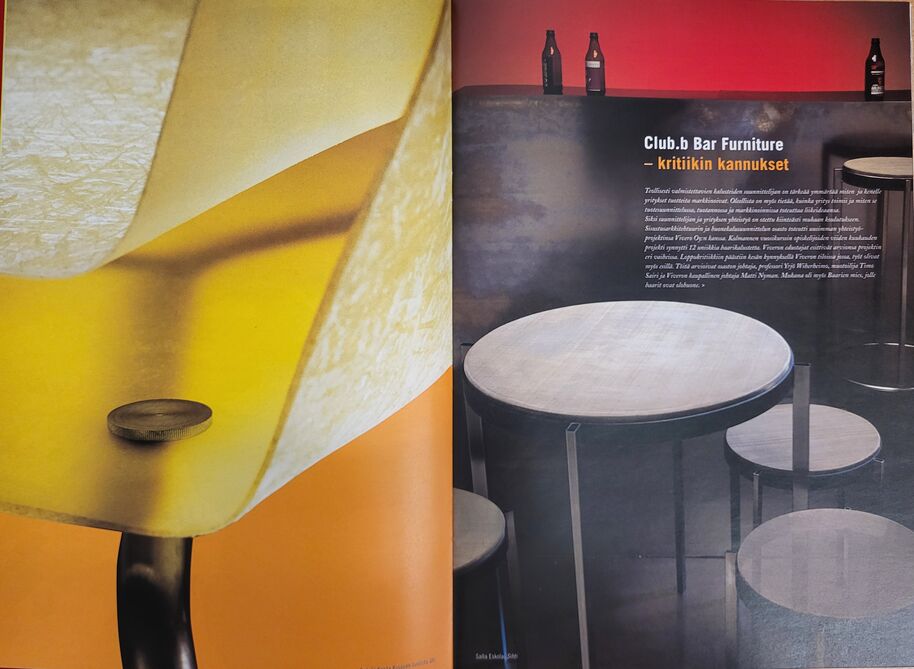
Layouts from the late 1980s and early 1990s

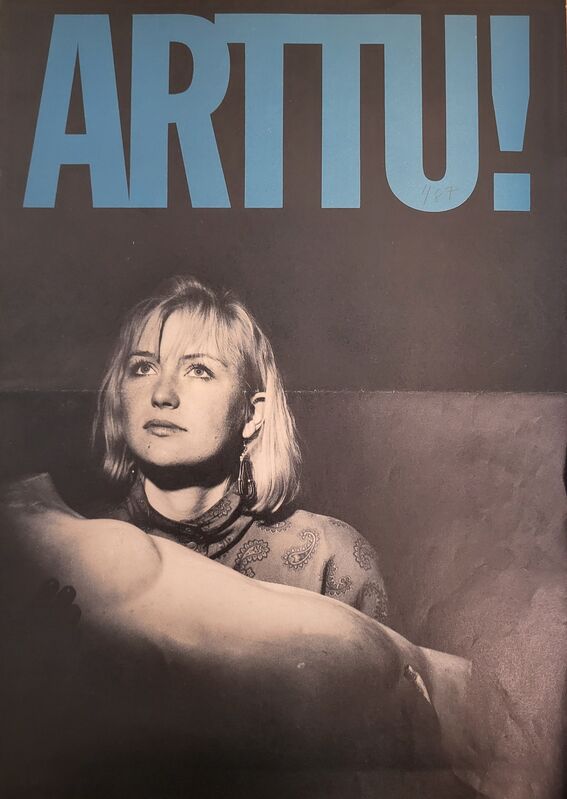
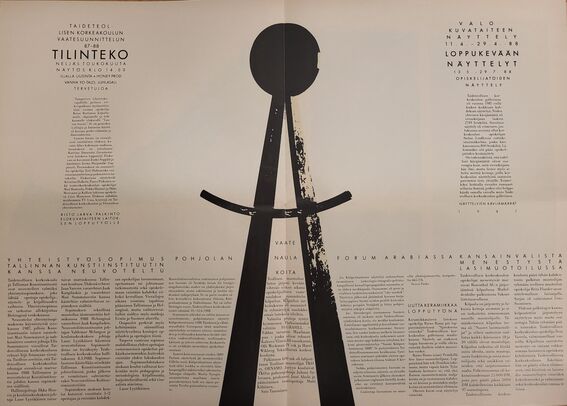
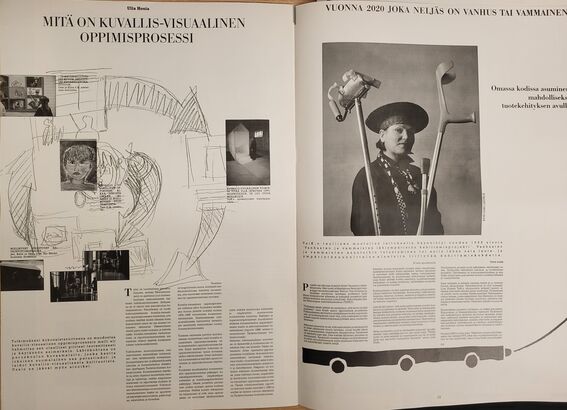
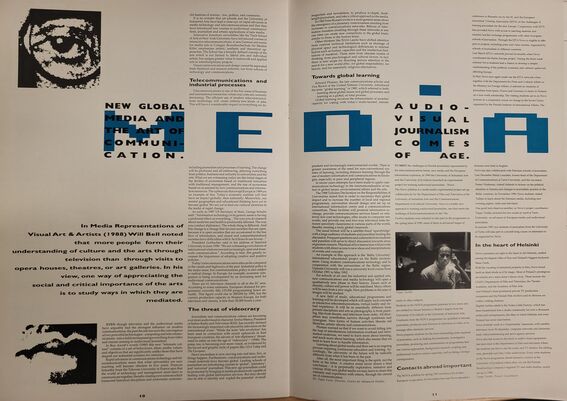


Arttu was published under the label ‘information bulletin’ until well into the late 1990s. Even so, soon after its launch it quickly became a true versatile design magazine: it both showcased the university’s activities and tracked and commented on events in the art and design field. A key force behind this new direction was the university’s rector Yrjö Sotamaa, who served as Arttu’s editor-in-chief from 1987 until the end of his rectorship in 2008.

As a student, Sotamaa had edited the student union’s paper and saw Arttu as a way to make the university’s voice more widely heard. By the turn of the millennium the magazine had settled on a slogan that described its broad remit more accurately: “the magazine of young design.” Even so, information bulletin -style news pieces always remained an essential part of its content. Through Arttu’s memo news column and other short items, readers could learn about current exhibitions, conferences, industry awards, new books, and dissertations among other things.

For most of its run, Arttu was often published as themed issues. Each themed issue focused mostly on a single topic. Often the magazine concentrated on a specific field within art and design—such as furniture design or film—while at other times it explored for example the nature of art research, the theme of the image or a major art and design conference. The themed issues also brought in guest editors who were often members of the university faculty or other figures active in the field of the theme.
The magazine’s points of emphasis and editorials highlighted the institution’s stance on different topics. Arttu kept pace with the times—and often led the way: in the late 1980s and throughout the 1990s its pages hosted lively conversation on topics such as computer aided design, new media, the development of the Arabianranta district with its design and information society neighbourhood projects, the university’s top priority of internationalization, and many other themes. To serve its international readership, Arttu also ran articles in English, and at regular intervals entire issues appeared in the language. In the new millennium, the magazine devoted considerable space to discussion around the proposed innovation university (Aalto), a process in which TaiK’s rector played a central role.


Arttu’s foremost task, however, was to showcase TaiK and its students’ work. After all, young design and the university’s students were at the heart of the magazine’s identity. Each year the university published a special issue presenting its new graduates and their theses, the “Graduation Work-Arttu”. It offered a diverse, curated selection of distinguished graduation projects from across the university’s departments. The selected students were given space to discuss the inspiration behind their projects, how they were carried out in practice, and their plans going forward. Being featured in Arttu brought a student’s work to a many-thousand-strong readership who actively followed Finland’s art and design scene. Later in the 2000s, after the concept was launched, the thesis issue began to cover each year’s Masters of Arts -festival in broader scope.
What truly made the magazine stand out was its visual outlook, which changed with every issue. For most of its publishing history, Arttu’s layout was created as group or pair projects by graphic design students as part of the university’s teaching. The students were given largely free rein with the layout, which often resulted in highly experimental outcomes. Broader design trends of the time are visible in the layouts; the more freewheeling approach of the 1990s gave way in the 2000s to a somewhat more toned-down design.
At times, professional graphic designers also took part in shaping the visual identity, but the student-driven approach proved the most effective. In addition to graphic design students, photography students influenced the look with their images. The students’ handiwork was appreciated outside the university as well. Over the years, Arttu performed well in Posti’s customer magazine competition.
Covers of Arttu from the 1990s and 2000s


Revived in 1987, Arttu’s came to an end in 2011 following the creation of the new innovation university. At Aalto, the decision was made to launch a single joint stakeholder magazine to succeed TaiK’s Arttu, the Helsinki School of Economics’ Avista, and the Helsinki University of Technology’s Polyteekki.
Browsing through Arttu is an excellent way to take a trip through the recent history of Finnish design, its trends and phenomena. The magazines offer a window onto parts of the field that don’t always reach a broad audience, or that might have already slipped from memory: student projects, the up-and-coming young designers of the past, and the internal conversations within the art and design community during a certain period. The 1987–2011 issues of ARTTU! can be read in digital form via the Aalto Repo platform.
Text: Roope Pölhö
Sources:
Arttu-magazines 1987-2011
Haikarainen, Paula. Arttu 1/2011, "Arttu on lehtimaailman outolintu".