






Quantum Computing and Devices (QCD)
We have a major effort on experimental low-temperature physics, but we also carry out computational and theoretical work down to fundamental quantum mechanics.

Recent improvements in our understanding of how the principles of thermodynamics apply in the quantum realm could give a boost to quantum technology, and a clearer picture of quantum thermodynamics could reciprocally enhance our understanding of classical thermodynamics. Now Aalto University researchers have demonstrated the first cyclic quantum heat engine inside a superconducting circuit.
Physicists have become increasingly fascinated with the idea that classical thermodynamics could be combined with quantum mechanics. Quantum mechanics captures the behaviour of particles on tiny scales—smaller than atoms—while thermodynamics is about large systems, from molecules up to the entire universe. How do strange quantum phenomena like tunneling, entanglement and superposition mix with the stolid familiarity of the heat engines that kickstarted the industrial revolution?
Heat engines, like James Watt’s famous steam engine, convert heat into useful energy, into work. They power our cars, ships, and planes, and heat engines are how most power plants generate electricity. Now, the world’s first superconducting quantum heat engine has been built: a tiny device consisting of a transmon qubit, a resonator and a quantum refrigerator.
The superconducting engine harnessed the miniscule amount of heat found in ultracold quantum conditions to cyclically output positive work, a long-sought goal for quantum engineers. The device provides a solid proof of concept for superconducting heat engines, which could be used to develop improved technology for quantum computers.
The study, led by Academy Professor Mikko Möttönen, was published in Nature Communications on July 13: https://www.doi.org/10.1038/s41467-026-72651-x
The team created an Otto cycle—the thermodynamic process that powers car engines, among other things—inside a superconducting circuit.
’In our experiment, we built a nanofabricated heat engine using superconducting circuits and operated it in a cryostat near absolute zero. At its heart is a transmon qubit, one of the basic building blocks of modern quantum technologies,’ says Tuomas Uusnäkki, the study’s first author.
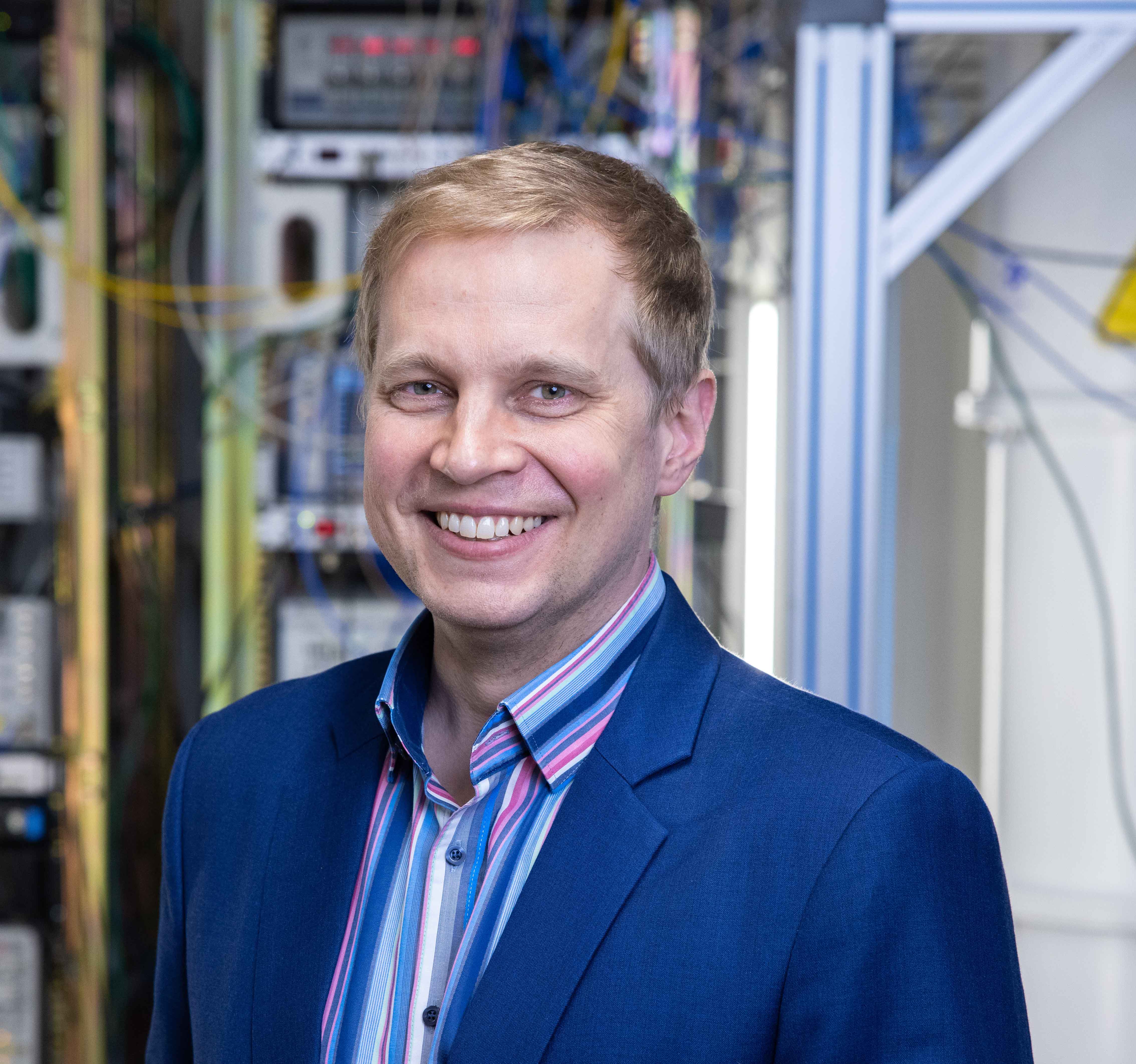
Tuomas UusnäkkiThis is the first experimental demonstration of a cyclic quantum heat engine in superconducting circuits.
By connecting the transmon qubit to a quantum-circuit refrigerator, the team could control the flow of heat at a quantum scale and show that it can be converted into measurable work. Unlike a typical heat engine, which uses separate hot and cold sources, the quantum heat engine relies on a quantum refrigerator to provide both heat and cold.
‘Our quantum-circuit refrigerator can be tuned to both heat and cool the qubit on demand. Using carefully timed control pulses, we drove the engine in an Otto cycle and monitored the qubit state as the engine ran,’ explains Uusnäkki.
The researchers saw that the heat flowing through the qubit in the cycle was generating positive work.
‘This is the first experimental demonstration of a cyclic quantum heat engine in superconducting circuits. Using a single controllable quantum refrigerator as both the hot and cold environment of the engine makes it simpler and more versatile,’ says Uusnäkki.
The team is working to improve their design, aiming to create an entirely autonomous heat engine that could do things like read out qubits without the need to bring the microwave pulse from millikelvin to room temperature. An autonomous engine on a superconducting circuit could reduce the cost and complexity of high qubit-count computers in the future.
‘Finland’s Quantum Technology Strategy envisions a quantum computer with one thousand logical qubits by 2035, which probably means hundreds of thousands of physical qubits. Doing that with current technology requires millions of microwave cables costing thousand euros each. The cables also introduce noise into the system. Using autonomous devices instead would mostly eliminate the need for those cables,’ Möttönen says.
The researchers used the facilities of OtaNano, Finland’s national research infrastructure for nano-, micro- and quantum technology in their pioneering study. The work was funded by the Research Council of Finland and the Finnish Cultural Foundation.

We have a major effort on experimental low-temperature physics, but we also carry out computational and theoretical work down to fundamental quantum mechanics.


