






Subnational income inequality revealed: Regional successes may hold key to addressing widening gap globally

Income inequality is one of the most important measures of economic health, social justice and quality of life. More reliably trackable than wealth inequality, which was recently given a gloomy report card by the G20, income inequality is particularly relevant to immediate economic relief, mobility and people’s everyday standard of living.
The new study, from an international team led by Aalto University and Cambridge University, is the first to comprehensively map three decades of income inequality data within 151 nations around the world. Despite finding that income inequality is worsening for half the world’s people, the study also indicates that effective policy may be helping to bridge the gap in regions such as Latin America — ‘bright spots’ in administrative areas that account for around a third of the global population.
‘This research gives us much more detail than the existing datasets, allowing us to zoom in on specific regions within countries,’ says one of the study’s lead authors, Professor Matti Kummu, from Aalto University. ‘This is significant because in many countries national data would tell us that inequality has not changed much over the past decades, while subnational data tells a very different story.’
‘The new data is particularly relevant in light of recent failings around wealth inequality, given that it could help shed light on what policy levers might be pulled to address inequality in the short-term,’ says co-lead author Daniel Chrisendo, nowan Assistant Professor at Cambridge University.
‘We have vastly more complete data on income than we do on wealth, which tends to be much harder to uncover and track,’ explains Chrisendo. ‘Especially given that income inequality leads to wealth inequality, it’s critical to tackle both forms — but income inequality is perhaps the easiest to address from an immediate policy perspective.’
The study was published in Nature Sustainability on 5th December, and the new global subnational Gini coefficient (SubNGini) dataset, spanning 1990-2023, is publicly accessible online. Global annual data and trends can be explored visually using the Online Tool, which enables users to explore how income inequality has played out in regions around the globe and also download the data for further analyses.
Pinpointing the role of policy
There are many examples where regional efforts have shone more brightly than is revealed by national statistics, say the researchers. However India, China and Brazil all present interesting case studies that affect large swathes of the global population.
‘With regards to India, relative success in the south is linked to sustained investments in public health, education, infrastructure and economic development that have benefited the local population more broadly,’ says Chrisendo.
Meanwhile, in China, market-oriented reforms and open-door policy have driven economic growth and dramatically reduced poverty since the 1990s. ‘But we can also see how this growth has been uneven, likely due to the Chinese government’s ‘Hukou’ policy limiting rural migrants' access to urban services,’ he explains. In response, the government has implemented various policy measures — such as regional development programs and relaxed Hukou restrictions — to address disparities and support internal migrants.
In Brazil, the mapping shows a potential correlation between reduced inequality and a regional cash transfer programme providing cash to poor families on condition of their children attending school and receiving vaccinations.
‘Overall, being able to visualise these success stories and pinpoint the changing trends in time could help decision-makers see what works,’ says Chrisendo.
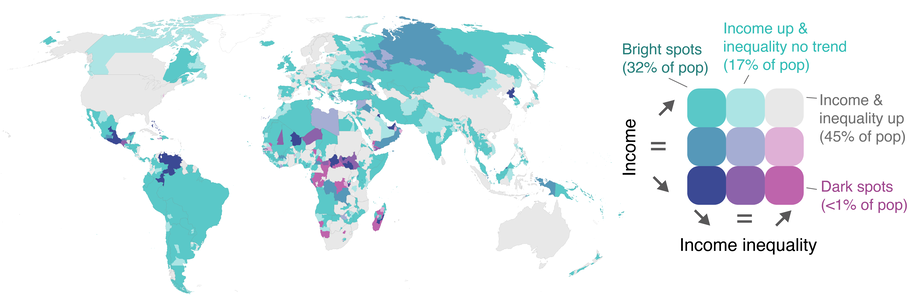
Income inequality rising for half the world’s people
Relative income growth for the world’s poorest 40 percent is one of the UN’s Sustainable Development Goals (SDGs), yet the study confirms the collective failure to meet this goal by 2030. ‘Unfortunately, not only are we quite far from that goal, but the trend for rising inequality is actually stronger than we thought,’ says Kummu.
The researchers are now expanding the data visualisation to encompass a vast range of other socio-economical indicators, from how populations are aging, to life expectancy and time spent in schooling, to improved access to drinking water — with the extensive new datasets slated for public launch in 2026.
As an expert in global food systems and sustainable use of natural resources, Kummu hopes the new datasets can be used to better understand, for example, the linkages between development and environmental changes. The recent study revealed links between more unequal regions and lower ecological diversity, which he would like to explore further.
‘It’s ambitious, but to have subnational, high quality data spanning over three decades is crucial to understand different social responses to environmental changes and vice versa. It gives us the means to start understanding the causalities, not just the correlations — and with that comes the power to make better decisions,’ he concludes.

Daniel Chrisendo
Read more news

How can we reinvent ourselves in the face of uncertainty? Five things everyone should understand about embracing the new
In a rapidly changing world, we need the ability to think differently, question what is familiar and recognise new opportunities. Aalto University’s Professor of Practice Nando Malmelin, explains how anyone can develop their openness skills
Peatlands in the Northern Hemisphere are changing – satellite study reveals clear regional differences
The Northern Hemisphere’s peatlands are being reshaped not just by heat, but by moisture, says a unique study––the first to span two decades. Many areas have switched from greening to decline in the 2010s.
The State of Marketing survey: Performance monitoring and budgeting remain relatively weak
Markkinoinnin tila (The State of Marketing) survey opens up important perspectives to the Finnish marketing knowhow and areas for development in marketing