






Aalto AI Assistant
A chat-based application powered by the same language models as ChatGPT

While AI is a valuable study tool when used correctly, it is different from the traditional study tools. Whereas a calculator goes silent once it has completed its calculation, a language model offers to take on further responsibility by asking follow-up questions. This leaves you, the student, with the responsibility of drawing boundaries and developing suitable working methods.
See the Student Guide for tips on using AI to enhance learning. How can you stay in control of your work when using AI in your studies? We have spoken to over a hundred students about this theme over the last year and have used their input to outline six perspectives on studying with AI.
As a general rule, you can use AI to support your learning, unless the teacher instructs otherwise. Teachers can restrict AI use in specific courses or assignments. To make it simpler for teachers to specify the course AI policy, we have prepared a template with the following general categories:
AI is a new development for teachers, too, and getting used to the new situation will take some time. If the rules regarding AI use are not clearly stated in the course or assignment, you should ask your teacher for clarification.
Producing text, calculations or code is a slow process, as thinking takes time. While AI can produce decent results in seconds, the thinking behind the results is left undone.
In the age of generative AI, we need to learn to recognise the value of human-written text. Writing allows you to organise scattered thoughts and gain insight. As you write about what you have learnt, you will gain a deeper understanding of the topic.
AI can, however, serve as a useful virtual coach and sparring partner when writing text or doing other assignments: language models can offer new perspectives, point out some blind spots in your thinking or, in a longer conversation, teach you something new.
In summary: You should first do your course assignments independently and then ask AI for observations and counter-arguments. Based on the comments you get, you can then edit your work. Adopting this working method will allow you to stay in command of your work and feel that you have genuinely done the assignment yourself, whilst broadening your perspective. As a student, you have the final responsibility for your outputs.

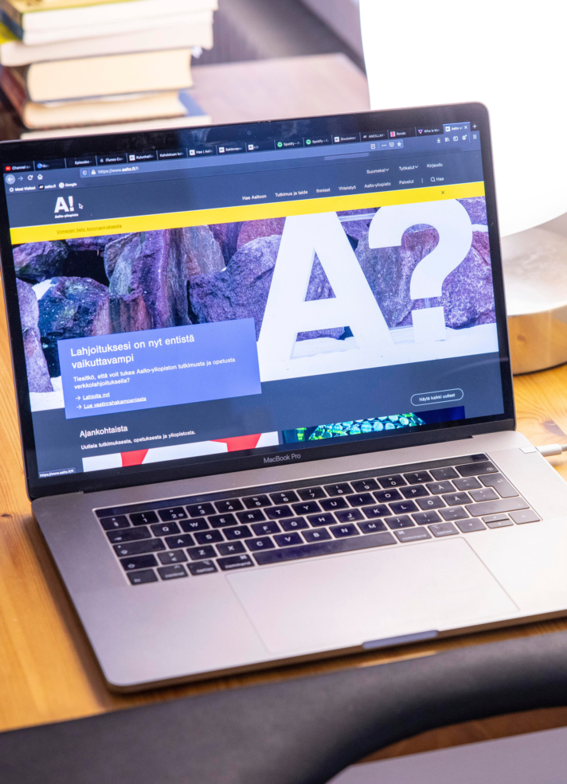

In commercial AI services, conversations between private users may be used to train language models, and you have no control over where your data ultimately ends up. Aalto University has its own AI tool, Aalto AI Assistant, where you can log in with your Aalto username and password. The data you enter into Aalto AI Assistant is protected by agreements that comply with the Aalto information security policies, and your conversations will not be used to train the models. Unlike with any external services, you can enter internal and confidential Aalto data into Aalto AI Assistant.
In Aalto AI Assistant, you can choose between various language models: OpenAI’s GPT models, Google Gemini models, and an open-source language model running on Aalto servers.
Students have a monthly quota of 30 euros for using the Aalto AI Assistant. The service has an indicator that allows you to track the cost of your use. It will not restrict your usage; it simply helps you to understand the costs incurred through your usage.
By providing context to AI, you help it understand what you are studying. Specify the intended learning outcomes and subject area of the course, as well as your own goals and background knowledge on the topic. Provided that the course guidelines and the access rights to its materials allow it, you can provide lecture slides or extracts from the course materials or your own notes as context for the AI.
Never enter personal data into AI services, or any material whose terms or use prohibit such use. Check carefully, in particular, the terms of use for the materials provided by library services. Further information on copyright in relation to AI: Artificial intelligence and copyright | Aalto University
The simplest way to make use of context is to revisit old conversations rather than always starting a new one. Within the same conversation, the language model remembers previous exchanges and uploaded documents. In Aalto AI Assistant, you can pin conversations for easy access.

You can also make use of context for more extensive learning tasks. Many students create a designated document chat, which acts as a sort of folder for a larger body of context materials specific to a course or assignment. You can upload multiple attachments to a document chat and start several chats that make use of the same documents. However, you should avoid uploading too many attachments, as a large body of context slows down the model and increases costs. You can break the topics down into several document chats if needed.

Ask the AI to provide guiding questions based on the context given, which will help you to gain insight yourself. To ensure that your learning is not excessively dependent on specific wording, ask the AI to explain things in different words if necessary. When revising for an exam, you can ask the AI to create practice tests based on your conversation.
Providing context does not change the fact that a language model can sound convincing even when it is wrong. Always cross-check the output of the language model against course materials or academic sources, and do not rely on AI as your sole source.
Using AI in ways that promote learning requires self-observation and reflection. It is easy to end up using a helpful language model in ways that you did not plan to.
Keep notes of how and why you used AI. Reflect on whether your use of it is driven by a desire to learn better, or, for example, by laziness or a wish to save time. Being aware of your AI use will gradually boost your confidence as an AI user and make boundary-setting easier.
In addition, documenting your AI use will train you to critically evaluate AI-generated content. If you use AI as a source of information, you must cite it in accordance with academic citation practices. Being transparent about your use of AI will show academic integrity and make you stand out. What is more, the ability to reflect on and document your work is an important skill for you as a future knowledge worker.
Sample questions:
Did using AI help me understand the topic well enough to explain it myself next time?
Did AI do something on my behalf that I did not originally intend it to?
When chatting with a language model, it is easy to fall into the illusion that you are speaking with a human being. However, a language model is a machine that predicts words. When you study together with other people, the studied topics come to life and become integrated into your everyday studies. What is more, unlike a language model, a fellow student might suggest taking a coffee break when you have been struggling with an assignment to the point of frustration.
Your attitude towards AI should be similar to the one you have towards a calculator, which was mentioned earlier in this article. It is a tool for which there is a time and a place and which can enhance learning when used right. By reflecting on your learning independently and together with others, you can ensure that AI does not do the studying for you.
If you start to feel burdened, you can turn to the Aalto wellbeing services for help. Fortunately, you do not have to do all this alone.
Next: What happens to your data when you start a conversation with AI? An article on information security will be published in the Student Guide in late autumn.
Text: Ville-Veikko Mäntylä

A chat-based application powered by the same language models as ChatGPT
Resource centre on the use of artificial intelligence in studies

Tips for using artificial intelligence in learning


