News

Health x technology: Magnetic stimulation activates neurons to target depression

Brain stimulation has helped depression patients for years, yet only a small minority can access the therapy. Researchers are now making it easier, faster, and more personalised.
Three researchers discuss a wired brain model in a lab, with a brain scan displayed on a large screen.
Juha Gogulski (left), Victor Souza, and Ida Granö, together with their colleagues, are developing a TMS treatment that, at best, could replace medication in the treatment of depression.

More than 300 million people — around four per cent of the world’s population — live with depression, according to the World Health Organization (WHO). Countries differ in how they make and track diagnoses, but the condition can be debilitating wherever it occurs. Sometimes depression eases on its own or with the help of therapy, but often medication is needed.

The first medication does not always work for severe depression, and the second may also prove unuseful. More medications may be tested out, but the likelihood of success decreases with each unsuccessful attempt.

Depression is typically considered treatment-resistant if two consecutive medication fail to produce a sufficient response. In these cases, one treatment option is transcranial magnetic stimulation, or TMS.

‘Roughly speaking, TMS treatment reduces depressive symptoms by more than half in every other patient. And as many as around 20 per cent of those treated may achieve remission, meaning that they no longer meet the criteria for the illness,’ says Juha Gogulski, a postdoctoral researcher and physician at Aalto University.

In a country like Finland, where the university is based, recent statistics indicate that more than 10,000 — possibly as many as 20,000 — people have treatment-resistant depression each year. Yet fewer than 800 people received TMS treatment in 2022.

So why don’t more people with depression have access to TMS?

‘TMS treatment requires equipment and personnel, whereas medication is relatively inexpensive to provide.’

Gogulski nevertheless believes TMS could help reduce the costs associated with people being unable to work.

The Organisation for Economic Co-operation and Development (OECD) estimates that depression costs the EU well over €100 billion a year in lost economic output. At this scale, even a small improvement in access to treatment and treatment outcomes could bring significant economic benefits, not to mention improvements in quality of life.

However, these calculations are not Gogulski’s area of expertise. His research focuses on developing features that could make TMS produce better treatment outcomes more easily and quickly, ultimately reducing the cost of treatment and improving access to it.

Two goals stand out above the rest and are closely intertwined: personalised treatment and automation. More than a dozen researchers in Aalto University’s TMS research group at the Department of Neuroscience and Biomedical Engineering are working towards them.

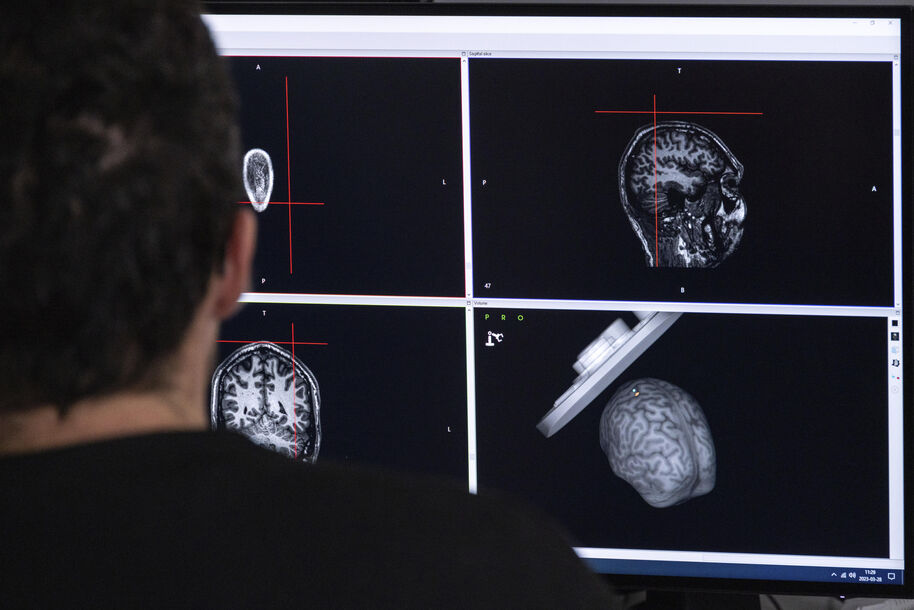
A man watching brain images on a screen
A stimulation coil — or magnetic coil — is placed against the surface of the head; it generates a short TMS pulse, a rapidly changing magnetic field.

Hitting the right nerve

From the patient’s perspective, TMS treatment is remarkably simple: the patient sits in a treatment chair for a few minutes on consecutive weekdays over a period of four weeks.

‘During the treatment, you feel small tapping sensations on your scalp. Afterwards, you may get a headache, but it usually goes away within the same day,’ Gogulski says.

He explains that TMS differs greatly from another effective form of brain stimulation, electroconvulsive therapy (ECT). In ECT, the patient is given a light anaesthetic and an electrical current is used to induce a seizure, which can cause memory problems.

The technological foundation of TMS was established some four decades ago. A stimulation coil, or magnetic coil, is placed on the surface of the patient’s head and  produces a short TMS pulse — a rapidly changing magnetic field. The magnetic field passes through the skull, generating a weak electrical current in the cerebral cortex. The current activates neurons, or nerve cells, in the brain.

What happens when the neurons are stimulated depends above all on where they are located. For example, when TMS is used to map the motor cortex, the stimulation is directed at an area controlling the hand, causing the hand to twitch. The motor cortex can also be targeted when TMS is used to treat neuropathic pain.

When treating depression, the target is the frontal lobe. The aim is for frequently repeated TMS pulses to activate or alter the activity of neural networks in the areas involved in mood regulation. Exactly which areas these are, remains one of the key questions for researchers.

‘The best results have been achieved for depression when TMS treatment has been targeted at an area of the frontal lobe that has a functional connection to the cingulate cortex deeper in the brain.’

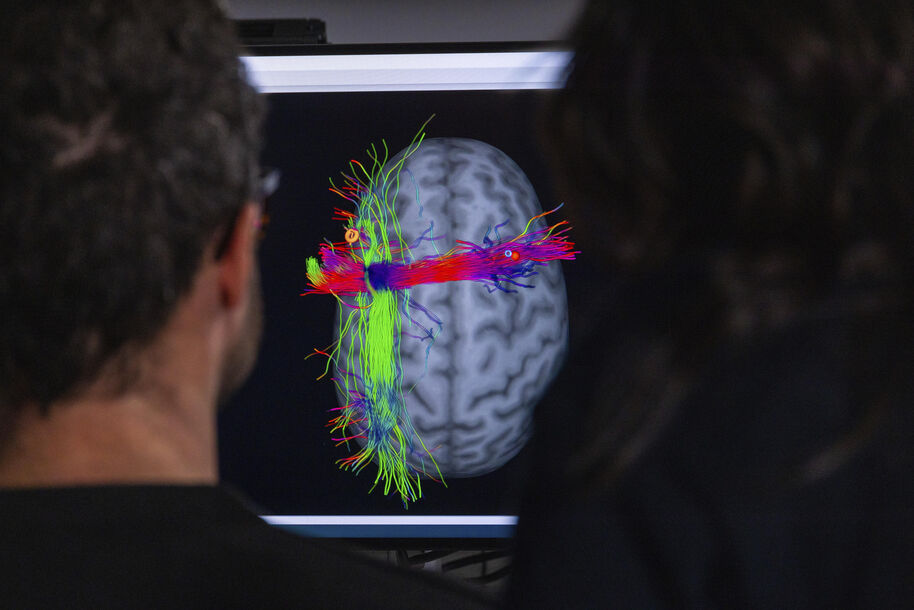
Mies katselee tietokoneruudulta kuvaa aivoista
Magnetic stimulation therapy requires an understanding of ‘brain geography’ to ensure TMS pulses are targeted correctly. In the treatment of depression, the target is the frontal lobe.

Personalised and automated

The target for TMS stimulation is typically found in one of two ways. In some hospitals, magnetic resonance images of the patient’s brain are taken, and navigation software helps identify the desired position for the stimulation coil. In other hospitals, a measuring tape is used to gauge the circumference of the patient’s head and distance between the ears.

‘As strange as it may sound today, good treatment results have been and are still achieved using a measuring tape,’ Gogulski says. There is still room for improvement in navigated TMS, however — enough that Aalto University doctoral researcher Ida Granö is working full-time on automated targeting of stimulation together with her colleagues.

People’s brains differ in their anatomy, and they also respond differently to TMS stimulation, Granö says.

Two people hold a white brain model with blue and red EEG wires attached around it
Granö uses a thin EEG cap.

In her research, Granö uses a thin cap fitted with electrodes that measure the electrical activity of the brain — EEG. When a TMS pulse is delivered through the cap, the researchers can measure the brain’s response: how the brain reacts to the pulse and how strongly. That being said, EEG picks up a lot of interference.

‘The TMS pulse itself creates a large spike in the EEG signal, and it also activates the muscles in the head, which leaves a mark on the EEG. Even blinking affects the signal. So we have to identify the relevant response despite all the interference,’ Granö explains.

The aim is to automatically adjust the location, direction, intensity and timing of TMS pulses during treatment based on the individual’s brain response. This requires algorithms, which are developed not only by collecting measurement data but also by writing code.

For Granö, combining measurement, analysis and coding has been familiar since the early years of her studies. She studied bioinformation technology at Aalto University, joined the TMS research group as a research assistant during her bachelor’s studies and has stayed on ever since.

Around the same time, in 2019, a €10 million EU-funded project brought together dozens of researchers from Finland, Italy and Germany to work on TMS. In Finland, HUS BioMag Laboratory connected Aalto’s research with clinical work.

At Aalto, TMS research brings together expertise in physics, electronics, statistics and mathematics. The group also includes researchers in neuroscience and cognitive science as well as medicine. Granö has also studied neuroscience.

Five stimulation coils for more reach

Conducting TMS measurements requires skill and precision from the researchers – as well as research participants. They do not have to look far for volunteers. 

‘I’m quite a difficult research subject because my brain is further away from my scalp. We always need a really strong stimulation. My MRI scan shows that there’s a lot of empty space in there,’ Victor Souza says with a laugh.

Older man in a chair undergoing brain scan with large white device fixed above his head.
Professor Risto Ilmoniemi often acts as the test subject himself when the research device is being tested.

Souza became familiar with the anatomy of his own head and with TMS while studying medical physics at the University of São Paulo in Brazil. He was drawn to Finland by Professor Risto Ilmoniemi’s reputation in the global TMS community, and he joined Aalto’s TMS research group as a postdoctoral researcher more than eight years ago. He brought with him navigation software he had developed, which the group still uses to target the stimulation coil.

From the beginning, Souza’s research and development work at Aalto has focused on a new-generation TMS device with five coils positioned on top of and overlapping one another. Some of his colleagues began working on the device 15 years ago.

‘The device developed at Aalto is the only multi-coil device in the world that has already been shown to work for brain mapping and demanding neurophysiological research. Commercial devices used in TMS treatment are still mainly single-coil systems,’ Souza says.

When used with an algorithm developed by Granö and her colleagues, the multi-coil TMS device can automatically change the location of the pulses without the device itself needing to be moved. A robotic arm can also be used to move the device with extreme precision.

According to Souza, a commercial version of the device will be ready for the market in 2027. It will be brought to market by the startup Cortisys Oy, founded in 2025 . Souza is the company’s chief technology officer and one of its four founders.

From lab to clinic

TMS has been used especially for mapping the brain, as well as for treating neuropathic pain and depression. Researchers are currently developing its use for treating many other psychiatric disorders, from memory disorders to obsessive-compulsive disorder.

According to Souza, Cortisys plans to start with the treatment of depression and first enter the market where regulatory approval for the device can be obtained most quickly, which means the United States and Europe. For now, the device’s advantages are ease of use and speed.

Souza envisions a future in which a single operator can treat several patients simultaneously and TMS treatment is available wherever patients receive mental health services.

‘TMS could become a first-line treatment for depression instead of being used only after other treatments have proved ineffective,’ Souza says.

Gogulski also believes that the first benefit of the multi-coil TMS device will be the ease and speed made possible through automation.

‘Time will tell how much personalising the treatment can also improve its effectiveness,’ Gogulski says. Of course, every step forward requires a great deal of long-term basic research.

‘It’s useful that I also get to do some practical TMS treatment work in the private sector. That way I don’t disappear completely down the scientific rabbit hole,’ Gogulski says smiling. He also worked with TMS patients while specialising in clinical neurophysiology at HUS. He put his specialisation on hold when TMS research took him to Stanford University for a couple of years and then to Aalto.

Gogulski also studies biomarkers, building on pioneering research by Granö and Pantelis Lioumis, the TMS group’s leader and docent. While Granö aims to use the brain’s response to target the next TMS pulse, Gogulski aims to interpret what the brain’s response tells us about the effects of treatment. He refers to the response as a biomarker. Other biomarkers for him include psychological and psychophysiological observations that could reveal the effects of treatment between sessions, before any change can be seen in depressive symptoms.

‘The development of algorithms and treatment protocols will naturally continue for years while the new device is already in use. And naturally we will also develop the device itself further. At the moment, the five-coil stimulation device is like a large plate. In the future, it could cover the whole head like a helmet — then we could treat any part of the brain,’ Souza says.


 Juha Gogulski

Juha Gogulski

Postdoctoral Researcher, Physician
 Victor Souza

Victor Souza

Researcher, Chief Technology Officer and Founder of Cortisys
 Ida Granö

Ida Granö

Doctoral Researcher

Text: Marianna Salin 
Photos: Matti Ahlgren and Mikko Raskinen / Aalto University

Read more

Mies on selkä päin kameraa, katsoo tietokoneelta kuvaa aivoista.

Playing with the music of the brain

Common neurological disorders like depression and chronic pain can be challenging to treat with conventional methods. An automated version of a long-used brain stimulation technique holds real promise as a reliable and effective drug-free alternative.

News
Illustration of combined TMS and EEG methods

Department of Neuroscience and Biomedical Engineering

We study system-level dynamic functions of the human brain, mind and body.

  • Updated:
  • Published:
Share
URL copied!

Read more news

A black hand touches a tablet screen with white shapes. Papers and a pen are on a pink surface.
Research & Art Published:
Large black letter A and question mark sculpture beside flower pot outside brick building with tall windows
Awards and Recognition, Research & Art Published:

Grants and recognition from the Wihuri Foundation

From Aalto University, 40 individuals or groups received funding in 2026. The largest single grant went to the Ownership Lab for research on ownership. In addition, Tapani Vuorinen received the Wihuri International Prize
Large white satellite dish structure inside a geodesic dome with a pinkish, triangular patterned roof
Research & Art Published:

Making music with the Cosmos: sound art and radio astronomy improvising at the Metsähovi Radio Observatory

Want to know what the origins of a solar system sound like? Scientists joined forces with a sound artist to play with molecular gas thousands of light-years away
Smiling man in a dark suit and glasses stands by a wooden staircase in a bright hallway
Awards and Recognition, Research & Art Published:

Professor Anton Zasedatelev awarded Väisälä grant to study how large particles behave near quantum limit

A better understanding of how macroscopic objects behave could unlock ultra-precise sensors or even help determine if gravity is quantum mechanical.