






From Design Factory’s Partner Plaza to PdP projects: Otos Health builds a medtech solution with Aalto’s support

As the population ages, hearing loss will affect almost all of us. Otos Health, a startup that emerged from Aalto University through Biodesign Finland in 2025, is developing an assessment platform for hearing and cognitive health that aims to integrate early detection, patient triage and continuous monitoring into the clinical workflow. The goal is clear: to free up specialist healthcare capacity and shorten the patient pathway, particularly for age-related hearing loss.
“Starting by looking for the right problem was the best decision we made,” says Otos co-founder and Chief Technology Officer Wycliffe Raduma. “During Biodesign and the R2B project, we realised that this is not a Finnish-specific issue: the larger the healthcare system, the bigger the problem. And globally, the same problem exists in almost every hospital.”
Current hearing diagnostics in specialised healthcare are thorough – and therefore burdensome. Otos’s solution focuses in particular on age-related hearing loss, where the care pathway is well established and hearing aids are often the right solution.
“If primary healthcare could produce a sufficient measurement result, a person with age-related hearing loss could be directed straight to a hearing centre. In an ideal scenario, the results would transfer directly to the pre-programming of hearing aids: the patient would arrive for the fitting, put the devices in their ears and begin, for example, a two-week trial,” Raduma explains. “This would free up specialist healthcare resources for those who truly need a more thorough examination.”
Otos was born from clinical observations made by Biodesign Finland at HUS and began with R2B funding. The company was launched as an Aalto spinout in 2025 and has so far raised more than EUR 1 million in combined private and public funding. The team currently includes three full-time and two part-time employees, and the company also uses consultants flexibly. In addition to Raduma, the company’s founders include Tanja Tervonen, as well as Associate Professor Saku Sinkkonen and Doctor Ville Sivonen, who work at HUS. Nick Freeman, who has significant experience and networks in the US healthcare sector, serves as CEO of Otos Health Inc., the company’s US parent company.
In a clinical study conducted as part of Aalto University’s R2B project, HUS and Aalto studied Otos’s combination of automated hearing testing and digital otoscopy in 2024–2025.
Through Design Factory’s Partner Plaza, space for product development
Raduma originally began studying mechanical engineering at Helsinki University of Technology with the aim of pursuing aeronautical engineering, but ended up in product development through mechatronics. During his studies, he worked, among other places, at ABB and as a product development intern at Philips, working on magnetic resonance imaging equipment. After graduating, he returned to Philips and designed receiver coils for the MR-Linac system, which combines magnetic resonance imaging with radiotherapy.
He later worked at KaVo Kerr Group on the development of dental X-ray equipment, then moved to Pexraytech in Otaniemi to develop portable X-ray devices for the security sector. He then became an entrepreneur and founded his own consultancy. Raduma was also involved in founding Hyperion Robotics, which develops 3D printing for low-emission concrete elements. Eventually, he returned to medical technology through the Biodesign Finland programme.
Otos started from Aalto with an unusual structure: a US parent company and a Finnish subsidiary that owns the intellectual property and is responsible for product development. Aalto is also a part-owner of the company. This connection to Aalto is visible in everyday work through Design Factory’s Partner Plaza programme: Otos can use Design Factory’s facilities, tools and expertise to accelerate prototyping and product development.

“Building our own product development laboratory with our own resources would not make sense at this stage. Design Factory is a familiar environment for us, with familiar tools, familiar ways of working—and a great deal of expertise,” Raduma says. “We can quickly do things that would otherwise take a huge amount of time and money if we outsourced them.”
For Raduma, Design Factory has been a home since his student days: he has participated in the Product Development Project (PdP) as a student, worked as a course assistant and later served as a corporate sponsor. That journey now continues through Otos.
“Things are worth doing boldly. What you don’t know yet, you learn very quickly,” Raduma summarises the shared mindset.
Product Development Project supports product development needs
Otos is a young company, but it is already sponsoring its third PdP project; the first was carried out while the company was still part of Aalto’s R2B research project. The timeline is clearly deliberate: the first project, during the R2B phase, looked far into the future, the second looked closer to the present, and this year’s challenge focuses on an immediate need.
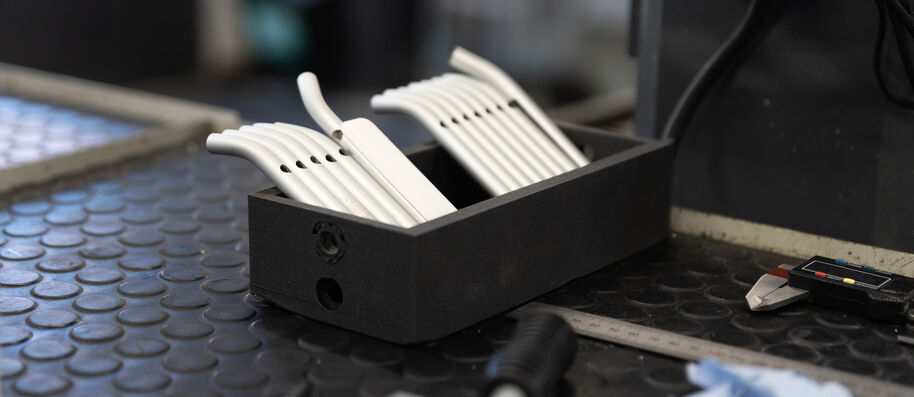
“The current PdP project is very practical,” Raduma says. “Our hearing examination includes imaging the ears. We want to make it easier and more hygienic, so that a nurse can also perform it well without an otolaryngologist’s specialist expertise.” The problem may look simple, but it has proven surprisingly challenging—which is why we need rapid iterations and new perspectives. In that, PdP is excellent.”
Through PdP, Otos also gets to know potential future recruits. “We wanted to get to know new students and see whether we could find future team members while solving a real problem.”
Aalto’s multidisciplinary ecosystem: visibility, peer support and creative storytelling
In addition to Design Factory, Otos has used Aalto Startup Center’s networks, student projects and events. “Being affiliated with Finland’s leading university brings visibility and helps us find talent,” Raduma summarises. The collaboration has also extended into art and media: as part of Aalto ARTS’s Luova Lämpiö research project, a video work based on contemporary dance was created for Otos, in which movement and sound depict the experience of gradually progressing hearing loss. The work was created by filmmaker Antti Ahokoivu, dancer Jukka Tarvainen and sound designer Richard Dunn. “It runs in the background of our website and presents an abstract but understandable story in a unique way.”
Student collaboration began already during the R2B phase. In 2023, Otos took part twice in MIMIR’s Deep Dive event: in the June preliminary rounds, a student team Arctic Elephants won the Otoscreen case and advanced to the September final. The students developed a validation strategy for Otos to test product-market fit and pricing in the United Kingdom. In 2024, student projects based on Otos’s topics were carried out in Aalto’s Life Science Technologies project course, a Hanken course and Aalto University School of Business’s Information Technology Program (ITP) summer programme, where a student team created patient profiles and prototypes for a patient application.
In spring 2024, Otos also brought an assignment to Aalto’s Device Design course and shared its experiences of medical device product development with students. At the same time, a thesis was completed on the usability of hearing examinations for older adults. As a company, Otos has continued along the same line: in 2025–2026, a master’s thesis was completed on the economic viability of hearing testing in US primary care, and in spring 2026, a student team from Aalto’s HealthTech Linkage course developed a model for piloting and launching Otos’s solution. “Student projects have been great. We want to maintain our roots at Aalto. With a small team, we have achieved a lot,” Raduma says.
Wycliffe Raduma, Otos HealthWe are surrounded by an incredible ecosystem that propels us forward.
Why Aalto’s model works
- Problem-driven approach: Biodesign Finland takes teams directly into clinical environments to identify real needs.
- Speed and agility: Design Factory’s Partner Plaza provides access to prototyping spaces, tools and expertise without heavy initial investments.
- Multidisciplinarity and visibility: PdP, ARTS collaborations and Startup Center networks combine technology, design, media and business, and help identify talent.
- Continuity: The same programmes connect alumni, companies and students in shared work year after year.
Read more news

Health x technology: Easier, safer knee surgery with 3D cameras
A 3D camera could guide surgical robots without the need for tracking markers, shortening operations and making them safer.
Aalto and Unite! develop new teaching modules through international collaboration
Aalto joined three other Unite! partner universities to develop 11 shared teaching modules in engineering, cybersecurity, robotics and ethics, bringing new expertise into teaching across the alliance.
Researcher Muhammad Awais to teach and collaborate at TU Darmstadt
Awais will join TU Darmstadt in Germany as a Unite! Visiting Professor, contributing to teaching and research on bio-based materials and strengthening collaboration between the two partner universities.