






Airborne laser scanning reveals where pine marten, stoat and least weasel thrive in pioneering study

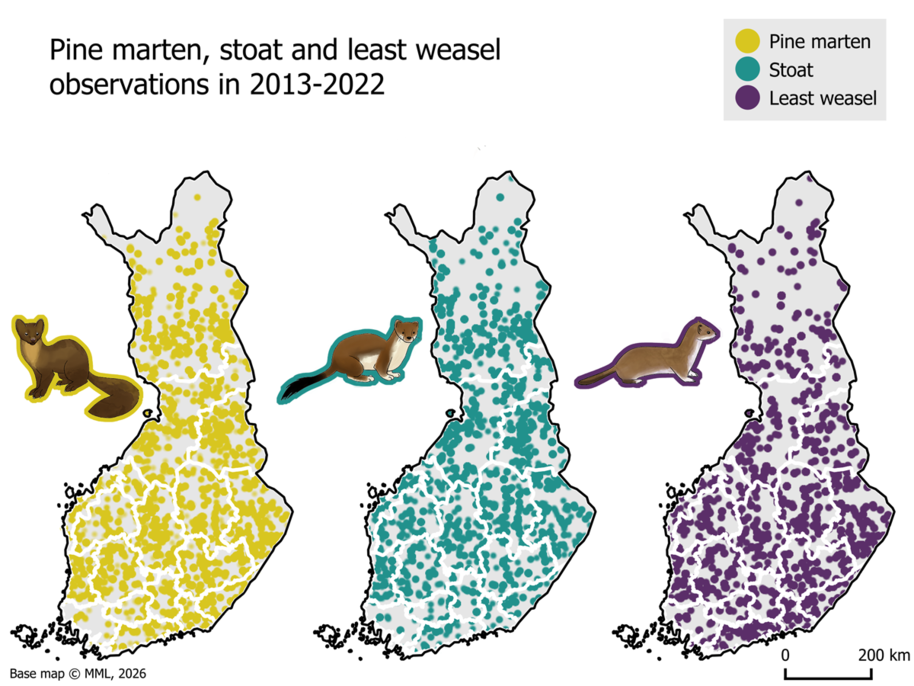
Researchers at Aalto University have, for the first time, mapped the habitats of the pine marten, stoat and least weasel across the whole of Finland. The study, based on airborne laser scanning and animal snow track observations offers unique insights into how forest structure and terrain influence the occurrence of these species.
'Populations of several mustelids have collapsed, and until now there has been no countrywide study of their habitats. Through a new research method, we obtained valuable information that helps identify key habitats for mustelids more broadly than before – and, going forward, assess how changes in land use may affect them,' says Pinja-Emilia Lämsä, a doctoral researcher in geoinformatics at Aalto University.
The study found clear differences between species: the pine marten prefers more mature forests that are dense and multilayered, while the stoat makes use of both forests and more open areas. The occurrence of the least weasel appears to be less tied to forest structure and more to ground-level vegetation.
'The least weasel lives closer to the ground and feeds almost exclusively on voles. The availability of voles may therefore be a more important factor for it than the terrain’s structural features when choosing a habitat,' Lämsä says.
Stoat and least weasel populations have collapsed
According to a report published by the Natural Resources Institute Finland (Luke) in 2024, populations of all three species have declined in many parts of Finland over recent decades. The pine marten population in southern Finland has shrunk to about half of what it was in the 1990s—though it has grown significantly in northern Finland. About 84 percent of Finland’s stoat population and about 70 percent of its least weasel population have disappeared.
This is not merely due to short-term population fluctuation but, especially for the stoat and least weasel, a long-term and pronounced decline, Lämsä notes. The exact cause is not yet known, but potential factors include weakened vole population cycles and changes in forest structure.
'All three live in the wild here and are a part of Finland’s nature. Population decline and ultimately possible disappearance affect interactions among organisms and food webs, which can, in turn, be reflected in vegetation and even the functioning of the entire ecosystem,' Lämsä explains. 'For example, the decline of the least weasel and the stoat may increase vole populations, which could lead to greater damage to young forest stands and thus affect both natural forests and forestry.'
Measuring terrain from the air
In this joint study between Aalto University and Luke, researchers used the National Land Survey of Finland’s countrywide airborne laser scanning (ALS) data, which can be used to produce a three-dimensional model of terrain and forests, including tree height, canopy density and layering, as well as landscape variability.
This forest structure data was then combined with ten years' worth of snow-track data from Luke.
'Airborne laser scanning can accurately depict the structure of habitats – such as forests – linked to the occurrence of many species. In this way, animal habitats can be studied at a larger scale and more efficiently than with traditional field measurements,' Lämsä says.
The researchers stress that strengthening mustelid populations will require more information about the causes of their decline. Future research should focus on combining laser scanning with more detailed information on, for example, vole populations, climate and ground-level vegetation structure.
Contact information
Finland’s smallest large carnivore seeks new forests – remote sensing supports wolverine conservation
Satellite data and snow track surveys reveal that wolverines have returned to Southern Finland. While the national population is growing, the species remains endangered. A new study sheds light on...

Read more news

How can we reinvent ourselves in the face of uncertainty? Five things everyone should understand about embracing the new
In a rapidly changing world, we need the ability to think differently, question what is familiar and recognise new opportunities. Aalto University’s Professor of Practice Nando Malmelin, explains how anyone can develop their openness skills
Peatlands in the Northern Hemisphere are changing – satellite study reveals clear regional differences
The Northern Hemisphere’s peatlands are being reshaped not just by heat, but by moisture, says a unique study––the first to span two decades. Many areas have switched from greening to decline in the 2010s.
The State of Marketing survey: Performance monitoring and budgeting remain relatively weak
Markkinoinnin tila (The State of Marketing) survey opens up important perspectives to the Finnish marketing knowhow and areas for development in marketing