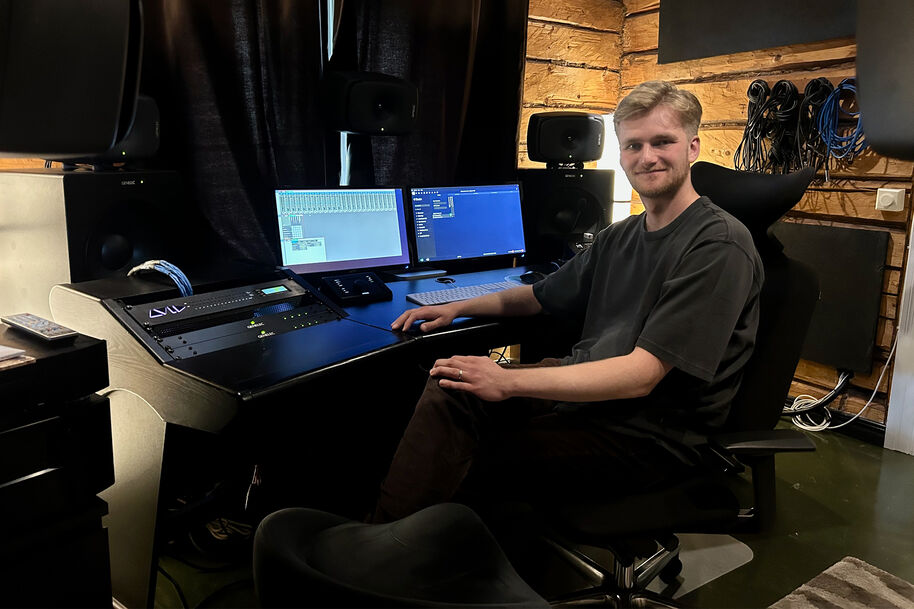
Sound is, at its most basic, vibration. What it means to us emerges when we hear it. That experience is what drew Sauli Norja to acoustics.
‘I’m interested in how different sounds relate to each other, and how you can use them to create spaces and emotions,’ he says.
Today Norja works as a research and development engineer at Genelec, which was his dream workplace even before he started his studies. Genelec is a Finnish loudspeaker and headphone manufacturer, used both for listening to music and for research into sound and hearing.
‘Genelec is an excellent place to work with sound. When I saw their demonstration of immersive audio production, I could see how much the company invests in research and development.’
Norja works mainly at Genelec’s Helsinki office, an old wooden villa in Arabia.
‘Wood is an excellent material for acoustics, as low frequencies pass through wooden walls. This means the room has little effect on sound reproduction.’
Hands-on experience helped him find his direction
His first contact with audio technology came at Vaskivuori Upper Secondary School. As a singer and guitarist, Norja became familiar with recording when the band made its own record. The school had Genelec speakers, and he was impressed by their quality.
‘I wanted our songs to sound the same as the albums of “real bands”. Through recording, I learned to listen to music with fresh ears and wanted to know how sound is created technically.’
When Norja did not get into university on his first attempt, he completed his civilian service at the Vernissa cultural centre. There he gained practical experience as a sound engineer. He applied to study sound design at Uniarts Helsinki’s Theatre Academy and to Aalto University, where he wanted to specialise in acoustics and audio technology.
‘I saw what the everyday life of a freelancer in stage technology is like, and I learned a huge amount from professionals in the field. That was when I decided to apply to Aalto specifically to develop technical expertise. The following autumn I started my studies in electrical engineering at the School of Electrical Engineering.’
A summer job opened the door to Genelec
When it was time to write his bachelor’s thesis, Norja sent Genelec an open application for a summer job. He called the person in charge of product development and was soon invited to an interview. He had a few possible topics in mind but went into the meeting with an open mind.
‘During the interview, Genelec suggested topics they were interested in but couldn’t justify spending extra staff hours on. We found one that suited my skills and interests,’ he says.
The summer job took Norja to Genelec’s factory in Iisalmi, where he worked on automating software system testing. His bachelor’s thesis gave the company useful information on how to make the software easier to test. The project also opened the door to further work in Genelec’s product development team alongside his studies and during later summers.
‘Moving to Iisalmi for the summer was exciting but also relaxing. During the first summer I worked and wrote my thesis. In later summers, I had my evenings free and could enjoy the feeling of being on holiday.’