






Turning bobbin lace into shape-shifting textiles
In bobbin lace making, the paths of individual threads can be precisely controlled. They can meander through the structure and form complex patterns. Using the lace-making technique, the researchers can create active materials that are capable of responding, for example, to changes in temperature.
“Bobbin lace making allows each individual thread to be controlled separately. This gives us the opportunity to create textile structures that would not be possible to produce using traditional weaving and knitting techniques,” says Maija Vaara, doctoral researcher.
Varying the paths of the threads is important when a shrinking thread is added to the textile structure. For a thread to be able to shrink, it needs to have some extra length between its points of attachment. In bobbin lace making, this extra length is created by making the thread follow a winding path. When the thread shrinks, it pulls on the rest of the structure, causing it to change shape.
“Bobbin lace making is particularly interesting because it allows the tesellation of a textile structure to be changed without changing its overall surface area. In this work, we demonstrate how this property can be used, for example, to create a fully textile-based transistor,” says Jaana Vapaavuori, associate professor.
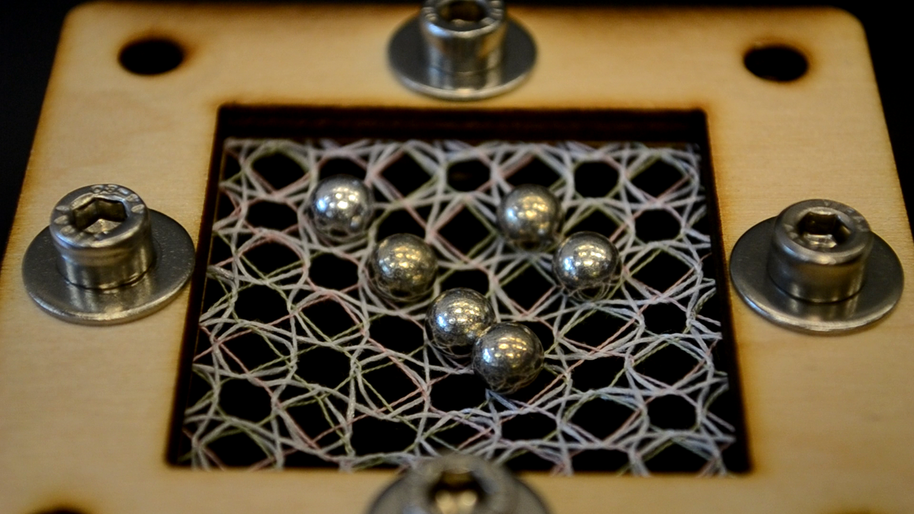
Heat causes the material to change shape
One of the active materials used in the project is a flexible, rubber-like liquid crystalline elastomer (LCE), which contracts when heated and returns to its original dimensions as the temperature decreases. There are also active materials that respond, for example, to moisture or light.
The researchers are particularly interested in how the properties of the material and the geometry of the textile structure work together to affect its behaviour. Computer modelling can be used to investigate how different structures change shape and how the structure can be designed to produce a desired behaviour.
“It is interesting to combine a very old handicraft technique with something genuinely new. We can physically create structures using a traditional craft technique while also modelling the same structures on a computer,” Vaara says.
A range of applications can be envisioned for shape-changing textiles. Structures that respond to temperature could, for example, be used in nets that open and close as needed:
“For example, as extreme weather events become more common, we could in the future design a garment that regulates temperature automatically: in cold conditions, the structure would contract, and as the temperature rises, it would open up. Similar structures could also be envisioned for regulating soil moisture, for example,” Vaara says.
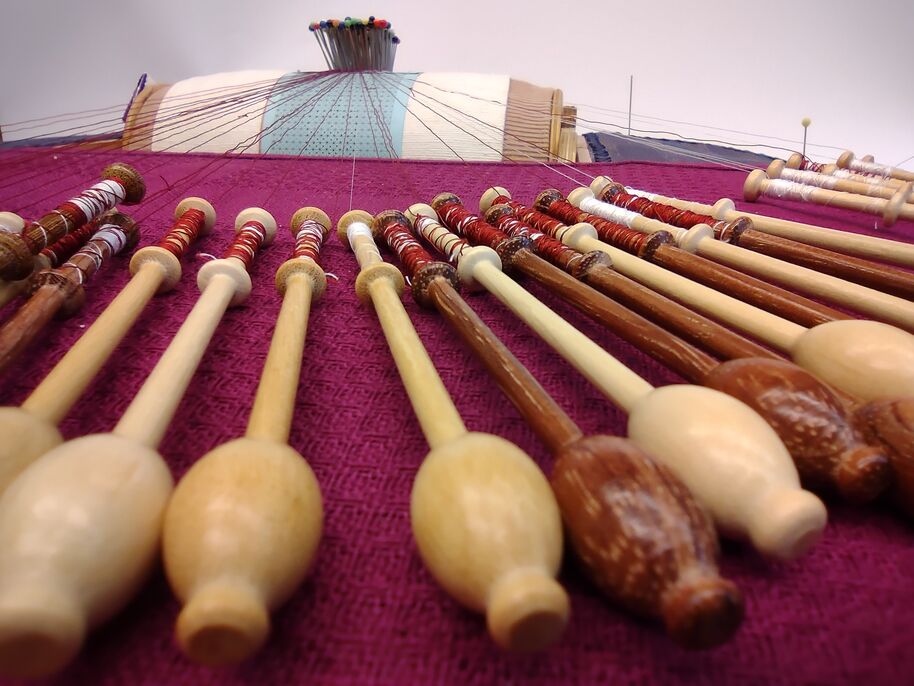
Traditional handicraft skills as a starting point for new research
The use of bobbin lace making in the research stems from Vaara’s interest in traditional Finnish handicraft techniques. She studied craft science and ethnology at the University of Helsinki and joined Professor Vapaavuori’s research group in 2021.
Bobbin lace making originally developed as a way of producing decorative textiles, but its structural versatility is precisely what makes the technique interesting for research as well. Complex structures can be created using even a relatively small amount of material, and the technique provides an opportunity to explore new ways of constructing textiles.
“Because the skill has been preserved, it can also be applied in new ways. So it is not simply a matter that we’re still able to make lace; the knowledge that has been preserved can open up opportunities for new kinds of research,” Vaara says.
Video and photos: Maija Vaara / Aalto University.
Multifunctional Materials Design
Research group led by Prof. Jaana Vapaavuori


Read more news

Is quantum the next AI? Behind the quantum hype
Doctoral researcher Christa Schauman explains how Finland and Europe are faring in a race everyone wants to join – despite its uncertainties.
Health x technology: Magnetic stimulation activates neurons to target depression
Brain stimulation has helped depression patients for years, yet only a small minority can access the therapy. Researchers are now making it easier, faster, and more personalised.
Training available in AI use, research data management, open science + more – register now!
New topics included! Registrations for autumn 2026 are open.