






Textile Chemistry Group Highlights advances in sustainable textile research at Summer Meeting


The event was inaugurated and chaired by Professor Ali Tehrani, Head of the Textile Chemistry Group, who opened the meeting by welcoming participants and highlighting the importance of collaboration and shared knowledge in advancing research. He emphasized that the development of eco-friendly solutions and cross-disciplinary cooperation is essential for reducing environmental impact and accelerating circularity in the textile sector.
Throughout the day-long programme, participants presented a wide range of research covering textile recycling, bio-based materials, functional coatings, smart textiles, and novel processing techniques reflecting the group’s growing focus on sustainability-driven innovation.
One of the central themes of the meeting was the development of bio-based and functional materials for next-generation textiles. PhD researcher Babak Abdi presented his work on bio-based coatings capable of providing electrical conductivity to cellulosic fabrics, offering potential applications in smart textiles. He recently completed his PhD on towards robust electrical heating bio-based textiles.
In the field of sustainable fibres, PhD researcher Olamide Badara presented research on the development of nonwoven materials using environmentally friendly fibre sources. Her work focuses on functional nonwovens derived from post-consumer textile waste and regenerated wood-based fibres.
Visiting doctoral researcher, Chen Ping-Chun, introduced research on CNTs/GNPs/PDMS/Nylon-based e-textile sensors designed to improve long-term monitoring of running biomechanics.
Postdoctoral researcher, Cherni Makrem, presented his work on life cycle assessment (LCA) and Safe-and-Sustainable-by-Design (SSbD) evaluation approaches, contributing to more comprehensive sustainability assessment frameworks for textile innovations.
Doctoral researcher, Elsa Vuorenmaa, presented progress from the SurfToGreen project, which focuses on bio-based surfactants for textile applications. The project aims to develop fully bio-based, high-performance, and scalable alternatives to fossil-based surfactants currently used in textile processing.
PhD researcher, Esubalew Kasaw, introduced eco-friendly hydrophobization strategies using bio-based surface treatments, aiming to create water-repellent textiles without harmful chemicals.
Master’s thesis researcher, Jenna Linnansuu, presented her study on the influence of dye chemical structure on resistance to colour stripping in textile recycling, contributing to a better understanding of dye behaviour in recycling processes.
Circularity and textile recycling were key focus areas throughout the meeting. Postdoctoral researcher, Md. Reazuddin Repon, presented progress from the EU-funded BioSusTex project, highlighting advanced methods for removing colour and elastane from post-consumer cellulose to improve recycling efficiency and material recovery.
Doctoral researcher, Tonmoy Saha, presented research on chemical and wet mechanical processing techniques aimed at improving the quality of recycled textile fibres while also assessing wastewater impacts.
Expanding sustainability beyond textiles, doctoral researcher Ritesh Sharma showcased approaches for valorising agricultural waste into functional treatments for cellulosic textiles supported by FinnCERES. His work focuses on sustainable textile printing using natural dyes and bio-based binders.
Under the TexirC project, doctoral researcher, Shubhajit Dutta, presented the methods for efficiently stripping reactive dyes from textile waste to enable improved textile-to-textile recycling pathways.
Doctoral researcher, Vafa Fakhri, concluded the technical presentations with research on multifunctional bio-based textiles, with a particular focus on textile-based sensing applications that combine performance with sustainability.
In the closing remarks, Professor Ali Tehrani, commended the participants for the breadth and quality of their research contributions. He highlighted how the group’s collective work is pushing the boundaries of circular textile systems, expanding the use of bio-based materials, and reducing environmental impacts across the textile value chain.
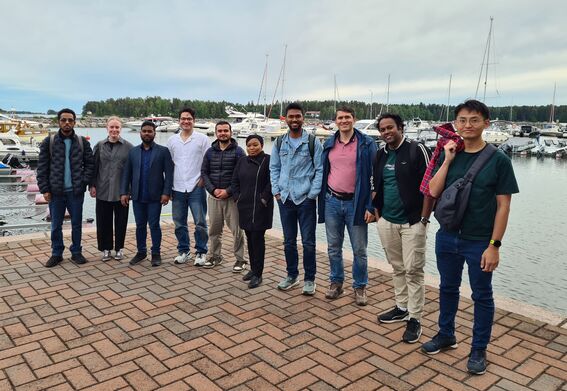
Following the scientific programme, participants continued the day with informal team activities, including a group paintball session, followed by a shared dinner, fostering stronger collaboration and community within the group.

Read more news

Every Step Brings You Closer to the Summit – Join UniSport’s Mount Everest Challenge in HeiaHeia
Students and staff of Aalto University celebrate this year’s Stair Days with a shared journey towards the summit of Mount Everest. UniSport’s new HeiaHeia wellbeing app inspires everyday physical activity, makes wellbeing actions visible and brings the whole community into a shared challenge.
Turn your idea into impact with 100STARTUPS, October 21-22
In October, we bring together students, job seekers, creators, dreamers, and future founders to learn the right tools and methods to start building what you always wanted to bring to life.
Web search is now available in Aalto AI Assistant
Web search is now available in Aalto AI Assistant for GPT-5 and Gemini models, enabling it to use up-to-date public web information for questions that depend on recent or external information.