






Scientific merit and fostering new talent land two major physics prizes

The Finnish Society of Sciences and Letters (Suomen Tiedeseura) presents scientists with annual prizes based on both scientific merit and impact on the scientific community. This year the winners include Professor Päivi Törmä and Professor Jukka Pekola, both prominent and internationally renowned experts in quantum science and technology from Aalto University’s Department of Applied Physics.
Something useful to humanity
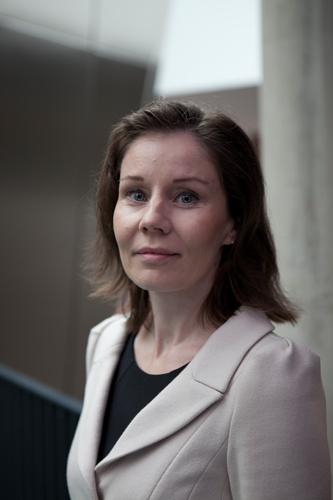
Prof. Törmä received the Professor Theodor Homén Prize in Physics for her wealth of first-class scientific publications in fields like theoretical and experimental quantum physics, nanophotonics, and many-body quantum mechanics. Törmä has more than 250 articles with over 10,000 citations. Of exceptional note is a 2015 article with Sebastiano Peotta, titled Superfluidity in topologically nontrivial flat bands—cited nearly 600 times.
“Working with the talented young researchers in my group has been a huge privilege- I cherish our weekly meetings and discussions to this day. They are a source of joy to me.”
The prize jury also noted Törmä’s securing of prestigious grants, her chairing of and membership in various scientific boards, and prodigious supervising of young talent—a dozen of whom have become professors themselves the world over.
Currently, Törmä not only heads the prolific and pioneering Quantum Dynamics research group at Aalto but also the SuperC collaboration, which gathers quantum experts from Finland, Europe, and the US.
SuperC aims to develop future superconducting materials that may be used in devices that do not dissipate energy as heat. Room-temperature superconductivity has been a grand dream in condensed matter physics for decades. Realizing it would not only slash energy consumption in the ICT sector potentially by as much as 25 percent, but dramatically expand basic knowledge in the field.
“I aim to contribute something useful to humanity. SuperC is fighting climate change. Collaboration is key to our success: I am in a privileged position to work with some of the best talents worldwide. That, and the vital support we receive from our funders and donors, I am immensely grateful for.”
Leader in every sense
Prof. Pekola was handed the Magnus Ehrnrooth Prize in Physics for pioneering work in experimental low-temperature physics. The prize jury indicates Pekola as “among the absolute international leaders” in the field. His scientific track record since 1990’s includes inventing a temperature sensor based on tunnel junctions, using the Maxwell demon for information-based nanoscale cooling, and a breakthrough with photon-based single-mode thermal conduction.
In addition to striking scientific merit, Pekola continues to foster and grow the Finnish quantum community by directing InstituteQ, heading Quantum Technology Finland, an Academy Centre of Excellence, and helping coordinate the research and technological development of experimental low-temperature physics.
The jury singled out his efforts to advance Finnish quantum technology as “substantial and pioneering”, without which Finland’s current international leading position in quantum technology would not have been achieved.
‘I humbly appreciate the recognition of scientific merit, of course, but it is pleasant to see that the work we’ve done to further the Finnish quantum community has also been acknowledged’, Pekola says.
Find out more about the Society’s motivations for each winner here: https://scientiarum.fi/wp-content/uploads/2025/04/Laureates_2025_Prize_Motivation.pdf
The Finnish Society of Sciences and Letters is a 403-member academy founded in 1838 and based in Helsinki. It organizes events, publishes scientific articles, and bestows grants and awards to accomplished scientists from various fields.
More information:
Read more news

Aalto Distinguished Professor Tapani Vuorinen receives prestigious Wihuri International Prize
Over more than four decades of research in wood chemistry, Vuorinen has had a wide-ranging impact on science, industry and society
Maarit Karppinen appointed Academician of Science
Fundamental research into new materials is at the heart of Karppinen’s work. What she is most proud of is her students, whose expertise benefits companies and society.
Making music with the Cosmos: sound art and radio astronomy improvising at the Metsähovi Radio Observatory
Want to know what the origins of a solar system sound like? Scientists joined forces with a sound artist to play with molecular gas thousands of light-years away