






Researchers aim to correct quantum errors at super-cold temperatures instead of room temperature

One of the major challenges in the development of quantum computers is that the quantum bits, or qubits, are too imprecise. More efficient quantum error correction is therefore needed to make quantum computers more widely available in the future.
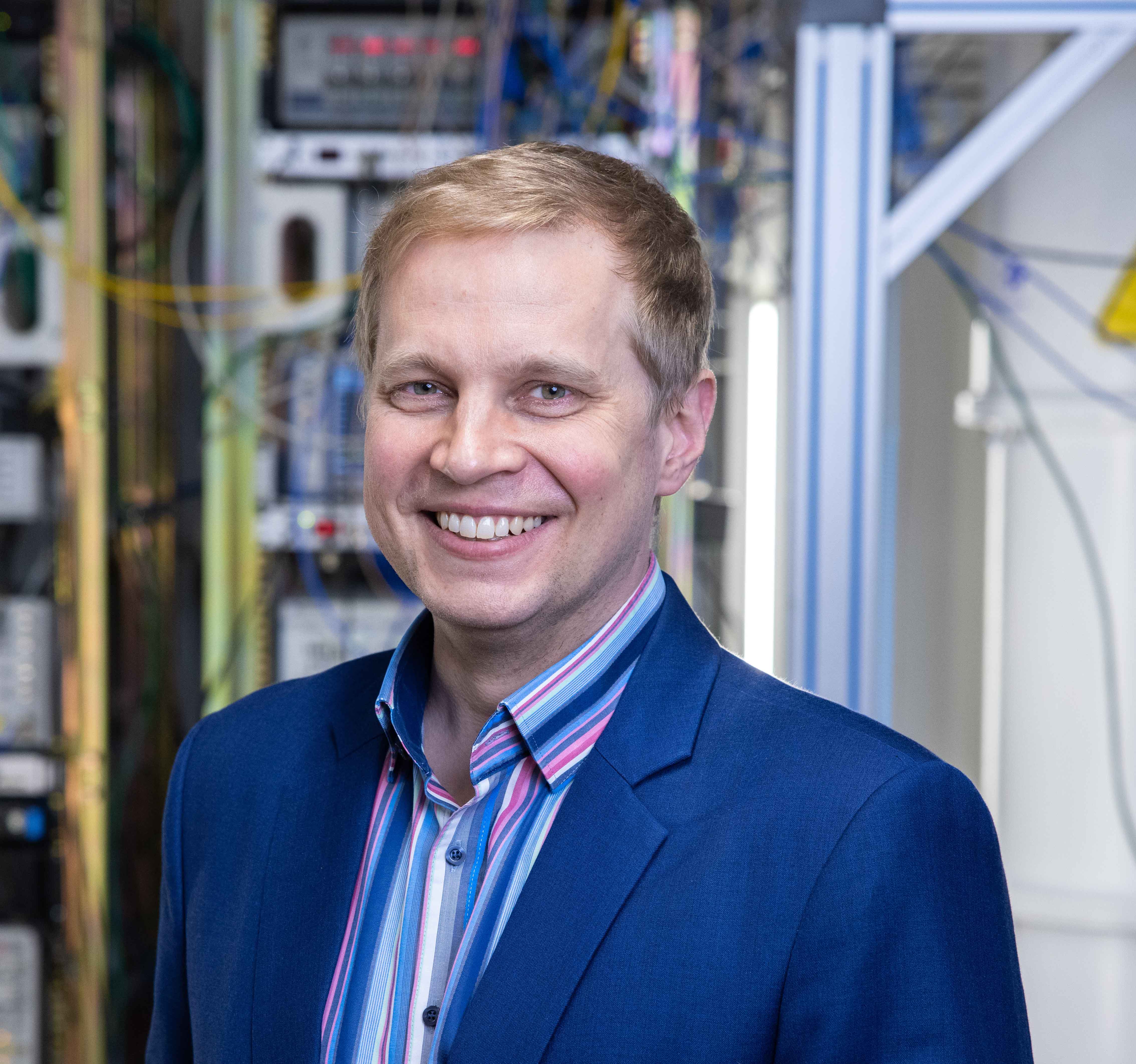
Professor Mikko Möttönen has proposed a novel solution for quantum error correction and has received a three-year grant from the Jane and Aatos Erkko Foundation to develop it.
‘Currently, these errors are read from a quantum processor by bringing the information through cables from -273 degrees Celsius to room temperature for processing by a normal computer,’ says Möttönen.
When the conventional computer figures out what kind of error it is, it sends a control pulse back from room temperature to the quantum processor in the super-cold temperature along similar cables. The whole process is far too slow, and during that time, more errors can be introduced into the qubits. The process also requires special components and is also very inefficient and expensive.
‘In the longer term, the idea is to build an autonomous quantum processor, but in three years we will certainly not yet reach this goal. This whole field is still in its infancy, and the feedback control has never been done at such low temperatures before,’ Möttönen says.

Mikko MöttönenThe pulse would never see room temperature and would therefore be invisible outside the super-freezer, or cryostat.
The initial aim is to build separate components, and to get at least two such separate devices—for example, a pulse source and a bolometer reading out the qubit—to work together with the qubit at low temperatures.
Möttösen's team has already made some progress with the bolometer in the low temperatures, but they still want to improve its reading accuracy.
‘When the readout circuit is right next to the qubits, you can stabilize the qubits, i.e., correct their errors quickly. The pulse would never see room temperature and would therefore be invisible outside the super-freezer, or cryostat.’
Google is also working on error correction with its new Willow quantum computer chip and by increasing the number of qubits. They are, however, reading the pulse at room temperature.
‘We are not competing with companies by correcting errors, but we want to show that we can build a small-scale autonomous quantum processor that can then correct these quantum errors on a larger scale,’ says Möttönen.
The Jane and Aatos Erko Foundation awarded Möttönen's group EUR 1.5 million grant. The long-term goal of the research is to build a fully low-temperature, small quantum computer with much lower energy consumption than today's computers.
Around five new researchers will be recruited at Aalto to tackle this challenge. The research will be carried out using Finland’s national OtaNano research infrastructure. VTT will also be involved in the project by taking responsibility in sample fabrication.
Contact information:
New method of measuring qubits promises ease of scalability in a microscopic package
Aalto University researchers are the first in the world to measure qubits with ultrasensitive thermal detectors

Read more news

Peatlands in the Northern Hemisphere are changing – satellite study reveals clear regional differences
The Northern Hemisphere’s peatlands are being reshaped not just by heat, but by moisture, says a unique study––the first to span two decades. Many areas have switched from greening to decline in the 2010s.
What is quantum tech?
Many of today’s devices would not exist without quantum technology, but the most exciting applications are still on the horizon
Is quantum the next AI? Behind the quantum hype
Doctoral researcher Christa Schauman explains how Finland and Europe are faring in a race everyone wants to join – despite its uncertainties.