News

Research shows that creativity is not only measurable but also a major competitive advantage – the focus now turns to leadership

The multidisciplinary Creative Leap (Luova loikka) co-research project has explored how creativity can be identified, developed, measured, and managed – and how it contributes to business success and the renewal of society.

Creativity is often perceived as an innate talent or something connected to the arts. Yet the World Economic Forum ranks it among the most essential skills for the future of work. In an increasingly complex and rapidly changing world, organisations need new ways to respond to uncertainty, technological disruptions, and the challenges of sustainable development.

Creativity enables people to view problems from new perspectives and to discover solutions that might otherwise remain unseen. However, organisations have traditionally struggled to harness it systematically, as measuring and managing creativity have long been considered challenging.

The two-year Creative Leap: Creativity as a Competitive Advantage in Business project, funded by Business Finland and Next Generation EU, brings together researchers from several disciplines at Aalto University and co-research partners including Fiskars, Kemira, Marimekko, Posti, Raisio, and Yellow Method. Together, they have generated new knowledge on how creativity influences organisational culture, financial performance, and employee wellbeing.

Supporting creativity – or holding it back

The research provides scientific evidence that creativity can be measured. This opens new possibilities not only to make creativity visible but also to turn it into tangible action within organisations, says Researcher Susanna Rahkamo, who has studied individual and organisational creativity with Professor Mark Runco, a leading US cognitive psychologist and Visiting Professor at Aalto University.

Their findings show that creativity can be measured in concrete ways – and that it correlates directly with key business performance indicators. According to Rahkamo, the study also revealed vast, untapped creative potential within companies.

‘When time and resources are scarce, doing something new becomes almost impossible. Structural barriers, a culture driven by efficiency, and low tolerance for risk or serendipity hold creativity back. Creative ideas often fail to turn into action – and that’s where leadership becomes a decisive factor,’ Rahkamo explains.

The study also identified key enablers of creativity in organisations, such as a psychologically safe work climate, active knowledge-sharing, and a strong commitment to renewal.

‘The bottleneck is not in individuals’ creativity, but in organisations’ ability and leadership capacity to support and utilise it,’ Rahkamo summarises.

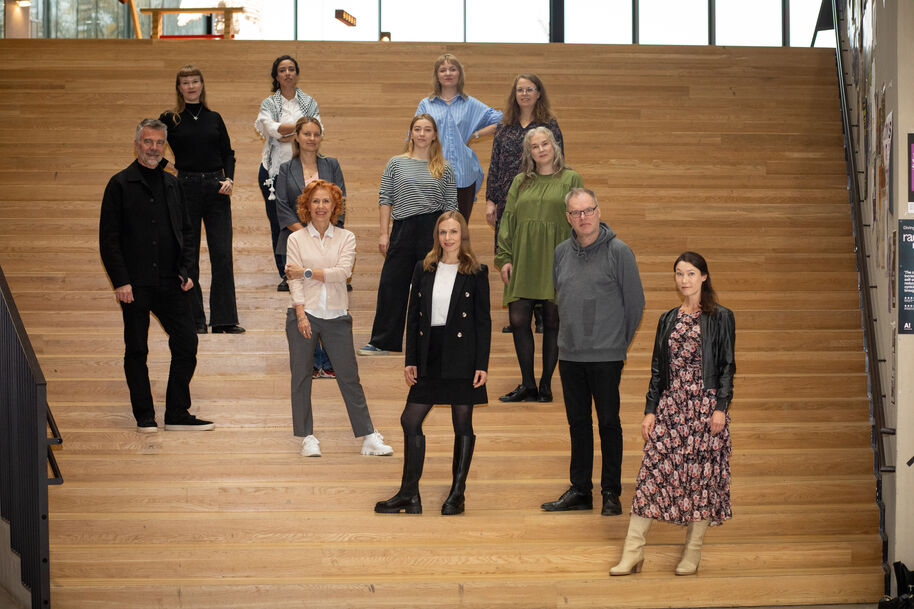
A group of people standing on wooden steps indoors. They are wearing casual and semi-formal clothing in various styles. Group is of Creative Leap research team.

Creativity emerges in everyday encounters

Another part of the project examined how leadership and organisational culture shape creativity. The results show that creativity thrives in organisational cultures that genuinely value and nurture diverse ideas – regardless of who brings them forward.

The researchers found that creativity often arises in informal, everyday encounters: conversations around the coffee table, during lunch breaks, or between meetings – not only in official sessions where ideas are expected to appear.

‘It’s in these informal moments that the “magic” happens – they create fertile ground for creativity. Spontaneous discussions, humour, and a shared understanding that uncertainty and even failure are part of the process all help to disrupt the linear, efficiency-driven rhythms of work. That’s when creative ideas are most likely to emerge and flourish,’ says Postdoctoral Researcher Ana Paula Lafaire.

While creative insights may sometimes emerge by chance, organisations can deliberately foster cultures that support creativity – for example, by strengthening a sense of belonging, psychological safety, and curiosity, and by creating collaborative spaces and practices, from coffee rooms to car parks.

‘The task of leadership is to strengthen a culture built on shared purpose and genuine interaction – enabling people to feel seen and heard,’ adds Assistant Professor Astrid Huopalainen, who led this part of the project.

Leadership – the strongest driver of creativity

One of the project’s central questions was whether individual and organisational creativity correlate with financial success. This was studied in Professor Matti Rossi’s research group, which also included Professor Eeva Vilkkumaa.

Among the companies examined, those with higher-than-average individual creativity and creativity-supporting culture were more likely to outperform their industry peers financially. Conversely, companies scoring lower on both creativity measures tended to underperform.

‘The results show that the link between a creativity-supporting organisational culture and financial success is even stronger than the link between individual creativity and success,’ says Vilkkumaa.

Leadership proved to be a critical factor in achieving such a culture – helping reduce the risk of underperformance. While high individual creativity can partly compensate for weaker leadership, strong leadership alone is not sufficient.

‘Leadership is the single strongest factor enhancing creativity. Yet if leadership is strong but the organisational climate does not support creativity, the company still performs worse – good leadership alone is not enough,’ Vilkkumaa concludes.

Creativity as a survival toolkit

The findings offer valuable insights for organisations seeking to strengthen creative culture, invest in renewal, and build sustainable competitive advantage. They also provide guidance for policymakers and educators on how creativity can be promoted more broadly across society.

Participating companies highlighted that creativity is no longer a “soft skill” or a nice-to-have – it’s a survival toolkit.

‘Creativity keeps companies relevant, agile, and in tune with the times. The world around us is constantly changing, and through creative thinking companies can stay one step ahead – reading and responding to both megatrends and micro-signals. In the future, creativity will have a central role in business,’ says Janni Vepsäläinen, Creative Director of Iittala, part of Fiskars Group.

Creativity may well become a defining factor in Finland’s global competitiveness – not only within individual companies but also in society’s overall innovativeness, resilience, and wellbeing.

To further strengthen these skills, Aalto University has launched a free online course, Diving into Radical Creativity, open to professionals, students, and lifelong learners alike. In addition, the documentary film Radical Creatives can be booked for screenings in organizations and communities. The film is subtitled in several languages, including English, Swedish, Spanish, and Japanese.


A group of people standing on wooden steps indoors. They are wearing casual and semi-formal clothing in various styles. Group is of Creative Leap research team.

Creative Leap: Turning Creativity into a Measurable Competitive Advantage

Over two years Creative Leap co-research project has explored how creativity can be identified, developed, measured and managed, and how it influences not only business success but society at large.

News
Text 'Creativity as a Competitive Advantage in Business', date 12.11.2025, logo of Aalto University, abstract background.

Creativity as a Competitive Advantage in Business

In a world defined by change, creativity is needed more than ever to renew, to create new solutions and to innovate. New Aalto University research shows that creativity-promoting leadership is a crucial component for companies' financial success.

Events
Aalto Radical Creatives, Photo: Lina Jelanski

Creative Leap: Creativity as a competitive advantage in business

The co-research project researches creativity as a competitive advantage and explores if creative approaches correlate with financial success

School of Arts, Design and Architecture
  • Updated:
  • Published:
Share
URL copied!

Read more news

A modern school building with a playground, surrounded by greenery under a partly cloudy sky.
Press releases, Research & Art Published:

Study: Wood is a more cost-effective building material than concrete when emissions are monetized

The costs of the wood-built school and sports hall in Myrskylä were compared to a reinforced concrete alternative — and wood proved clearly more economical when environmental impacts were assigned a monetary value.
Members of the Urban Policy Council.
Cooperation, Research & Art Published:

The Urban Policy Council’s First Report: Qualified Early Childhood Teachers Are More Common in Socioeconomically Advantaged Areas

The Urban Policy Council’s first report examines educational segregation in the Helsinki capital region and raises critical questions for municipalities.
A small satellite with black panels and a red tag that reads 'REMOVE BEFORE FLIGHT' on a grey background.
Press releases, Research & Art Published:

Finland’s Foresail-1p science satellite successfully launched into space

The Finnish science satellite Foresail-1p was successfully launched into space after 8 PM Finnish time on Friday 28 November 2025, aboard the Transporter-15 mission from Vandenberg Space Force Base, California.
A 3D structure with green spheres interconnected by a grey mesh, set against a multicoloured background.
Research & Art Published:

A paradigm shift: machine learning is transforming research at the atomic scale

Assistant professor Miguel Caro and his research group use and develop machine learning tools to accelerate discoveries from simulation to experiment