






Prestigious Faraday Medal acknowledges circular economy trailblazer Mari Lundström

The Royal Society of Chemistry presented the Faraday Medal in Electrochemistry to Mari Lundström, Professor of Hydrometallurgy at Aalto University, at a ceremony in York (UK) on 24 August.
The prestigious award recognises a mid-career researcher working outside the UK and Ireland for outstanding contributions to research and innovation in electrochemistry. The international honour is named after self-taught English physicist and chemist Michael Faraday (1791–1867), the inventor of the electric motor and the first person to discover electromagnetic induction.
The international honour acknowledges Lundström’s pioneering work in hydrometallurgy, specifically in sustainable electrochemical processes for the recovery and recycling of critical raw materials. Electrometallurgical processes can provide new refining routes when low-grade and more impure raw materials need to be processed, while simultaneously decreasing the dependence on chemical intensive processing. Many of the chemicals are imported from outside Europe, whereas electricity can be generated locally, often from renewable energy sources.
‘Europe currently consumes around 20% of the world's metals but produces only a few per cent of them. Therefore, strengthening Europe's competitiveness and self-sufficiency in mineral processing and metal recycling is of high importance,’ Lundström says.
The green transition brings a growing demand for metals. ‘Metal production will always have environmental impacts, and our responsibility is to make it as sustainable as possible rather than shifting the processing – and its consequences – to someone else's backyard,’ she says. Lundström is the first Finnish researcher to receive the Faraday Medal, with previous recipients including Millennium Technology Prize winners and scientists who supervised future Nobel laureates.
Mari LundströmStrengthening Europe's competitiveness and self-sufficiency in mineral processing and metal recycling is of high importance.
Towards more efficient metals recycling
One of the most significant innovations in Professor Lundström’s research is the patented Electrodeposition-Redox Replacement method (EDRR). Unlike conventional separation methods, EDRR uses electricity instead of chemicals to separate metals. It can recover precious metals like gold, silver and platinum from ores and recycled materials at extremely low concentrations––well beyond those of conventional separation methods––and without the need for volatile chemicals.
Alternating between the forced electrochemical reactions traditionally used in metal separation and spontaneous electrochemical reactions, the approach enables efficient recovery of critical materials. The method is a remarkable step towards more efficient recycling of critical resources.
The underlying principles of EDRR have for some time been applied in materials science, particularly for producing coatings. However, in 2015 Lundström and Kirsi Yliniemi, Senior University Lecturer at Aalto University, were the first to explore its potential for metal separation. Over the years, together with their colleagues, they further developed the technology, securing several patents. In 2022, Lundström co-founded Elmery, a spin-out company commercialising the technology and continuing its development with industrial partners around the world.
A creative playground for research
Professor Mari Lundström began a career in industry while completing her doctoral studies. She earned her Doctor of Science (Technology) degree from the Helsinki University of Technology,(now part of Aalto University), in 2009. She came to Aalto University in 2015 to lead research in hydrometallurgy.
Lundström has published more than 200 scientific papers and founded BatCircle, Finland's national circular economy ecosystem for battery recycling, which brings together research organisations and industry. She also serves as its principal investigator.
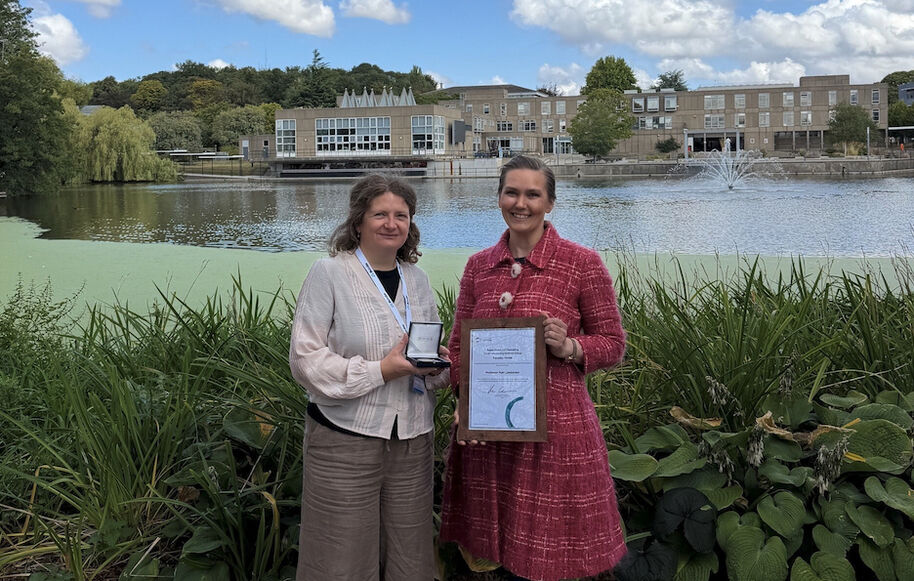
‘The deeper you go into research, the more fascinating it becomes. It feels like play to me – much like jazz improvisation for a top musician,’ says the award-winner. ‘I’m delighted to receive this honour, which serves as acknowledgement of how important developments in this field are. Without new research and expertise, we simply won't have enough metals to meet even today’s needs, let alone support the green transition.’
The Faraday Medal for electrochemistry has previously been awarded to, among others, Millennium Technology Prize winner Michael Grätzel and Heinz Gerischer, the doctoral supervisor of Nobel Prize-winning chemist Gerhard Ertl.
See the full list of previous Faraday Medal recipients here.
Battery demand is growing exponentially – BATCircle3.0 provides a leap in battery material and recycling research in Finland
The three-year BATCircle3.0 project, led by Aalto University, offers a strategic focus on new openings for battery materials refining and battery recycling.

Read more news

Aalto Distinguished Professor Tapani Vuorinen receives prestigious Wihuri International Prize
Over more than four decades of research in wood chemistry, Vuorinen has had a wide-ranging impact on science, industry and society
Maarit Karppinen appointed Academician of Science
Fundamental research into new materials is at the heart of Karppinen’s work. What she is most proud of is her students, whose expertise benefits companies and society.
Professor Anton Zasedatelev awarded Väisälä grant to study how large particles behave near quantum limit
A better understanding of how macroscopic objects behave could unlock ultra-precise sensors or even help determine if gravity is quantum mechanical.