






Peatlands in the Northern Hemisphere are changing – satellite study reveals clear regional differences

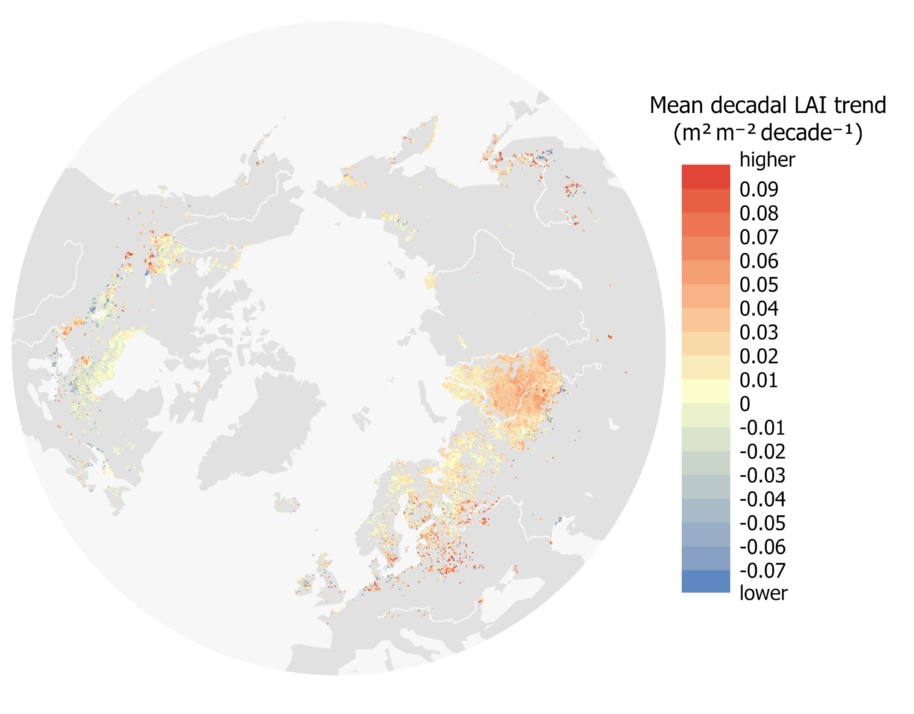
Northern Hemisphere peatlands store vast amounts of carbon, and climate warming can alter their vegetation in ways that affect this carbon stock. In a recent study led by Aalto University, satellite imagery was used to examine increases and decreases in leaf area, or the greening and browning, of peatland vegetation north of 45°N throughout 2001–2023.
‘For the first time, we were able to monitor peatlands this broadly over more than 20 years and to see changes even in areas where observations are otherwise very scarce. We found that changes in northern peatlands vary by region. In some areas the vegetation has greened, in others it has browned, and in many areas the direction also changed during period studied,' says Professor of Remote Sensing Miina Rautiainen from Aalto University.
During the monitoring period, 77 percent of peatland areas in the Northern Hemisphere showed local increases in leaf area, meaning greening occurred in many more places than browning. However, when regional variation and the magnitude of change were taken into account, there was no significant net increase in leaf area at the scale of the entire study region.
Greening and browning tell us a peatland is changing, but they do not directly indicate whether it is storing more carbon, Rautiainen says.
'Greening can, for example, reflect an increase in shrubs, grasses, or trees—sometimes at the expense of Sphagnum mosses that are crucial for peatland carbon stocks. On the other hand, browning can indicate, for example, tree mortality, drought or insect damage.'
Satellites enabled a pan-northern assessment
The researchers used a more than 20-year, multi-satellite time series of the leaf area index (LAI), which quantifies the amount of green leaf area in the vegetation canopy.
‘This was only possible through satellite-based remote sensing. Ecologists have long made field observations of vegetation change across ecosystems, including peatlands. But field studies can never cover such vast and hard-to-access areas, all the way to remote regions of Russia,’ Rautiainen notes.
In most of the studied areas, leaf area changed steadily in the same direction over the full 23-year period. In some areas, however, the trend reversed at some point. The turning points often coincided with shifts in the Pacific Decadal Oscillation (PDO), a long-term phenomenon of climate variance over the Pacific.
‘During the monitoring period, greening was strongest in southern West Siberia, Central Europe and southern Fennoscandia, whereas browning was more common in North America. The timing also varied: in many parts of Europe, Northeast Asia and Canada, leaf area increased into the early or mid-2010s and then started to decline,’ Rautiainen says.
Peatlands are sensitive to changes in moisture
According to the researchers, climate change and natural climate variability intertwine in the dataset spanning more than 20 years. Northern peatland vegetation does respond to climate, but the response is not a simple consequence of warming: the changes on peatlands were more closely related to moisture conditions than to temperature alone.
‘Peatlands are ecosystems governed above all by hydrology. If a peatland dries, its vegetation and carbon cycling can change drastically. The importance of moisture is especially pronounced in northern peatlands, where fluctuations in the water table can determine whether vascular plants, shrubs, and trees spread, or whether the peat-forming Sphagnum mosses persist,’ says researcher Iuliia Burdun, who now works at KU Leuven.
The researchers emphasise that changes in northern peatlands should not be interpreted as simple greening. Rather, they are moisture-sensitive and regionally variable phenomena influenced by both local vegetation composition and climate variability over multiple decades.
Follow-up studies need more detailed information about what satellite-detected greening or browning actually indicates about peatland condition in different regions. Therefore, satellite observations should be complemented with data on peatlands' hydrology, plant species and history of disturbances, such as drainage, fires, permafrost thaw or the drying of small water bodies.
This study is linked to the Research Council of Finland’s Centre of Excellence in Peatlands, Climate Change and Ecological Restoration.
Read more:
Contact

Read more news

Prejudices are more complex than stereotypes suggest
According to social psychologists, individuals who belong to one’s own group, as well as those associated with highly esteemed and approachable groups, more often elicit admiration or respect compared to those who belong to less esteemed or perceived-as-distant groups. New brain research shows that the emotions people evoke depend not only on the social group, but also on the emotional expression and the distance from the viewer.
Government support can help SMEs internationalise – but it can also become a ‘golden cage’
Governmental support can end up undermining the internationalisation, new research shows.
Your home’s energy performance is already affecting your mortgage – soon climate risk will too
European banks are already taking into account energy performance when they make loan offers, finds a new study.