






Outdoors areas and pedestrian routes will be improved near Otakaari 1 and Dipoli

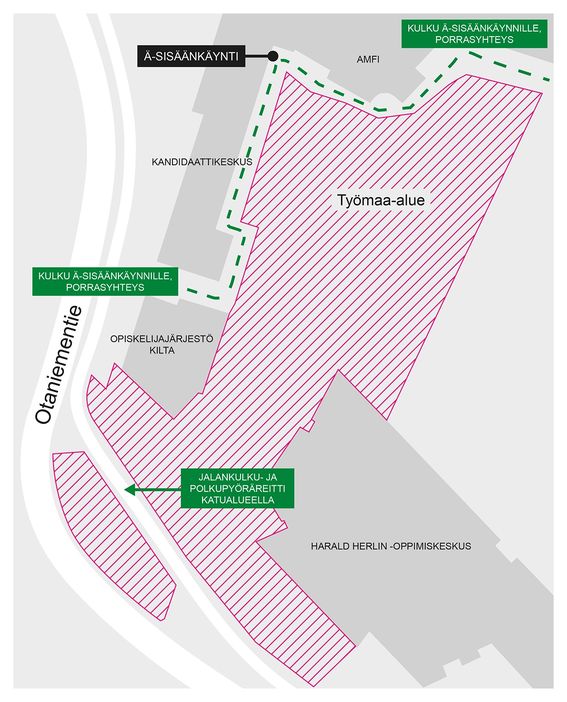
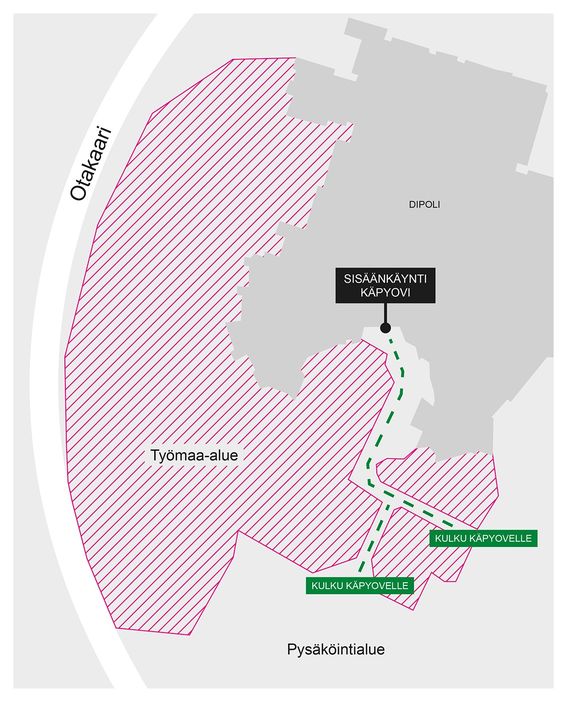
During August, two landscape construction projects will be carried out on the Otaniemi campus. Projects are to develop the route from the metro to Dipoli, as well as the Amphitheatre Square area between Undergraduate Centre and Learning Centre. The projects will be completed during 2022.
A linear access route from the metro and the shopping centre A Blanc to Dipoli will be built. In addition, the comfort of the area will be further enhanced by adding more vegetation and benches and by enabling e.g. presentation of works of art. Connections and opportunities for the Amphitheater Square, which serves as one of the campus's key green areas, will be improved and the area's biodiversity will increase. The projects will also improve the lighting of the areas.
Both projects respect the original plans of the areas as well as the cultural-historical significance. In addition to Aalto University, others involved in the planning were the The Finnish Heritage Agency, the Alvar Aalto Foundation and Pietilä Arkkitehdit Oy. The building permit for the projects has been granted by the City of Espoo. Construction sites will be demarcated and walking will be directed to emergency routes guided during construction.
More information:
Pauliina Skyttä, Campus architect, pauliina.skytta@aalto.fi
Aapo Pihkala, Project Manager, sustainability and landscape, aapo.pihkala@aalto.fi
Routes and construction areas near Amfitheatre Square and Dipoli.
Read more news

Damask expands services at A Bloc: now a full-service hair salon for everyone
In addition to its popular barber services, Damask now also offers full hair salon services for women.
Aalto Distinguished Professor Tapani Vuorinen receives prestigious Wihuri International Prize
Over more than four decades of research in wood chemistry, Vuorinen has had a wide-ranging impact on science, industry and societyWebinar series on neurodiversity
The webinar series consists of three webinars during autumn 2026, focusing on the neurodiversity in higher education and work life.This English-language three-part webinar series explores how neurodiversity can be better understood and transformed into a strength for individuals, teams, and organizations.
