






Open Access Publishing Is the Predominant Publishing Method at Aalto University – From 13% to 82% in Eight Years

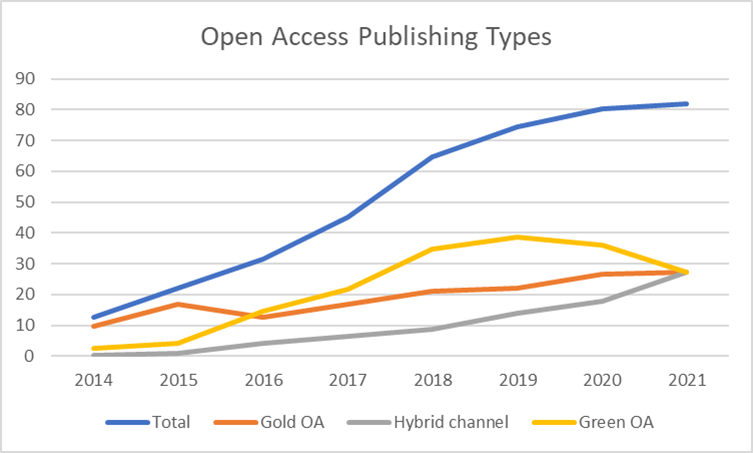
Aalto University published its first open access recommendation in 2014. The recommendation was impactful: the open access publishing % of all peer-reviewed scientific publications rose from 13% in 2014 to 22% in 2015.
The next step was to mandate the publishing of scientific publications in green open access. In 2018, the former vice president of research, professor Tuija Pulkkinen, required that the final accepted manuscripts of all peer-reviewed scientific publications should be parallel published in ACRIS, Aalto’s research information management system. As a result, the percentage of open access publications rose from 65% in 2018 to 75% in 2019.
In 2019, The Ministry of Education and Culture in Finland decided that it will start paying a 1,2 coefficient for open publication from 2021 onwards. In addition, in 2020, Aalto University published a comprehensive Open Science and Research Policy. These changes had a minor impact: the percentage of open access publications from all publications rose from 80% in 2020 to 82% in 2021.
The figure below shows the percentage of open access scientific publications of all scientific publications and its steady increase – although at decreasing speed in recent years.
A big change is the proportions of open access types. The current open access agreements apply mostly to hybrid journals, thus, hybrid open access is likely to become the most common type of open access publishing in the future.
The article continues after the picture.
According to Plan S, transformative journals (hybrid journals in which it is possible to buy articles open) should be flipped to open channel journals by the end of 2024. We are eagerly awaiting if this actually occurs. To add to the uncertainty, we will have two definitions of open access publishing, especially regarding green open access. The Ministry of Education accepts publications as open publications with embargoes and without a CC BY license whereas Horizon Europe demands immediate open access with a CC BY license. We are still awaiting the Academy of Finland’s definition of green open access.
More information on open access publishing development is available for Aalto users: Open access publications - Power BI Report Server.

Read more news

Shimmering Success: Aalto Acoustics Lab team wins Best Paper at DAFx 2026
The paper reimagines the popular 'shimmer' effect, known for its ethereal, pitch-shifted ambience
What does ‘quantum’ mean?
Two quantum researchers at Aalto University explain how the seemingly impossible becomes a part of everyday reality.Samu Taulu develops next-generation brain imaging methods
Associate Professor of neurostimulation and neuroimaging Samu Taulu develops more precise methods for understanding the brain