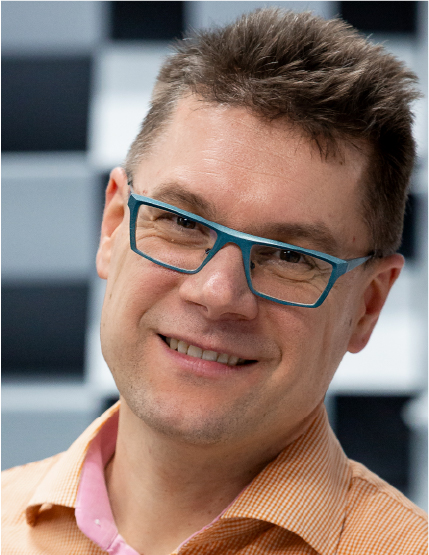
This autumn, excitement in Turku peaked as the Fuuga Music Centre opened to the public. Aalto University Professor Tapio Lokki served as the client advisor forFuuga’s design, and the hall’s soundscape was carefully refined using findings from Lokki’s research group. Lokki’s virtual acoustics groupis especially known for its research on concert hall acoustics.
The project shows how translating basic research into practice is long‑term work that may require the researcher’s direct involvement beyond the university. Lokki articulated the acoustical objectives for Fuuga’s designers, and it is exceptional that the latest scientific findings were so broadly considered in the design – especially since many aspects of acoustics cannot be measured objectively. The result is acoustics that can compete with the world’s best concert halls. The opportunity was unique, as new concert halls are rarely built in Finland (Sibelius Hall 2001, Helsinki Music Centre 2011, Fuuga 2026). Design and construction typically take 5–10 years.
Rich timbre and warm bass
Fuuga’s designers paid particular attention to three findings from Tapio Lokki’s research group. The first concerns early reflections – sound waves that bounce and arrive within 100 milliseconds of the direct sound. According to Lokki, his group’s studies have confirmed which kinds of early reflections create a strong, clear, and intimate sonic image.
’The acoustic designers optimised early reflections for every seat in the hall using computer models. The acoustics consultants who designed Fuuga, Finnish company Akukon and Belgian company Kahle Acoustics, have followed my group’s work since 2010 and have carefully read the scientific articles published by my team,’ Lokki says, adding:
’In fact, most Finnish acousticians have been trained at the Aalto’s Acoustics Lab.’
The second important research result considered in the design concerned sound diffusion, meaning the even spreading of sound. In Fuuga, diffusion was achieved with curved surfaces that preserve the phases of harmonic frequencies – that is, the overtone series – intact. The basic principle is that sound reflections preserve the overtone series characteristic of each instrument, which helps with clarity and richness of timbre.
’In our articles we have shown that when sound reflects from flat or curved surfaces, the brightness and clarity of music are better preserved. This is new information and sets Fuuga apart from almost all concert halls in the world, because the commonly held belief is that concert halls should have sound-scattering surfaces, so-called diffusers,’ Lokki continues.
Acoustics are influenced not only by the building’s surfaces but also by its interior. The third essential research finding had to do with the height and design of the seat backs – in particular, whether sound can pass beneath them. These features have a clear effect on bass frequencies.
’Based on extensive measurements and modelling, we have demonstrated how the design of the seats and the rake of the seating affect low frequencies. Fuuga’s seats and the slope of the floor were designed to minimise attenuation of low frequencies. This is one reason the hall now has a warm and hefty bass sound. Of course, the stage structure, as well as the mass and stiffness of the walls, also play a role,’ Lokki explains.
Among the best concert halls
The project was the first of its kind for Lokki, as he had not previously been so comprehensively involved in the design of a concert hall. He says the job was both very interesting and rewarding, albeit time-consuming. The project also sparked a new inspiration for research into concert hall acoustics and generated new research ideas. The excitement is not diminished by the fact that the hall has been a great success.
’The hall turned out absolutely amazing! Our goal was a warm and bright sound and a clear, intimate, and enveloping sound. The hall responds to the orchestra’s dynamics from the quietest pianissimos to thunderous fortissimos. All the reviews of the first concerts have been glowing, and both musicians and journalists are thrilled. Once we get visiting orchestras into the hall, its reputation will spread worldwide. I can proudly say that Fuuga easily ranks among the top ten concert halls in the world,’ Lokki says.
More information