






From research to resilient energy systems: Halide Energy accelerates battery development at Aalto Design Factory

When a growing deep-tech company needs a custom component in days rather than weeks, access to the right tools and people can make a meaningful difference. For Halide Energy, an Aalto University spinout developing sustainable Copper Flow Batteries, Aalto Design Factory has become a place where ideas can be tested, problems solved, and prototypes improved at the pace that product development demands.
Halide develops cost-effective, high-performing, and sustainable Copper Flow Batteries for grid-scale and industrial users. The company aims to help energy-system operators meet long-duration storage and resiliency needs while reducing lifetime costs and improving operational profitability.
Halide’s team describes itself as moving “from researchers and students to founders,” reflecting how the company grew directly out of university collaborations, with origins in the Horizon 2020 CuBER project. As the research progressed, the team’s ambition shifted from developing knowledge to creating a scalable product. The company formally began operating at the beginning of 2025. Now a team of around eight people, it brings together chemical, mechanical, and electrical engineering expertise.
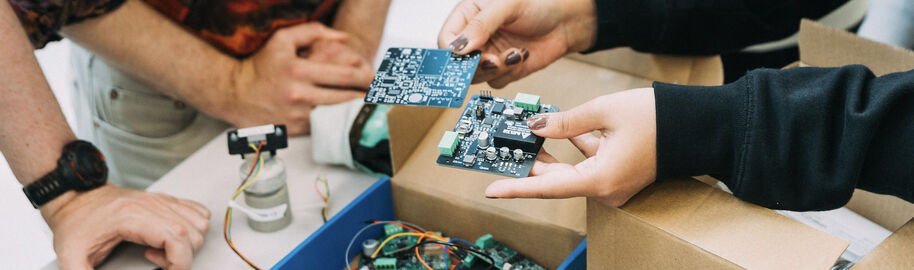
Design Factory as a practical bridge
As the company matured, its needs evolved. The team required not only advanced research infrastructure but also flexible, hands-on facilities where they could quickly prototype, modify, and test components without long procurement cycles or high outsourcing costs.
Halide Energy discovered Partner Plaza through another company working at Design Factory. The programme gives companies a base in the DF community, access to workshops and equipment, and support from staff with extensive practical experience.
For a multidisciplinary team, this builds a hands-on understanding of how different manufacturing methods can support problem-solving. The result is faster iteration, as well as more creative and practical ways of approaching technical challenges.
Akseli Rautakorpi, a Chemical Engineer at Halide, notes that the team uses “diverse fabrication methods to develop and refine electrochemical set-ups,” including CNC milling, waterjet cutting, 3D printing, laser cutting, and workshop fabrication for custom stands and electrode shaping.
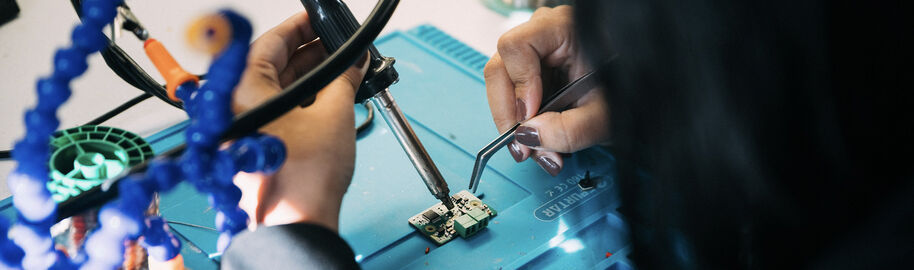
Mishal Fatima, an Electrical Engineer, highlights the electronics shop for soldering, assembly, troubleshooting, and debugging, using oscilloscopes and signal generators to verify prototype performance.
San Vo, a Mechanical Engineer, lists CNC and manual machining, metalwork, hydraulic pressing, waterjet cutting, and hands-on milling instruction among the key resources. “On top of that, DF is a lifesaver for last-minute emergencies. Missing nuts and bolts, extra holes to drill, or quick glue gun fixes, DF always has us covered,” Vo says. “It has saved us a tremendous amount of time, stress, and resources.”
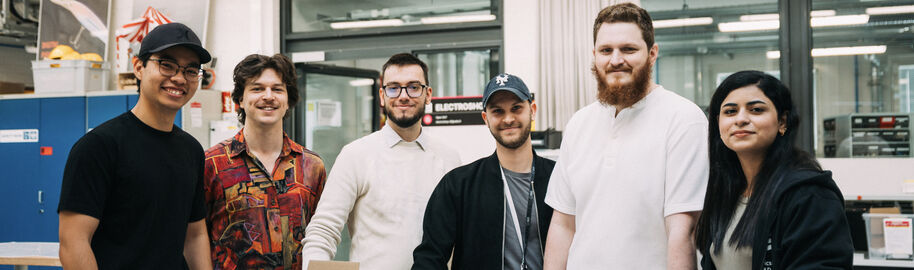
A place to solve problems
For Halide Energy, this is particularly valuable because it operates between laboratory and industrial scale. Standard parts are not always available at that size, while custom manufacturing can be both expensive and slow.
One example involved protecting a pressure sensor from the battery electrolyte. The team needed a connector to join an American-threaded valve isolator with the European-threaded system used elsewhere in the battery. An external supplier would have charged several hundred euros and taken around four weeks. At DF, the team made the component in about four days.
“The ability to fix what we just forgot quickly is really vital for us,” explains Wouter Badenhorst, CTO & Co-Founder. “Especially when it is the first time designing a bigger hydraulic circuit, you do not always flag everything immediately.”
This ability to make, test, and revise components quickly helps the company reduce delays, avoid unnecessary equipment purchases, and keep development moving.
A recent assembly jig illustrates this approach. The jig ensures that battery components are correctly aligned during assembly. An external manufacturer quoted a high price and an approximately eight-week lead time. Instead, Halide Energy developed an alternative in the DF workshops: a laser-cut acrylic jig that could be assembled in-house in around two days at very low cost.
“That ingenuity is the main thing we are taking from DF,” Badenhorst says. “We have a problem — let’s solve it in a nice way.” The solution also supported the assembly of what Badenhorst describes as the company’s best-built battery so far.
Benefitting from the innovation ecosystem
The Partner Plaza experience is about more than machinery. The DF staff help companies assess manufacturability, choose suitable production methods, and troubleshoot technical challenges. Halide’s electronics work has benefited in particular from guidance in the DF Electroshop:
“The electronics workshop people have really helped the most with our growth,” Badenhorst says. “My colleague has communicated a lot with the staff there about parts, how to build things, and how to debug things.”
The company has also learned from other Partner Plaza members. Informal conversations and shared problem-solving have connected Halide’s team with people facing similar technical questions.
For Halide Energy, Partner Plaza provides immediate and longer-term value: access to infrastructure, shorter development cycles, reduced one-time costs, and a stronger connection to the Aalto innovation ecosystem. The company also lists its access to DF infrastructure in public funding applications, where it can demonstrate the practical resources available to support development.
The broader Aalto ecosystem has helped the company progress from research to entrepreneurship through funding pathways, startup services, and personal connections. “There are complete systems, but it is still the individuals in those systems that become the driving force,” Badenhorst says. “They see the potential and really start helping you. You can call them and ask for help.”
His advice to startups considering Partner Plaza is straightforward: make time to explore the facilities and meet the people who work there. “Take a full walk through the place,” he says. “Take half a day to really figure out what you can do here and who the people that work here are.”
Read more news

Aalto ARTS exhibiting AI-inspired designs at Dutch Design Week 2026
Aalto University’s School of Arts, Design and Architecture returns to Dutch Design Week with ‘art-ai-fact’, an exhibition featuring multiple AI-inspired designs.
Aalto WiT Programme and Fida International collaborate in Kenya to create accessible playgrounds for children with disabilities
The Inclusive Play project designs an accessible playground that is suitable also for children with disabilities. The project strives for a holistic experience of education, play and belonging.
Aalto University and partners launch MELANGE, a new EU project using design to transform colouration practices in the interior textile industry
The new Horizon Europe project MELANGE will transform colouration practices in the European interior textile industry by moving colour design from the end to the beginning of the manufacturing process.