






Aalto Inventors
The first step on your innovation journey: Field-specific innovation training designed for researchers to discover the impact potential of your work and build relevant networks.

A late-2025 report by the European Centre for International Political Economy sent ripples throughout Finland’s scientific community when it named Greater Helsinki one of the top two quantum innovation hubs in the world.
Otaniemi has long been the throbbing heart from which much of that innovation has proliferated. Decades of commitment to fundamental research, dating back to the founding of Professor Olli V. Lounasmaa’s pioneering Low-Temperature Laboratory in the 1960s, have created fertile ground from which some of the world’s highest-profile quantum technology companies have sprung.
This very environment of curiosity, or to put it another way, inventiveness, has inspired a recent coordinated effort at Aalto to tease budding ideas out of the minds of researchers. One of the latest approaches is the Aalto Inventors.
Myungji Suh, an Aalto alum who became a research entrepreneur facilitator, launched this programme in 2025 to help doctoral students in deep-tech fields realise the business potential of their work. ‘I’m so proud to be in contact with these researchers, and if we can put a little seed into their heads so they can later go back and realise, “Actually, maybe I could start something,” then it’s really great,’ Suh says.
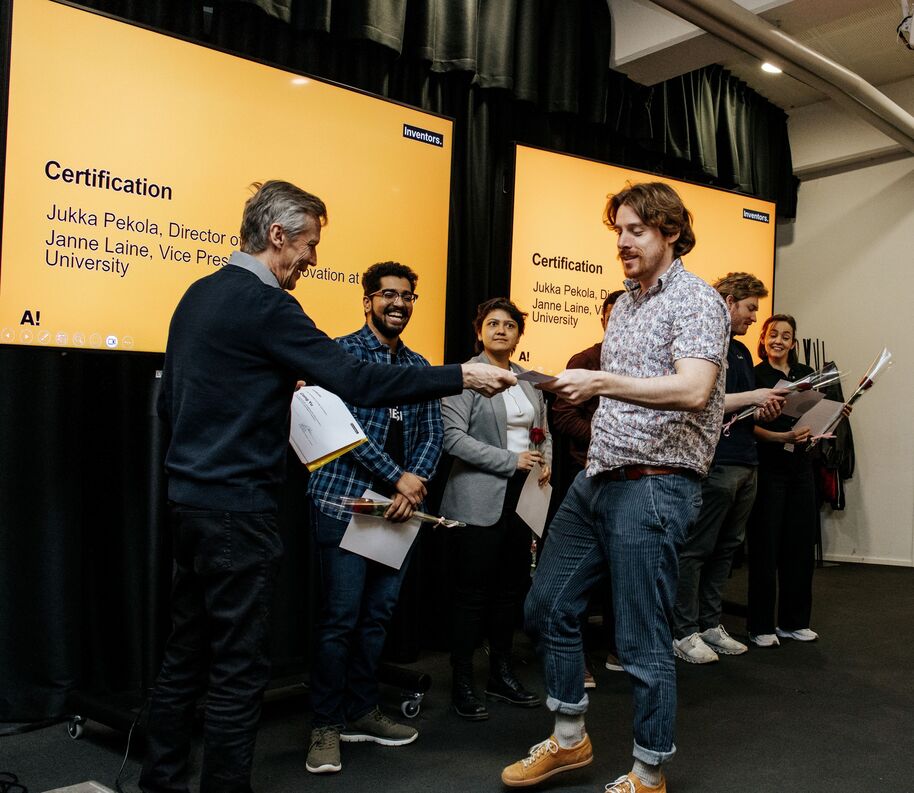
The Aalto Inventors programme is now in its second year running, with the final presentations of a quantum-focused cohort having wrapped up in April 2026.
This quantum cohort included doctoral students from universities throughout Finland, many of whom are part of the Quantum Doctoral Education Pilot Programme (QDOC), which is coordinated by Aalto University. The content of quantum Inventors cohort was developed jointly by Suh, Aalto Corporate Relations Manager Juho Pirinen, and Aalto Inventors Specialist Elettra Virtanen.
The structure of the course can vary slightly for each new cohort but roughly follows the same 8-session structure. This includes valuable expert advice from top industry leaders, a venture capital funding crash-course, intellectual property rights training, customer discovery know-how, and roundtable discussions with industry and researcher-entrepreneurs – the types of lessons not typically covered in doctoral education.

Even though not all the student projects are destined to become a unicorn, that’s not exactly the point of the Inventors programme.
From ideation to end product, course participants are tasked to confront market considerations that are often absent in the lab. They learn that it doesn’t do to just have a good idea. You also have to find a first customer, come up with a financial model and revenue projections, learn how to communicate the idea effectively, and actually name the problem that exists and the solutions that you provide.
‘Your research deserves more than a paper,’ Suh says, echoing a phrase that’s become something of a motto for Aalto Inventors. ‘It really deserves to change the world, create jobs, and help someone – save someone’s life or make the planet greener.’
Rather than diminishing the immense effort that goes into writing a scientific paper, this motto is meant to challenge students to conceptualise their research in a non-academic setting. Where a paper identifies a breakthrough, a well-executed business proposition can take it out of the lab and into everyday use.
‘I definitely don’t think it’s a bad idea to get academics more involved on the industry side. Because, in the end, hopefully academics are the ones who know what the future is going to be like in their space, and I see no reason why they shouldn’t profit from it,’ says University of Jyväskylä doctoral researcher Clemens Lindner.
Several of the quantum cohort participants had never really considered that building their own business was a possibility.
‘There are a lot of problems out there that we’re not even aware of, and they’re possible markets for startups,’ says Alina Helena Sánchez Gallardo, a doctoral researcher at the University of Oulu.
‘You actually build the connections in this cohort, because otherwise we’re kind of thinly spread out,’ added Aalto University doctoral researcher Christa Schauman. ‘This is a great way to actually try out business partners – you need to work with them a little.’
The quantum scene is currently experiencing a massive boom in Finland. In the last three years alone, a number of Finnish startups have entered the global arena as serious players in various domains. From algorithms and hardware to AI-integration and photonics, Finland is absolutely punching above its weight in an industry traditionally dominated by the likes of the US and China.
‘What left the strongest impression on me was the level of interest in entrepreneurship among students and scientists in quantum technologies. It feels very different from when I was a student 25 years ago, and very encouraging to see,’ says Juha Vartiainen, Co-Founder and Chief Global Affairs Officer at IQM Quantum Computers and one of the industry representatives providing feedback at the quantum cohort’s final showcase.
‘I have come to believe that strong ecosystems are built step by step, through people sharing what they’ve learned, supporting one another, and helping the next generation find their way.’
This article has been published in the Aalto University Magazine issue 38, September 2026.

The first step on your innovation journey: Field-specific innovation training designed for researchers to discover the impact potential of your work and build relevant networks.

Choose a field-specific cohort in AI, biotechnology, water management, energy, or medtech — or join a multidisciplinary track open to researchers from any discipline.

InstituteQ coordinates quantum technology research, education and innovation across Finland

Corporate partners in the Quantum Doctoral Pilot programme (QDOC) say that collaborating with the programme helps them distinguish between technology hype and developments that are truly relevant to them.

National Graduate School in Quantum Science and Technology


