






BioProTex Targets Greener Medical Textiles
Take face masks as an example. A study from 2021 estimated that the world discarded 3.4 billion single-use masks daily during the time of COVID-19 pandemic. You might not want to think about what a used mask has when it goes into the trash. Their disposal also raises a longer-term question about the material itself.

Polypropylene which is widely used in disposable medical textiles is estimated to take up to 450 years to break down in the environment. As it breakdowns, it can release microplastics. Masks are one familiar example of a wider problem that also involves surgical gowns, drapes and other single use protective textiles.
Where that plastic ends up depends on how well each country manages its waste. Plastic pollution can spread through rivers, oceans and food chains without any borders.
This was the challenge that Esubalew Kasaw Gebeyehu, Doctoral Researcher at the Textile Chemistry Group, Aalto University, brought to the stage at the XII Johan Gullichsen Colloquium and PI Scholarship Gala on 29 September 2026 at Pörssitalo in Helsinki. He received the Johan Gullichsen Award in recognition for his excellent speeches on BioProTex. The recognition suggested that the message resonated with the audience.
The presentation also suggested a way to move forward. Cellulosic fibers from wood pulp and cotton provide a renewable starting point and the textile industry already knows how to process them at scale. To serve demanding medical applications, these fibers also need the right functionality. Coatings can help fabrics resist blood and body fluids and limit bacterial growth.
However, environmentally persistent coatings can undermine the sustainability benefits that make cellulose appealing in the first place. The opportunity is to use biobased chemistry to provide these functions across medical textiles with the aim of retaining the biodegradability of renewable fibers.
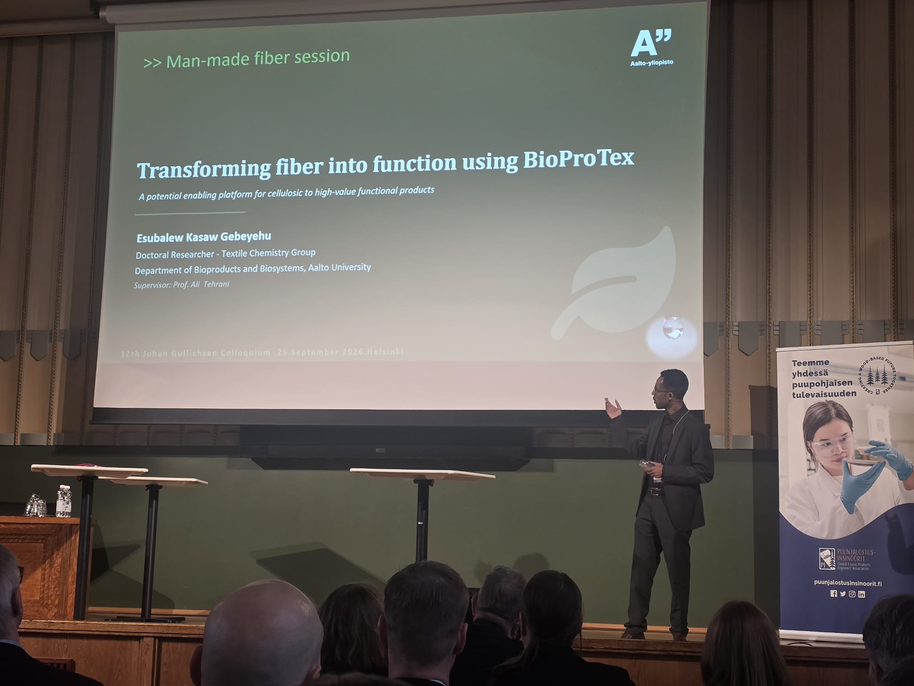
Through BioProTex, Esubalew and Panu Miettinen are working to address this challenge in the Textile Chemistry Group led by Professor Ali Tehrani. The Aalto R2B project, funded by Business Finland, has developed a coating made entirely from biobased ingredients. It combines liquid repellency and antibacterial activity in a single treatment designed to fit existing textile finishing processes.
Based on the promising early laboratory results, the researchers are developing the approach to give manufacturers an economic reason to consider the alternative alongside its environmental promise.
Read more news

How can we reinvent ourselves in the face of uncertainty? Five things everyone should understand about embracing the new
In a rapidly changing world, we need the ability to think differently, question what is familiar and recognise new opportunities. Aalto University’s Professor of Practice Nando Malmelin, explains how anyone can develop their openness skills
The State of Marketing survey: Performance monitoring and budgeting remain relatively weak
Markkinoinnin tila (The State of Marketing) survey opens up important perspectives to the Finnish marketing knowhow and areas for development in marketing
What is quantum tech?
Many of today’s devices would not exist without quantum technology, but the most exciting applications are still on the horizon