






Aalto Distinguished Professor Jukka Pekola’s message: Basic research is at the heart of progress

The Finnish quantum technology scene is a comparative giant. Just this year the European Centre for International Political Economy ranked it second-best in the world. You would be hard pressed to find anyone in the field who would not credit Aalto University’s Department of Applied Physics Professor Jukka Pekola as a driving force behind this success.
Pekola, Professor of Applied Physics at Aalto University, is among the world’s globally leading experts in quantum thermodynamics: a field at the intersection of quantum mechanics and thermodynamics. He is the director of the Finnish quantum community InstituteQ and his own PICO research group, and serves as the scientific director of OtaNano, Finland’s national research infrastructure for nano-, micro and quantum technologies.
Pekola led to completion two highly successful quantum-focused Centres of Excellence, has held the title of Academy Professor twice and was instrumental in founding the famed Nanoscience Centre at the University of Jyväskylä. Pekola, whose scientific publications have been cited over 20,000 times, was appointed the Aalto Distinguished Professor (ADP) for 2026 on September 1.
Despite these accolades, Pekola remains humble.
'My first thought was “am I going to get fired?”’ he tells of the moment he received the meeting invitation where President Ilkka Niemelä and Provost Kristiina Mäkelä informed him of the decision. ‘This is a tremendous honour particularly for me, but also for the entire quantum community, I hope.’
Retirement is a distant prospect for Pekola. He just received significant funding allowing him to study thermodynamics in quantum systems and find out how to control heat in future quantum devices like computers. The goal is to find a solution for a problem plaguing all quantum technologies: overheating.
It is a challenge the likes of which Pekola has never shied away from.
From humble beginnings to the top
In the 1970s Pekola was a recent high school graduate, fascinated by natural science and wanting to study physics at the Helsinki University of Technology because, as he says, it was a difficult place to get into.
'It was already back then the best place in Finland to study physics.’
Pekola took up an internship in the famed Low Temperature Laboratory set up and ran by the esteemed Professor Olli V. Lounasmaa. This led to a PhD, followed by postdoctoral studies in Berkeley, California, eventually returning to Finland in the early 1990s to follow Professor Mikko Paalanen (who is now a Professor Emeritus at Aalto) to Jyväskylä to study nanophysics.
Aalto Distinguished Professor Jukka Pekola‘I have always tried to find my own thing and nurture it, instead of rushing to do what everybody else is doing.'
Pekola and Paalanen set up a laboratory and initiated a new field of research in Finland from scratch. ‘It was pretty barebones at the time. I recall asking the metal workshop next door for a piece of dirty copper, which I cut down to size and vapourised on top of a silicon wafer to create a new nanocomponent.’
Half by coincidence and half by design the result was an on-chip refrigerator, which is based on the movement of electrons from copper into a superconductor. That refrigerator, and a nanoscale thermometer developed during the same period, are in use by research groups the world over. They and rank among Pekola’s most celebrated achievements.
'I have always tried to find my own thing and nurture it, instead of rushing to do what everybody else is doing,’ he says.
That approach paid off. Pekola, who returned to Otaniemi in 2002, has since earned prestigious awards like the Simon Memorial Prize, and his PICO group is a globally renowned pioneer of quantum thermodynamics.
‘The intersection of quantum mechanics and thermodynamics is an incredibly fruitful area of study. I’m particularly interested in how closed isolated quantum systems thermalise, meaning how they get their temperature,’ says Pekola. ‘It has been an open question for close to 100 years, but now technology has developed to the point where the question can be explored experimentally too.’
Pekola says technological development has blurred the demarcation between theoretical and experimental physicists.
'For example, Aalto’s own quantum computer Q20 is a platform where we get to manipulate the connections between qubits and their frequencies. That way a theoretician can play-act an experimentalist, which is a big change. In the PICO group we don’t draw a line between the two but focus instead on a holistic approach to research that is based on the individual expertise of each member.’
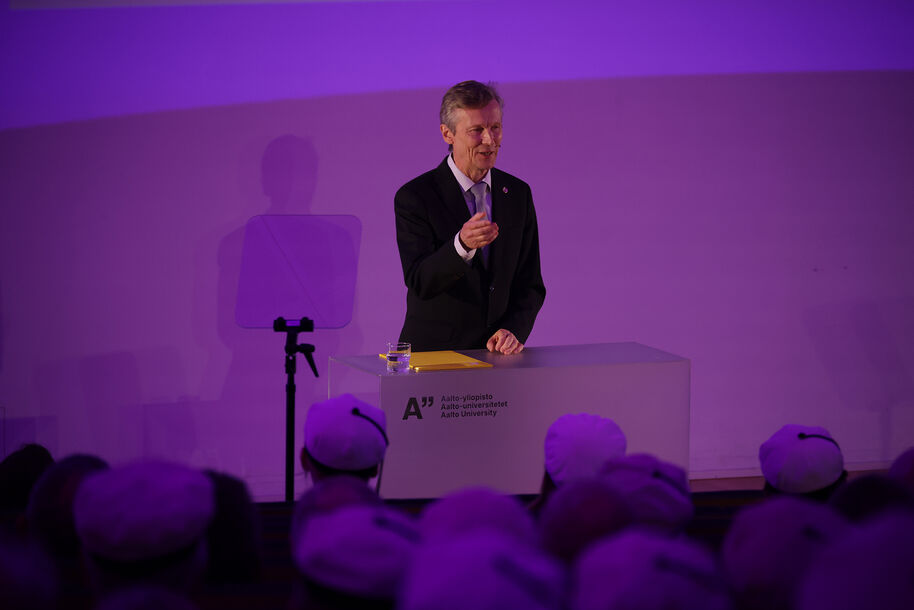
Pekola is happy to hand any scientific discovery over to the next person. For example, VTT has continued to develop Pekola’s cooler and thermometer, and others are looking to commercialise them.
‘Fundamental research and finding new seeds to sprout is my strong suit,’ he says. It’s paramount, he adds, because there are still many open questions in quantum technology.
‘People want to pile on more and more qubits into quantum computers, but, at some point, they will face the same problem as all electronics: there is simply too much heat. We must know the limits of quantum systems better than we do right now.’
He says there is another, even more relevant, reason. ‘One of the lessons the Low Temperature Laboratory model has taught us is that persistent basic research bears fruit: for both scientific and societal progress.’
A quantum metamorphosis
Otaniemi has been the home of quantum technology research since the 1960s, but it is over the last 30 years that the field has undergone metamorphosis.
‘The Finnish quantum scene has a good communal spirit now. Funding has increased many times over, the number of research groups has exploded and companies are starting up spontaneously. There are new research topics like quantum algorithms and quantum materials. InstituteQ together with the Finnish Quantum Flagship is comprised of universities, research institutions and corporate partners, and now we work together with end-user companies, who are also investing in quantum.’
According to Pekola, it has never been easier to start in quantum.
’Just over the last couple of years quantum education has taken major strides, for example with cross-studying, a doctoral pilot and new starting spots for master’s students. We can now offer a much better experience for anyone starting quantum studies than when I started.’
Yet despite its incredible trajectory the Finnish quantum scene should not start competing globally with raw strength, Pekola advises.
‘I think we as university researchers should not develop better and better qubits, because then we are competing with giants like Google. We should always strive to find our own thing.’
The title of Aalto Distinguished Professor is granted to a professor whose merits are exceptionally significant.
Ilkka Niemelä: In the age of AI, university education builds the ability to learn, think critically and collaborate
Universities bring together what society needs most: understanding of the world and cutting-edge technologies and the profound ability to question, assess and innovate, says President Ilkka Niemelä....

Read more news

Training available in AI use, research data management, open science + more – register now!
New topics included! Registrations for autumn 2026 are open.
Turn your idea into impact with 100STARTUPS, October 21-22
In October, we bring together students, job seekers, creators, dreamers, and future founders to learn the right tools and methods to start building what you always wanted to bring to life.
Making music with the Cosmos: sound art and radio astronomy improvising at the Metsähovi Radio Observatory
Want to know what the origins of a solar system sound like? Scientists joined forces with a sound artist to play with molecular gas thousands of light-years away