






Prototyping and Validation Grant: WeatherSens AI
The weather station that flies.
A weather station is expensive and stuck in one place. A weather balloon goes up and comes down. Satellites cannot see vertical structure, and hours pass between overpasses. Between all these, from street level to a few hundred metres above it, there is almost no measurement at all.
Forecasts fill that gap with simulation. National weather services run enormous physical models of the atmosphere, then zoom in with downscaling or CFD. It is expensive, and however finely you zoom, it is still a simulation with no measurement underneath to check it against.
Wind and solar producers live on those forecasts. They promise the grid a certain production hours ahead, and every 15 minutes the difference between the promise and reality is settled in euros. Over a fleet of wind parks, a small forecast error becomes a large bill.
WeatherSens AI is betting the gap can be measured instead of only simulated. Their instrument is a small drone that measures wind, temperature and humidity from the ground up to a few hundred metres. Those readings feed an AI physics model the team built themselves, which corrects the national forecast for the place where the drone flew. The result is a view of the lowest layer of the atmosphere that today's instruments mostly miss, and the layer that wind, solar and other sectors depend on.

Who they are
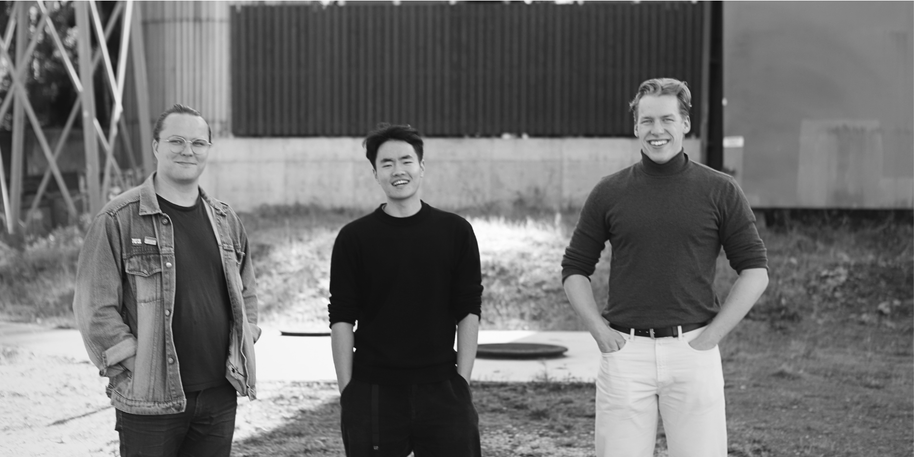
WeatherSens AI is Atte Laakso, Aarni Nordström, and Qilun Li. Aarni leads hardware and previously worked at Vaisala, the Finnish company whose instruments sit in weather stations around the world. Atte builds the models, the machine learning and physics that turn sensor readings into a forecast. Qilun runs the business side, has started two small companies before this one, and previously worked at Capalo AI, a Finnish startup unlocking the full potential of energy storage.
All three have been full-time on WeatherSens AI since they joined the Ignite accelerator in summer 2026, where they won first place. When they applied, there was almost nothing to show.
"We started basically from zero," Qilun says. Some validation had been done. Most of it still lay ahead. The first question was not whether they could build the device, but whether anyone needed it: is hyperlocal weather a global problem, and is it painful enough that someone will pay? They concluded it was. Then they had to prove it.
What the grant unlocked
WeatherSens AI received the Aalto University Prototyping and Validation Grant, supported by Aalto Founder School, Aalto Design Factory, and Aalto Innovation. It came at the stage where the idea was still mostly a hypothesis, with one MVP already built, which is exactly when it mattered most.
"It was so early stage, and such a big risk to put our own money in," Atte says. "The grant let us test some risky stuff we wouldn't have been able to do otherwise."
Their advice to the next applicant is practical. Do not ask for the minimum because it feels like the easiest to get, and do not ask for the maximum just because it is possible to get that much. Write down what you actually need and be ready to explain every purchase.

Atte Laakso"Running a full weather model is really expensive," Atte says. "We don't rerun it. We take the national forecast and correct it locally with real measurements. That is cheap to run, and the data comes from where you actually are, so it anchors the forecast to reality."
Two prototypes
The first prototype was physically big. It established that the sensing approach could work at all. The second was smaller and more compact but, in the team's own words, still very messy. It proved something more important though: a drone in flight can return a clean signal, not just noise.
The drone itself is not the invention. It is mass-produced by another company and flown in Finland under standard drone rules. WeatherSens AI's work is the sensing layer and the model.
"Running a full weather model is really expensive," Atte says. "We don't rerun it. We take the national forecast and correct it locally with real measurements. That is cheap to run, and the data comes from where you actually are, so it anchors the forecast to reality."
Hardware is slower to build than software, Aarni admits. "Slower, but harder to copy."
The mistake
After the first prototype, the team went out to validate the idea with wind and solar producers. The interest was there, but the talks stalled. They could not sell a promise of precision with a prototype that could not yet deliver it.
So they turned to the customers who were easiest to reach. They approached wakeboarding companies, a market where the wind on one specific stretch of water matters enormously, to prove that local weather as a service and the first model worked before going back to the energy sector.
Two pilots were started, one paid. The summer season ended and so did the subscriptions, even though the wakeboarding companies were satisfied.
"It was a mistake," Qilun says. "We should have just kept on building and pouring more of our focus and validation into just the energy market. It's not like you can make a scrappy product and people want it. Precision is key to solving this problem."
That is the lesson most hardware founders learn the hard way. The team went back to the workshop. The customers are there. Many have said, in effect, that a product with more accurate data and forecasts is a no-brainer, because it saves them money and makes them money. Until the device delivers that, the team keeps talking to those customers, because they are the source of truth on what is actually needed.

How they work now
Ask how decisions get made and the answer is a philosophy of challenge. Nobody second-guesses Aarni on which sensor goes where. But the questions come anyway.
"I'm not going to ask whether this sensor is in the right place," Qilun says. "I ask: Can you skip this sensor? Can you buy this already made? Can this be done in another, more efficient way?"
It is a way of forcing execution. "We want to disprove our hypotheses as fast as possible," Qilun says.

The bet
The rest of 2026 has one milestone: a finished device that produces data clean enough that customers pay for it. The remaining grant money is earmarked for that build. Field accuracy still has to be proven, and they say so themselves.
So the call they are making now is to professionals in wind and energy companies, and to the people who measure and model weather for a living.
"We're looking for people who want to help solve this problem in weather forecasting and data collection, not only in green energy but in other sectors too," Aarni says. "And for people who would like to disprove our hypothesis."
Entities behind the grant.
Aalto Founder School is Aalto University's entry point to entrepreneurial learning, open to students from all six schools. It brings entrepreneurship closer to students through monthly Founder Talks, Founder Minor studies programme, and a tailor-made 3 months Founder Sprint programme for the most driven founders. The focus is early-stage founder development: building the mindset, skills, and network to start something over time.
Aalto Design Factory is an experimental learning and co-creation community for product design and development. Open to students across every Aalto school, it offers hands-on prototyping facilities, workshops, and team spaces where ideas move quickly from concept to physical prototype. Its philosophy is simple: learning by doing
Aalto University Innovation Services manages the commercialisation of inventions, intellectual property, and technology transfer at Aalto. It helps turn research ideas generated at the university into products with real societal impact, supporting researchers and the wider Aalto community through protection, development, and commercialisation.
Get in touch with WeatherSens AI.
Read more news

Every Step Brings You Closer to the Summit – Join UniSport’s Mount Everest Challenge in HeiaHeia
Students and staff of Aalto University celebrate this year’s Stair Days with a shared journey towards the summit of Mount Everest. UniSport’s new HeiaHeia wellbeing app inspires everyday physical activity, makes wellbeing actions visible and brings the whole community into a shared challenge.
Training available in AI use, research data management, open science + more – register now!
New topics included! Registrations for autumn 2026 are open.
Grants and recognition from the Wihuri Foundation
From Aalto University, 40 individuals or groups received funding in 2026. The largest single grant went to the Ownership Lab for research on ownership. In addition, Tapani Vuorinen received the Wihuri International Prize