Designed and built entirely in Finland, the Foresail-1p satellite is a national collaboration led by the Finnish Centre of Excellence in Research of Sustainable Space (FORESAIL). The Centre of Excellence brings together the top experts in Finnish space science and space technology: the University of Helsinki, Aalto University, the University of Turku and the Finnish Meteorological Institute (FMI). The University of Helsinki coordinates the programme.
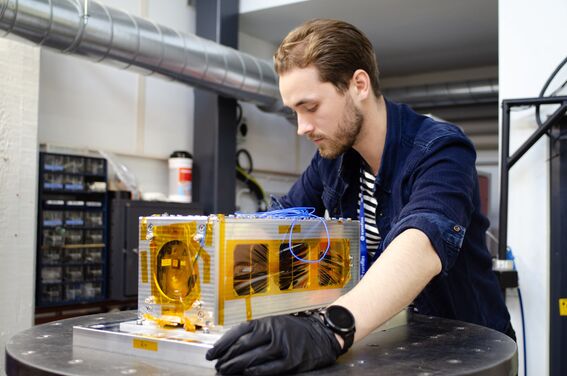
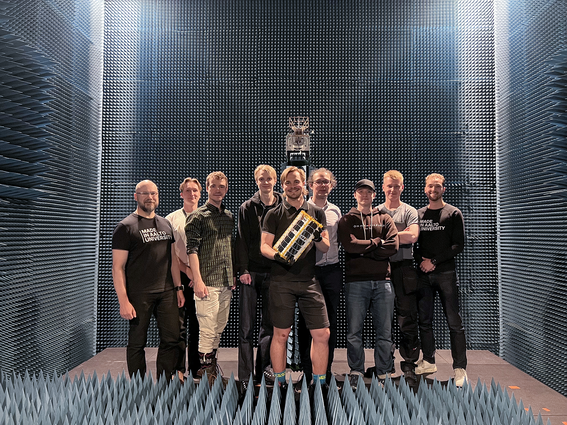
Researchers within the Centre of Excellence have jointly defined the objectives of the satellite mission. The University of Turku and FMI developed the satellite’s scientific instruments and will analyse the data collected by them. Aalto University designed and built the satellite specifically for this mission. Control and communication with the satellite are handled through Aalto University’s ground station in Otaniemi, which has likewise been designed and constructed at Aalto.
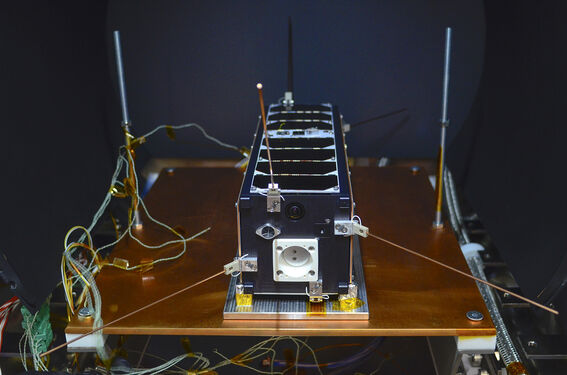
The satellite carries two key scientific instruments developed within the Centre of Excellence: the PATE particle telescope, which studies the near-Earth radiation environment, and the Plasma Brake experiment, which tests the deorbiting of the satellite in order to reduce orbital debris.
The measurement data produced by the satellite will provide valuable information for refining the world-leading near-Earth plasma and radiation models developed at the University of Helsinki. In addition, the experiments with the Plasma Brake will enable the first-ever space measurements of the use of Coulomb drag – the space plasma analogy of air drag – to change a satellite’s orbit. The results of the experiment will be compared with models developed at FMI.
“Foresail-1p is a major step forward for Finnish space research. Through the collaboration of top Finnish teams, we have developed an independent national capability to carry out our own scientific space missions. The systems and instruments developed for the Foresail satellite are already in use in some European Space Agency missions and onboard several new Finnish satellites. Foresail technology also plays an important role in Aalto’s space technology education and in future student satellite projects,” says Professor of Space Technology Jaan Praks from Aalto University.
Towards sustainable space – and beyond
The radiation-tolerant systems of the Foresail-1p satellite, together with its scientific instruments, promote the sustainable use of space and improve our understanding of the space environment. The satellite also tests novel technology that enables satellites to be safely removed from orbit once their mission is complete.
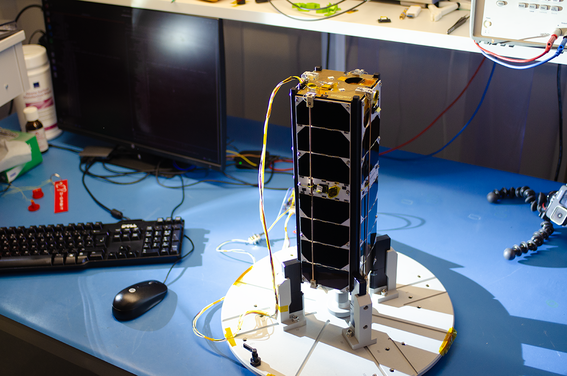
“The Aalto satellite team has developed the satellite systems to withstand faults and radiation. The satellite technology was thoroughly tested before integration, and the flight model went through a demanding environmental and functional test campaign prior to launch,” Praks explains.
The satellite technology developed in the Foresail programme provides a foundation for future university satellite projects, enabling not only faster development but also more reliable scientific missions.
New insights into space weather and safer orbits
The PATE instrument, developed by the University of Turku, measures high-energy particles arriving from Earth’s radiation belts, as well as neutral high-energy particles coming directly from the Sun. These data help to improve our understanding of the radiation environment in low Earth orbit and thus enhance the modelling of space weather. Professor Rami Vainio from the University of Turku is responsible for the PATE mission.
The task of the Plasma Brake is to speed up the deorbiting of the satellite once its work and journey are complete. The device is based on a long, high-voltage metallic tether that interacts with the plasma in Earth’s ionosphere – the uppermost part of the atmosphere – and gradually slows down the satellite’s orbital velocity. As a result, the satellite re-enters the atmosphere and burns up safely. Without this technology, the process could take several years, but with the Plasma Brake it is reduced to just a few months. The Plasma Brake mission is led by Research Manager Pekka Janhunen at FMI.
Foresail-1p will be deployed from its carrier spacecraft approximately two weeks after launch, marking the beginning of its real trial by fire: the commissioning and in-orbit testing phase. Professor Jaan Praks at Aalto University is responsible for the overall Foresail-1p mission and satellite operations.
Contact information
Jaan Praks, Professor, Aalto University, jaan.praks@aalto.fi, p. +358 50 420 5847
Rami Vainio, Professor, University of Turku, rami.vainio@utu.fi, p. +358 29 450 4294
Pekka Janhunen, Research Manager, Finnish Meteorological Institute, pekka.janhunen@fmi.fi, p. +358 50 380 3164
Minna Palmroth, FORESAIL Centre Director, Professor, University of Helsinki, minna.palmroth@helsinki.fi, p. +358 40 5311 745
Emilia Kilpua, Professor, University of Helsinki, emilia.kilpua@helsinki.fi, p. +358 50 4155 358