






Aalto Startup Center (external link)
Aalto Startup Center accelerates the growth and success of early-stage startups, particularly those with a focus on high-tech and sustainable innovations.

For some, Demo Day is an opportunity to catch up with familiar faces and make new connections over a cup of coffee. For others, however, it can be a crucial next step towards a dream. In any case, it is easy to be swept up by the excitable atmosphere of Aalto University’s A Grid building. Who knows, maybe someone’s career is about to change.
Organized by Aalto Startup Center and A Grid, a home for nearly 150 startups and partners, Demo Day is an opportunity to see the innovation that comes out of Aalto. Aalto Startup Center is one of Europe’s longest-running, university-based incubators, supporting research-based startups and deep tech ventures since 1997.
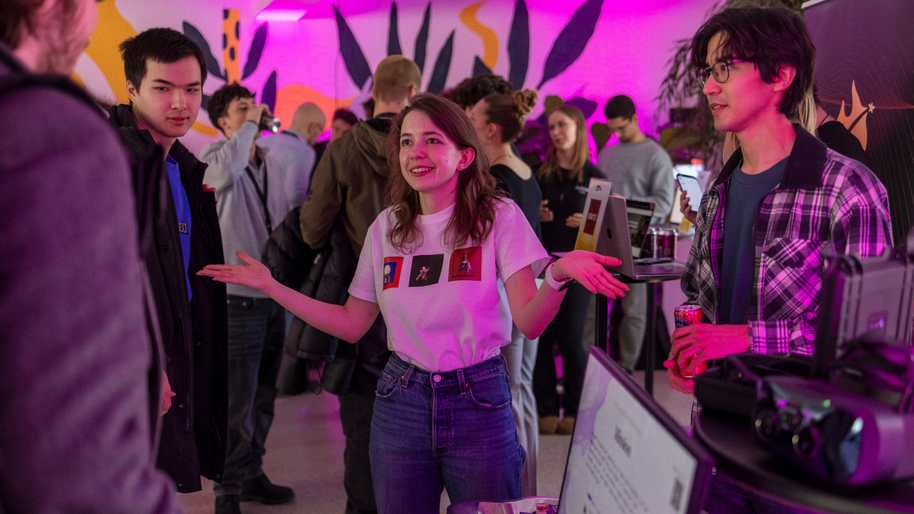
At Demo Day, dozens of startups and research-to-business cases set up booths to present their cases for participants to explore.
To begin the day on a high note, we caught up with SisuSemi, the winner of FiBAN’s (Finnish Business Angels Network) pitching competition.
Hailing from the University of Turku, SisuSemi offers an atomic-level semiconductor cleaning solution to boost performance and reduce leaking current. Translating a highly technical solution into a digestible business story is no easy task, says COO Pasi Pietilä. A good pitch develops through feedback, data, and discussions.
“Delivering a pitch is an iterative learning process, just as deep tech product development is. You do something, you have your delusions of it being good, and then you look at the feedback,” Pietilä says. A pitch is more than a presentation: it’s an important part of a startup’s product development.
“For an IPR-based deep tech startup like ours, a pitch is both a marketing and an educational tool at the same time. We work with a niche technology that is not familiar to most people, so we need events such as Demo Day to create contacts, gain visibility in the ecosystem, and present our work to a wide audience,” says SisuSemi’s CEO Erkki Seppäläinen. Demo Day has grown into a platform where startups like SisuSemi can do exactly that.

One day, 90 booths, nearly 800 registered visitors, and over 75 investors. These are the numbers behind Demo Day 2026. When the event was first organized back in 2018, though, the stats looked very different. What now spreads across several floors of the A Grid building was once a grassroots event taking place in just one large room.
“The goal has always been to provide the companies at Aalto Startup Center with a safe place to grow. Demo Day is a low-threshold event where startups can practice their pitches, make meaningful contacts, and gain attention,” describes Marika Paakkala, Head of Aalto Startup Center.
From research-to-business cases to scale-ups, she has witnessed countless entrepreneurial journeys, each of them following the iterative footsteps of their predecessors. For nearly a decade, Demo Day has woven these stories together.
“The event brings together startups at different stages and from different fields, students, investors, and budding entrepreneurs. Stakeholders are generally very interested in the Otaniemi ecosystem, in what’s going on inside these red brick buildings. Everyone is welcome,” Paakkala says.
FiBAN’s board member, investor Perttu Ilmarinen, recognises Paakkala’s sentiment.
“For an angel investor, the highlight of events such as Demo Day is getting to build relationships. We’re sometimes following founders and startups’ development for years before actually investing. Demo Day offers a front-row seat to technological innovation and promising ventures,” he says.

One founder currently navigating an entrepreneur’s journey is Emil Bulut, CEO of deep tech gaming startup Taru Tech. He recently spent three months in San Francisco as part of the SILTA program for Finnish founders.
“Finns often compare growing a startup to building a pyramid. In San Francisco, it felt more like a sprint. Ambition was on a next level: almost every investor told us to add a zero to the amount we were seeking,” Bulut says. During his 90-day stay, he witnessed people move to the city, found a company, and go bankrupt.
The sheer speed of things and the cultural differences reinforced Bulut’s sense of unpredictability in the startup scene. Not knowing what might happen next can be a very good thing, though. In fact, last year’s Demo Day played an unpredictable yet significant role in Bulut’s next steps as a founder. A representative from the SILTA program saw Taru Tech’s pitch, and months later Bulut found himself in Silicon Valley.
“At events like Demo Day, you can expect to meet some potential clients and investors and have productive conversations. Usually, though, you can’t predict what’s going to happen. You just have to be here,” he says.
Now Taru Tech has fixed its previous integration issues and continues to build its AI-powered player behavior simulation technology. Next up? A pilot with a well-known gaming company.

While Bulut’s and Taru Tech’s story is aspirational, it’s not unique. For many teams at Demo Day, showing up can open unexpected doors.
Another example of the necessity of “just being here” is Mind’s Eyetrack, a startup company from Aalto Startup Center. When approached at the booth, Managing Director and PhD Researcher Anna Ptukha is immediately ready to pitch.
Mind’s Eyetrack develops an eye-tracking technology that helps diagnose neurodivergence in children. Eye movements reveal, for example, dysfunctions in cognitive control, attention, and emotional processing.
“Disorders such as ADHD, autism, and dyslexia affect at least one child in ten, yet are often diagnosed late, even up to three years,” Ptukha says. With her team, she aims to speed up the diagnostic process and reduce the number of related doctor’s visits in the private sector. The company’s technology has been validated, but the team is waiting for regulatory approval by 2027.
The system combines hardware, a cloud-based platform, and data analysis to capture and interpret signals to support diagnosis. Next to the stand, Mind’s Eyetrack’s hardware is set up in a soundproof booth for visitors to examine. A robotised camera tracks a person’s eye movements when they watch a cartoon. Currently, the technology can track up to 28 different features of eye movement.
At Demo Day, research becomes tangible.
As a day of startup showcases nears its end, Marika Paakkala sits down for a breather. Surrounded by the continuous buzz of conversation and lit by a nearby neon light, she’s already thinking ahead to next year’s Demo Day. In 2027, Aalto Startup Center turns 30.
“We have grown alongside our startups, and we wouldn’t be here without them. We will need to have a big party,” she says.
Growth brings its own challenges for both startups and events: should we rent a larger space? Should we hire more people? Paakkala, however, wants to maintain the DIY attitude of Demo Day. There might be temporary shortages of coffee, but at the end of the day the event is built on mutual care.
“Not everything has to be perfectly polished. What matters is the entrepreneurial spirit and the willingness to help each other out. Anyone can walk in and contribute something. That’s what makes the ecosystem richer.”
In Otaniemi, Demo Day is more than just an event. It is a snapshot of a living ecosystem where ideas, research, and entrepreneurship meet. And judging by the growing crowds, the next decade of startups is already taking shape.

Aalto Startup Center accelerates the growth and success of early-stage startups, particularly those with a focus on high-tech and sustainable innovations.

A Grid is home for nearly 150 ambitious startups and partners, and acts as a gateway to the university’s ecosystem of resources, talented students and cutting-edge research and infrastructure.

Hosted by Aalto Startup Center and A Grid, Demo Day brought together nearly 800 visitors, 90 startup booths, and over 75 investors. What began as a grassroots gathering in 2018 has grown into one of Finland’s most vibrant startup showcases.
Aalto Startup Center accelerates the growth and success of early-stage startups, particularly those with a focus on high-tech and sustainable innovations.


