






Bio-based materials pave the way for safer construction

Fire safety can mean the difference between life and death. If a fire occurs, the materials used in buildings need to slow the spread of fire, buying valuable time for evacuation. That is why building materials must meet increasingly strict fire safety requirements.
Many construction materials meet these standards using chemical fire-retardant treatments. Some of the most widely used fire-retardant chemicals have negative impacts on human health and the environment. Several are now being restricted or phased out in the European Union, which creates an urgent need for safer alternatives.
The FireSafe project, led by Professor of Practice Juha Lipponen and funded by Business Finland, is addressing this challenge with bio-based fire-retardant systems made from renewable raw materials. Working together with the South-Eastern Finland University of Applied Sciences (XAMK) and industrial partners, the team aims to replace conventional fire-retardant chemicals with sustainable alternatives that work just as well, or even better, than current materials.
Two Master's students from Aalto, Soile Auvinen and Maryam Afzal, have played an important role in that work. Their theses focus on different aspects of the same technology, helping answer the question: can bio-based fire retardants provide both excellent fire protection and a healthy indoor environment?

Bio-based coating exceeds expectations
Soile Auvinen joined the FireSafe project through her Master's thesis in Chemical Engineering and later continued working as a research assistant. Her task was to optimise an environmentally friendly fire-retardant coating that helps wood resist fire by expanding into a protective insulating layer when exposed to heat.
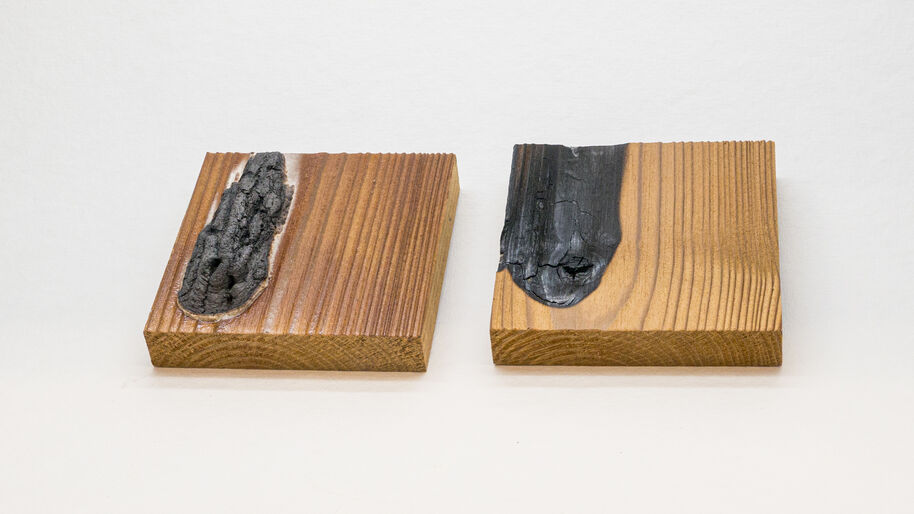
When exposed to heat, the coating rapidly expands into an insulating char layer that slows the spread of fire and protects the underlying material.
“The project immediately interested me because it combined sustainable materials with a practical challenge that has clear societal importance. Improving fire safety while reducing the use of harmful chemicals felt like a meaningful goal,” Auvinen says.

One of the main objectives of her research was to determine whether the developed coating could achieve the B-s1, d0 Euroclass fire classification – the highest fire classification wood can receive under European standards. The results exceeded expectations.
“Already during our laboratory testing, we saw that the developed coating slowed wood combustion considerably more effectively than a commercial fire-retardant treatment. That gave us confidence that we were moving in the right direction,” she says.
The team later demonstrated that the bio-based coating could indeed achieve the indicative B-s1, d0 classification in Single Burning Item (SBI) testing, showing that renewable materials can provide fire performance comparable to conventional fire-retardant systems.

Fire safety alone is not enough
Maryam Afzal joined the FireSafe project as a Master's thesis student and later continued working as a research assistant. Her thesis focused on evaluating the indoor air quality performance of bio-based fire-retardant systems developed during the project.
While fire retardancy is essential for building safety, construction products must also comply with strict indoor air quality requirements.
“Many fire-retardant systems can release compounds that negatively affect indoor environments. Therefore, it is important to ensure that new sustainable fire-retardant solutions are not only effective against fire but also safe for building occupants,” Afzal says.

Afzal's research focused on measuring how much ammonia different coating formulations released and exploring ways to reduce these emissions without making the coatings less effective at protecting wood from fire. Her work also contributed to one of the project's major milestones.
One of the FireSafe coatings successfully achieved the Finnish M1 emission classification—the country's highest emission class for building materials. Based on standardised 28-day chamber testing, the coating showed extremely low emissions of volatile organic compounds (VOCs), formaldehyde and ammonia.
The successful M1 classification demonstrated that bio-based fire-retardant systems can combine excellent fire safety with excellent indoor air quality.
"This is particularly important because future construction materials will increasingly need to satisfy both fire safety and environmental performance criteria," Afzal says.
Research with close ties to industry
Throughout the project, both students worked closely with the Bioproduct Technology research group, industrial partners and fellow researchers.
Regular discussions with supervisors, laboratory work and collaboration across disciplines helped shape the research. Companies also played an important role by providing practical perspectives on manufacturability, regulations, scalability and future product development.
"Working with industrial partners taught me that scientific performance is only one part of the picture. You also need to consider how the technology can actually be manufactured, commercialised and integrated into existing products," Auvinen says.
Maryam Afzal says that the collaboration with industry displayed to the young researchers how academic research can directly contribute to solving practical industrial challenges.
“It also strengthened my communication skills and taught me how to present research to audiences with different priorities,” she says.
Although further development is still needed before commercialisation, the project demonstrates the considerable potential of bio-based fire-retardant systems for future commercial use. The developed coatings could eventually be used to protect wood-based construction materials and other building products while reducing reliance on conventional fire-retardant chemicals.
Photos: Juha Lipponen / Aalto University.
Further information:

Read more news
Comment on Finnish national Open Science policy
The National Open Science and Research Coordination invites comments from the scientific community on two Open Science policies.
New podcast explores Finnish contributions to artificial intelligence
Researchers Arno Solin ja Eric Malmi interview pioneers, entrepreneurs and experts about the AI field's history, disruptive consequences and the probability of humanity's destruction.
AI model captures how humans read, paving the way to personalised text and better augmented reality
The new model could hold the key to developing highly customisable applications that adapt to different types of reader