






Experimenting with Geopolymers (26 – 29)

Research Council of Finland funded project 2026–2029
Material Specific Evaluation for Ceramic Practices
This research project explores how the materials we work with shape creative practice and our relationships with the environment. Beginning with geopolymer experimentation in the ceramic studio, the project investigates material alternatives and approaches to evaluating their environmental, practical, and cultural implications.
Exploring materials through making
What are we working with when we work with materials? Beyond their physical properties, materials carry histories of extraction, production, use, and disposal. They connect creative practices to places, communities, and ecosystems, bringing responsibilities that extend beyond the studio.
Material Relations brings together experimental material development and an investigation of how materials are selected, understood, and used. Geopolymers provide a starting point for exploring processes that can harden without the high-temperature firing associated with conventional ceramics. The research examines their possibilities for creative practice while critically evaluating the resources, processing, and energy involved.
Studio experiments investigate different formulations and the incorporation of materials such as waste glass, fired ceramic residues, reindeer bone ash, and similar materials. Through making and documentation, the project examines how material composition and working processes influence form, surface, performance, and the experience of working with these materials.
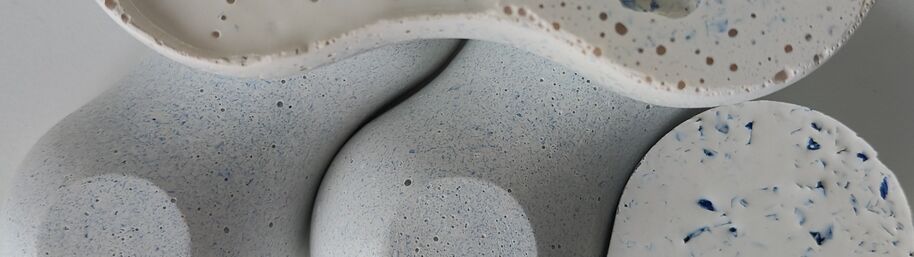
Connecting material development and creative practice
Alongside studio experimentation, the research draws on the experiences of creative practitioners, students, and educators. These perspectives help identify the practical demands, values, and responsibilities involved in introducing alternative materials into creative work.
The project considers both the elemental composition of materials and the contexts from which they emerge. Close engagement with materials becomes a way to investigate relationships between making, environmental responsibility, and the cultural meanings of material use.
Rather than treating sustainability as an inherent property of a material, the research examines it in relation to sourcing, preparation, making, use, and eventual disposal. Its aim is to support more informed and reflective material choices within creative practices.
Follow the research
The project website shares material studies, developing geopolymer formulations, studio documentation, publications, and activities. It provides an evolving record of the possibilities and limitations encountered throughout the research.
Visit the Material Relations project website
Want to contribute to the Research?
If you are a creative practitioner, student, teacher, artist or designer, and working with a particular material or materials in a studio context, please participate in our survey that focuses on the use and selection of materials in creative practices.
Research team
PI Priska Falin
Academy Research Fellow
Aalto University
Arun Joji
Doctoral Researcher
Aalto University
Funding
This project has received funding from the Research Council of Finland for the years 2026 – 2029. Funding decision number 368002.
