Department of Chemistry and Materials Science

Electrochemical Materials and Applications

We develop electrocatalytic materials and processes that turn renewable feedstocks and waste into valuable chemicals through electrochemical oxidation and hydrogenation, with green hydrogen co-production in selected processes. Led by Assistant Professor Daniel Martín-Yerga, our group combines materials design, advanced characterisation and automated experiments to connect fundamental understanding with practical applications.
Electrochemical Materials and Applications logo, with a few pictures of electrochemical devices and nanoparticles

Explore the group

Research  ·  Projects  ·  Team  ·  Publications  ·  Join us  ·  LinkedIn

Research areas

♻️  Renewable and waste-to-chemicals

We use electrochemical oxidation and hydrogenation to turn biomass-derived molecules and plastic residues into valuable chemicals.

Projects: COPRO · VALOPET

⚡  Hydrogen co-production

We combine renewable-feedstock conversion with green hydrogen production in selected co-electrolysis processes.

Projects: CELL2H2 · AGRI-WASTE2H2 · HYXYL

🔬  Electrochemical interfaces across scales

We connect nanoscale structure and reactivity with performance in batch and flow cells to guide electrocatalyst and process design.

Explore our methods

How we work

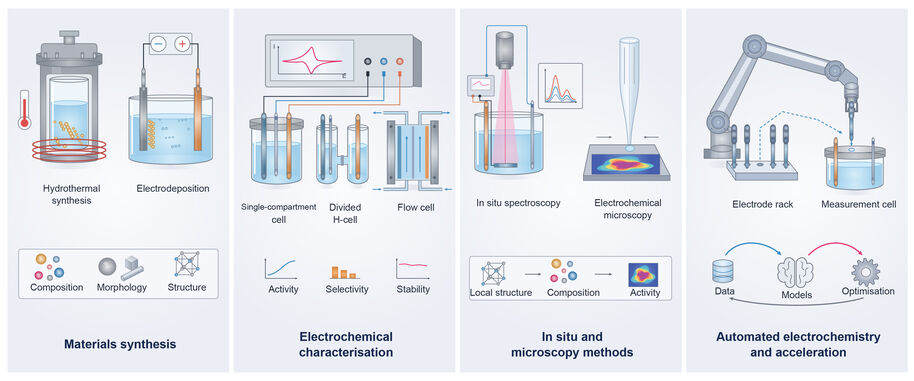
We combine materials design, laboratory experiments and advanced characterisation to understand what makes an electrocatalyst active, selective and stable.

  • Materials synthesis: We use hydrothermal synthesis and electrodeposition to tailor catalyst composition, morphology and structure.
  • Electrochemical characterisation: We evaluate catalyst performance in laboratory-scale single-compartment cells, divided H-cells and flow cells. We identify and quantify reaction products mainly using high-performance liquid chromatography (HPLC) and gas chromatography (GC).
  • In situ spectroscopy and microscopy: We develop and apply in situ spectroelectrochemistry (Raman and ATR-FTIR) and scanning electrochemical cell microscopy (SECCM) to connect local structure and composition with electrochemical activity.
  • Automated electrochemistry: We are developing closed-loop workflows that combine automated experimentation with AI-guided selection of the next experiment. Each result informs the next step, enabling autonomous optimisation of experimental parameters.
EMA Research Approach

Current projects

CELL2H2 project schematic

CELL2H2

Green Hydrogen and High-Value Chemicals by Electrocatalytic Valorisation of Cellulose

Department of Chemistry and Materials Science
AGRI-WASTE2H2 project summary

AGRI-WASTE2H2

Green Hydrogen and Platform Chemicals from Agricultural Residues

Department of Chemistry and Materials Science
HYXYL graphical abstract

HYXYL

Hydrogen production via co-electrolysis of xylan

Department of Chemistry and Materials Science
Graphical abstract for VALOPET project

VALOPET

Sustainable Valorization of PET Waste to Polymers and Hydrogen

Department of Chemistry and Materials Science
Graphical abstract for COPRO project

COPRO

Electricity-driven co-production of xylitol from forest sugars and glycolic acid from PET waste
Department of Chemistry and Materials Science

Our team

 Daniel Martín-Yerga

Daniel Martín-Yerga

Assistant Professor
EMA Group Leader

Manuel Gutierrez Roa

Postdoctoral Researcher
Electrochemical valorisation of plastic waste

Iida Pyymäki

Doctoral Researcher
Electrocatalytic oxidation of low-value molecules

Jiaqi Wang

Doctoral Researcher
Electrocatalytic hydrogenation of lignin derivatives
 Sardar Muhammad Asad Hayat

Sardar Muhammad Asad Hayat

Doctoral Researcher
Electrochemical conversion of hemicellulose derivatives
 Sayani Biswas

Sayani Biswas

Doctoral Researcher
Electrochemical oxidation of glucose using gold-based catalysts

Xinyue Liu

Doctoral Researcher
Self-driving platforms for electrocatalyst discovery

Giao Tran

Research Assistant
Electrochemical oxidation of cellulose

Contact the group

Interested in a thesis project, research opportunity or collaboration? Please contact our group leader, Assistant Professor Daniel Martín-Yerga.
Email Daniel

News and highlights

A close-up of numerous small, rectangular particles with rounded edges, appearing grey on a dark background.

Catalysis in a new light: Microscale interactions could enhance clean energy technologies

A new study provides a more detailed view of how catalysts function during chemical reactions. The discovery could help develop more efficient materials for applications such as green hydrogen production and a more sustainable chemical industry.

News
Four men in formal attire, each in different settings. One wears a turtleneck, others wear suits with ties.

Future makers research batteries, cryptography and plastic recycling

The Technology Industries of Finland Centennial Foundation awarded 3.5 million euros in research funding to eight projects, five from Aalto University.

News
Daniel Martin-Yerga

Daniel Martin-Yerga has been appointed Assistant Professor at the Department of Chemistry and Materials Science

Ph. D. Daniel Martin-Yerga has been appointed five-year fixed term Assistant Professor position at the Department of Chemistry and Materials Science as of 1 January 2025.

News

Latest publications

Graphical abstract comparing Rh/C and Pt/C catalysts: rhodium favours methoxy retention, while platinum favours methoxy cleavage during electrochemical hydrogenation of lignin-derived aromatics.
Graphical abstract: Wang et al., ACS Catalysis (2026). CC BY 4.0.

ACS Catalysis

October 2026 · Open access

Controlling selectivity in lignin hydrogenation

Rhodium and platinum steer lignin-derived molecules towards different products: rhodium favours methoxy retention, while platinum promotes cleavage.

Metal-Dependent Control of Methoxy Retention versus Cleavage in Electrocatalytic Hydrogenation of Lignin-Derived Aromatics

Jiaqi Wang et al.

Figure 1 from Wang et al., Small: a schematic of condensed-tannin nanosphere assembly, electron micrographs of uniform spheres, elemental maps and particle-size measurements.
Figure 1: Wang et al., Small (2026), e75461. CC BY 4.0.

Small

August 2026 · Open access

Tannin-derived nanospheres for electrocatalysis

Uniform nanospheres made from condensed tannin provide a renewable platform for finely dispersed metal catalysts. Platinum-decorated carbon nanospheres improve the electrochemical hydrogenation of guaiacol.

Monodisperse Condensed Tannin and Derived Carbon Nanospheres Featuring Well-Defined Surface-Structured Metal Species

Weitong Wang et al.

Scanning electrochemical cell microscopy uses a pipette droplet to map reactions across platinum crystal grains. Schematics compare formic acid oxidation, oxygen reduction and their coupled reactions.
Figure 1: Xu et al., Nature Catalysis 9, 307–318 (2026). CC BY 4.0.

Nature Catalysis

March 2026 · Open access

Mapping how catalyst sites work together

Scanning electrochemical cell microscopy reveals how different platinum crystal grains contribute to formic acid oxidation and oxygen reduction, and how these reactions couple during thermochemical catalysis.

Electrochemical imaging of thermochemical catalysis

Xiangdong Xu et al.

Join us / Open opportunities

We are always eager to connect with motivated and talented researchers who share our vision for advancing sustainable electrochemical materials science.

  • We don't have any funded positions open at the moment.

Who to contact
For enquiries about joining the group, please contact our group leader, Assistant Professor Daniel Martín-Yerga:
daniel.martinyerga@aalto.fi

Funders

Location

Kemistintie 1

Kemistintie 1

Kemistintie 1

Locations
  • Updated:
  • Published:
Share
URL copied!