






AI Training for the Entire Aalto Community
After just an hour or two with our learning materials, you'll have a clear understanding of what AI is, how it can support your work, and what ethical principles guide its use..

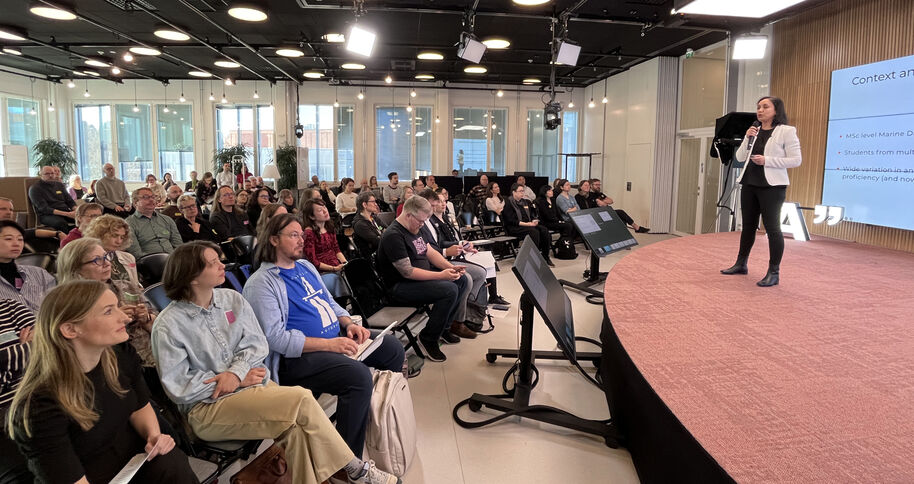
Vice President Petri Suomala and Vice Dean for Education Jani Romanoff (ENG) opened the event by framing AI as a powerful accelerant rather than a total break with the past. AI will undoubtedly change how students study and how teachers design courses, they noted, but the core purposes of university education remain the same: strengthening fundamentals and critical thinking, supporting motivation and autonomy, connecting assessment to real‑world problem‑solving, and nurturing curiosity, creativity, independence and human interaction.
Romanoff illustrated the evolution of engineering education with a century‑long comparison: from a 1928 master’s thesis on hull forms and steel plates to a modern 5 ECTS course that covers complex geometries, whole‑system performance and even “leading oneself as a professional”. AI will push this progression further, but the human competences underneath it cannot be outsourced.
Mashrura Musharraf – If AI Can Code It, What Are We Teaching?
Musharraf explored what happens when AI can produce code or draft answers on demand. In this reality, traditional content delivery is no longer enough. Their approach shifts emphasis toward structured in‑class activities where students must make their reasoning visible, compare their thinking with AI‑generated outputs and bring evaluation back into the classroom. The teacher’s role becomes designing learning situations where AI is present, but understanding and judgement are still clearly in the students’ hands.
Craig Carlson – AI in the wings, human judgement in the spotlight
Carlson’s T‑shirt, quoting The Hitchhiker’s Guide to the Galaxy with a bold “Don’t Panic”, captured the tone of their talk as well as the event. In a course on health technology assessment and regulatory affairs, AI is already used to support scenario work and accelerate certain analyses, but it is kept “in the wings”: available as a tool to test and critique, never as an unquestioned authority. Carlson emphasised that while AI can speed up parts of the work, only human judgement makes the outcomes trustworthy, especially in complex regulatory and ethical contexts.
Malka Gotthilf – AI as a Teaching Partner
Gotthilf offered a very concrete view of AI as a teaching partner in academic writing and Finnish as a second language. To meet the need for more relevant, real‑life material with limited time, they use large language models to draft course content directly from vocabulary lists and topics, and to support planning and feedback. Avoiding AI, they argued, is not a realistic option; instead, teachers must learn the tools, guide students in how to learn with them and take responsibility for quality control.
In their courses, Gotthilf has set clear boundaries that are also part of what students learn: AI is treated as a tool, not an author, and its outputs must always be checked against reliable sources; personal data is not entered into AI services; grading is not delegated to AI; and they favour university‑managed solutions such as AaltoAI over public services. Some assignments are deliberately brought back into the classroom to support fair assessment. At the same time, students are encouraged to use AI critically for tasks such as translations, vocabulary work, grammar support, generating examples and commenting on their own writing, always with alternative strategies at hand.
Lauri Järvilehto – Future‑proof AI users from Aalto’s students?
Järvilehto closed the programme with a forward‑looking and deliberately provocative perspective. General‑purpose language models that try to do everything and always “please the customer”, they noted, can easily turn into sophisticated bulls**t generators if they are used as universal problem‑solvers. Rather than relying on a single all‑purpose system, they suggested that Aalto should think in terms of a diverse AI toolkit: different tools for different tasks, and students who know how to choose and combine them.
Future‑proofing Aalto graduates, in Järvilehto’s view, means giving them access to state‑of‑the‑art tools, integrating AI as a working tool across disciplines, ensuring that all students understand basic AI concepts and limitations, and creating engaging, challenge‑based learning situations where students can experiment with and compare tools in practice. AI may change how students work, but universities remain responsible for cultivating the judgement and critical thinking needed to navigate this landscape.

Thinking together about what should not be lost
After the talks, most participants stayed on for thematic dialogue sessions. The discussions approached the topic from three viewpoints: university education as a whole (what is transformed and what should not be), the teacher’s role (from course planning and teaching methods to assessment in an AI‑rich environment), and the student’s experience of learning and the competences graduates will need. In small groups, participants shared experiences, listened to different perspectives and allowed room for unfinished thoughts rather than aiming for quick consensus.
By the end of the morning, one thing was clear: in the age of rapidly developing AI tools, Aalto’s teaching community is keen not only to try out new technologies, but also to think together about what must remain at the heart of teaching and learning. Some participants were already asking when the next Marsio Presents will be held – a sign that this shared, down‑to‑earth exploration of creative teaching, built on pedagogical peer dialogue and the sharing of good practices, is needed.

After just an hour or two with our learning materials, you'll have a clear understanding of what AI is, how it can support your work, and what ethical principles guide its use..

Aalto University and its School’s offer many different opportunities for the academic community to engage in teaching and learning -related discussions and collaborative development of teaching. From this page you can find the different opportunities that are available for you.


