






New Fundamentals: ELLIS Institute Finland launches with bold scientific ambitions
AI and ML for transforming R&D, enhancing human-AI teamwork, and creating exciting new science
The founding director of the institute, Aalto University professor Samuel Kaski has received the European Research Council Advanced Grant to develop new types of machine learning.
Many popular and widely available AI tools appear to be extremely versatile and agile, but there is still a hole in the underlying machine learning, argues Kaski. ‘The basic tenet of machine learning is to apply a model trained on a learning data set. But that only works if the set is representative of the deployment setting — and that seldom holds, because life happens. Unexpected factors, statistically speaking covariates or confounders, may kick in and drive the system outside the training distribution.’ These failures in ‘out-of-distribution’ deployment are precisely what Kaski’s five-year project aims to address.
An important example is scientific research and R&D process itself, where developing something new necessarily requires going outside the existing data. ‘Design processes involve a particularly important ingredient which I believe is necessary for introducing the missing link: domain expertise,’ explains Kaski. ‘Including the expert in the loop, while aiming to minimize their workload, may be a way around the out-of-distribution deployment problem—alternatives like collecting a lot of new data may be costly or even impossible.’
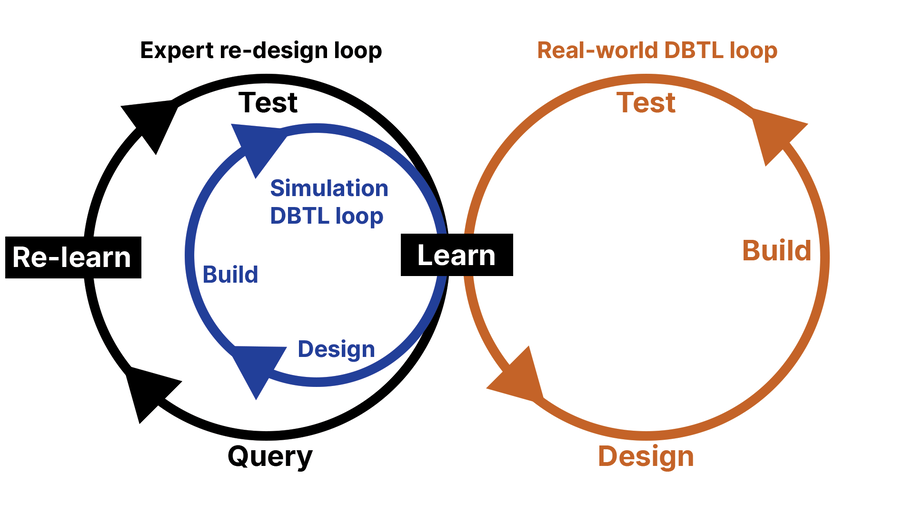
‘A very nice additional result would be that we may be able to improve the core element of all design problems, from scientific experimental design to product design, R&D or complex decision making: the design-build-test-learn loop,’ says Kaski. ‘If we can make this loop more effective, with machine learning and a human expert at the core, the cumulative impact could be massive.’
A virtual, simulation-based laboratory, in which scientists receive AI assistance and part of the scientific process can be automated, is one example of how the new machine learning results can make ‘AI4Science’ a reality. The purpose of automation is not to remove scientists from the process or humans from the eventual output.

‘I am working towards a future where humans are involved one way or the other, and then the real, scientifically most interesting challenge is how do we automate with humans explicitly in the loop,’ says Kaski. ‘A part of the solution needs to be that the outputs are useful and make sense to users , whether they are scientific experts or people using AI assistants on their phones.’
For AI to become an effective team player with humans, it needs to develop what psychologists call theory of mind—in R&D, this would mean an understanding of scientists’ often tacit objectives. Kaski believes that developing machine learning to better understand the scientist will unlock new solutions to tough R&D challenges.
'Some of the biggest problems society is facing today require truly interdisciplinary scientific teamwork. If we can engage humans and AI in the problem-solving loop, we can combine expertise, reasoning and optimal decision-making for groundbreaking outcomes.’ AI has to learn to understand that human teamwork is cooperative, iterative and adaptive, with shifting goals, feedback and consensus mechanisms. ‘We think we can make AI agents that can reason about and optimise over the behaviours of multiple experts,’ says Kaski.
Ultimately, the ERC-funded project is about making machine learning more applicable, which is also a key aim of ELLIS Institute Finland, the new research centre that Kaski directs. A partnership of 13 Finnish universities, the institute is a recent major expansion of ELLIS, the European Laboratory for Learning and Intelligent Systems.
ELLIS Institute Finland is in the process of recruiting its first principal investigators and creating a cross-domain collaborative environment where academics and companies can advance fundamental research towards applications.
‘I look forward to welcoming new colleagues to the ERC project and also to work in and collaborate with the ELLIS Institute,’ says Kaski. ‘We welcome our excellent colleagues and aspiring new AI and ML talent globally to work with us in Finland.’

AI and ML for transforming R&D, enhancing human-AI teamwork, and creating exciting new science

ELLIS Institute Finland is a world-class research hub in AI and machine learning and part of the European Laboratory for Learning and Intelligent Systems (ELLIS).

We develop new methods for probabilistic modeling, Bayesian inference and machine learning. Our current focuses are in particular learning from multiple data sources, Bayesian model assessment and selection, approximate inference and information visualization.


